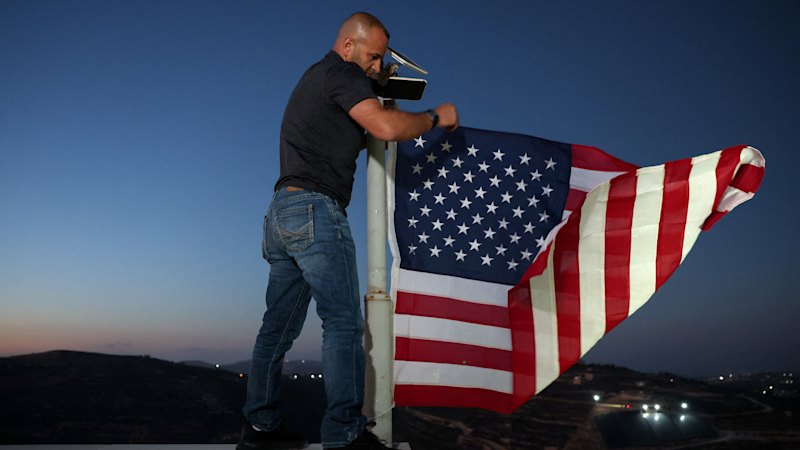
Thousands of miles away from his daily routines in Ohio, Loui Ridi watched live security camera feeds of strangers pitching tents outside his front door. They were not tourists or municipal workers. They were extremist Israeli settlers attempting to systematically sever access to his family home in the occupied West Bank village of Qusra, south of Nablus. For over a week, Ridi monitored the squeeze from the American Midwest before buying a plane ticket to Tel Aviv, determined to stop his property from being stolen while he watched from a smartphone screen. His return highlights a broader, escalating crisis across the West Bank, where property takeovers have evolved from sporadic local disputes into a coordinated blueprint for territorial expansion.
The mechanics of these property takeovers follow a chillingly predictable trajectory. Extremist groups target isolated homes on the periphery of Palestinian villages, often setting up illegal encampments directly outside residential gates. The goal is psychological exhaustion. By cutting off basic provisions, restricting movement, and creating an atmosphere of constant threat, the strategy aims to force families to abandon their deeds out of sheer terror. When Ridi finally arrived with a military escort to enter his house and hoist an American flag on the roof, the physical reclamation offered little real security. The surrounding area had been designated a closed military zone, trapping him inside while settlers continued to roam freely just yards away.
The Anatomy of Institutional Impunity
Observers watching from the outside often wonder why occupying military forces do not simply clear trespassers off private land. The reality on the ground exposes a profound structural breakdown. Throughout the West Bank, state policies under right-wing leadership have systematically shielded settler movements, creating an environment where formal laws are applied selectively.
When Ridi stepped outside his home to challenge the presence of settlers on his property, Israeli soldiers ordered him back indoors rather than removing the trespassers. The soldiers pleaded with the settlers to leave peacefully, treating armed agitators as equal negotiating partners rather than lawbreakers. This dynamic illustrates why property defense in the region has become nearly impossible through normal legal channels. The military apparatus tasked with maintaining public order frequently functions as a buffer that protects the expansionist goals of the settler groups.
Dual Citizenship and Diplomatic Limits
The involvement of foreign nationals introduces a complex layer of international pressure, yet even diplomatic leverage often hits a brick wall. Ridi holds American citizenship, a status that prompted rare public condemnations from United States officials, including Ambassador Mike Huckabee labeling the actions terrorist behavior.
Yet, a blue passport does not create a protective shield once someone steps inside a West Bank enclave. Ridi found himself needing hours of coordination just to request basic supplies, wondering if local authorities would grant permission for groceries to cross military checkpoints. The stark limitation of diplomatic protection reveals that individual citizenship rights hold little weight against entrenched geopolitical maneuvers on the ground.
The Wider Campaign Across the Hills
The standoff in Qusra is not an isolated incident. It represents a scalable tactic deployed across multiple hillsides in the West Bank. In neighboring villages like Jalud, similar sieges have played out with the silent acquiescence of regional authorities. Homes, agricultural fields, and community infrastructure are targeted systematically to establish contiguous blocks of settlements that permanently fracture Palestinian territorial continuity.
Official statistics underscore the soaring violence accompanying these land grabs. Dozens of Palestinians have been killed in clashes and raids involving settlers and military units over the past year. The strategy relies on relentless escalation. Every successful takeover of a private home normalizes a new baseline, pushing the boundaries of what is tolerated by the state and ignored by the international community.
For families like the Ridis, guarding a family home requires round-the-clock vigilance. Even after breaking the initial siege by returning physically, the threat persists the moment the cameras turn off or the military escorts shift positions. The front door remains locked from the inside, not to keep the world out, but to survive the night
This short video clip provides visual documentation of Palestinian-American Louai Abu Rida returning to raise the U.S. flag at his besieged home in Qusra.
http://googleusercontent.com/youtube_content/1