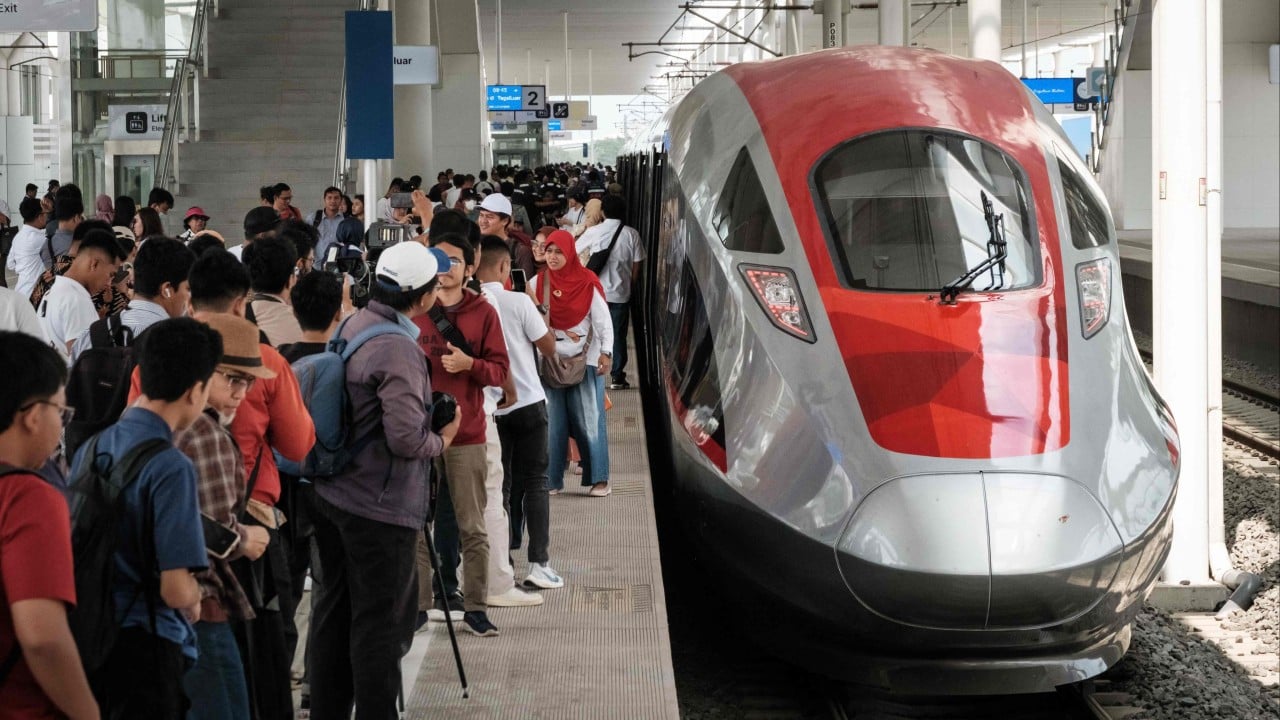
The train glides out of Halim station at three hundred kilometers per hour, slicing through the West Java mist with effortless modern grace. Inside the cabin, passengers marvel at the digital speed readout, snapping photos of a technological milestone that was supposed to catapult Southeast Asia's largest economy into the twenty-first century. Yet behind the gleaming titanium exterior and the presidential ribbon-cutting ceremonies lies a stark financial reality. Whoosh, Indonesia's flagship high-speed rail line connecting Jakarta and Bandung, has morphed into a fiscal anchor. The fundamental question of who will ultimately shoulder billions in ballooning debt remains a high-stakes game of political hot potato, threatening to strain state coffers for decades.
To understand how a showcase infrastructure project became a structural liability, one must look past the optimistic ridership projections and examine the mechanics of the financing. The Jakarta-Bandung High-Speed Rail, operated by PT Kereta Cepat Indonesia China (KCIC), carried a final price tag of roughly $7.27 billion, bloated by severe cost overruns that added more than a billion dollars to the initial estimate. Approximately seventy-five percent of this capital was secured through loans from the China Development Bank, carrying interest obligations that demand steady, predictable cash flows. Those cash flows have not materialized at the scale required to service the obligations comfortably. If you enjoyed this post, you should look at: this related article.
State-owned railway operator PT Kereta Api Indonesia (KAI) bears the heaviest burden as the majority shareholder of the Indonesian consortium. KAI leadership has openly signaled the strain, noting that servicing the transit project's liabilities has bled capital away from other vital regional rail networks. For years, official rhetoric insisted that the project would require zero state budget allocation, relying instead on corporate balance sheets and commercial revenues. That assurance has evaporated. When revenue generated by the line falls significantly short of annual debt service requirements owed to overseas lenders, the fiction of corporate self-sufficiency collapses.
The institutional shuffle to find a solvent balance sheet has exposed deep divisions within Jakarta's economic technocracy. Early proposals floated the idea of utilizing Danantara, the newly established sovereign wealth fund, to absorb the pressure without directly tapping national tax receipts. Critics immediately pointed out that shifting liabilities from one state-backed entity to another is merely an accounting maneuver that leaves ordinary citizens exposed. By mid-2026, the administrative reality caught up with political ambition. The Finance Ministry moved to restructure the obligations and take a commanding equity stake in the operator, effectively acknowledging that the national treasury must step in to manage the multi-billion-dollar exposure. For another look on this development, check out the latest update from Reuters Business.
This bailout dynamic highlights a recurring hazard in belt-and-road style mega-projects across the developing world. Governments eager for rapid modernization accept foreign financing packages with heavy capital requirements, assuming that economic growth will naturally inflate away the debt. When passenger volumes fall short of feasibility studies due to pricing pressures and competitive alternatives like upgraded regional highways, the state is left holding an unhedged portfolio risk.
Furthermore, the financial friction has coincided with heightened scrutiny over procurement and land acquisition. Anti-corruption investigators have probed irregularities in inflated land purchase valuations and per-kilometer construction expenses that outpaced similar domestic builds elsewhere. While investigations crawl through administrative archives, the financial clock continues to tick. Loan extensions and maturity stretch-outs negotiated with Beijing offer temporary breathing room, but they do not erase the principal or the compounding interest.
As the government formalizes its takeover of the operational liabilities, the true cost of high-speed transit becomes visible. It is measured not just in concrete, steel, and electrical overhead lines, but in the opportunity cost absorbed by a national budget stretched thin across competing social priorities. Every dollar diverted from healthcare, education, or basic infrastructure to subsidize high-speed rail interest payments represents a concrete policy trade-off. The bullet train races across West Java every single day, a monument to engineering speed, while the bill for its creation settles slowly onto the shoulders of the Indonesian public.
This short clip provides a quick overview of the recent debt restructuring agreements finalized for the Jakarta-Bandung high-speed rail project.