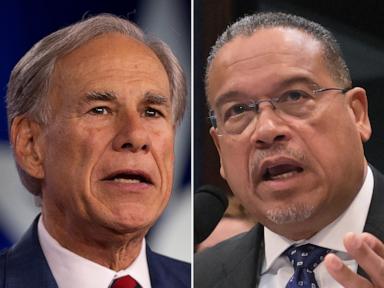
Minnesota Attorney General Keith Ellison has filed a federal lawsuit against Texas Governor Greg Abbott, demanding the immediate extradition of Christian Castro, a U.S. Immigration and Customs Enforcement agent charged with felony assault. The legal action, filed in the Southern District of Texas, targets an unprecedented political logjam. Abbott has stalled signing the rendition warrant for months, putting the accountability of federal law enforcement on a collision course with interstate politics and threatening to release an accused shooter into the public.
The core of the dispute centers on a January 14 incident in Minneapolis during Operation Metro Surge. Castro, 52, is facing four counts of second-degree assault and one count of falsely reporting a crime. Prosecutors allege that Castro fired his weapon through the front door of an occupied home, striking a Venezuelan immigrant named Julio Cesar Sosa-Celis in the leg. According to charging documents filed by Hennepin County Attorney Mary Moriarty, Castro subsequently fabricated details, claiming he and fellow officers were attacked with a snow shovel and a broom to justify the gunfire. Surveillance footage reportedly undermined those claims, leading to criminal charges in May.
While Castro was arrested by Texas Rangers in Cameron County on May 29, he has remained in a local jail ever since. Extradition is historically an administrative, ministerial duty between states. Governors routinely sign these warrants without injecting personal or political grievances into the process. That routine machinery has completely broken down.
The Mechanical Failure of Interstate Rendition
Under the federal Extradition Act and established constitutional principles, a governor's obligation to honor an out-of-state warrant is non-discretionary. The United States Supreme Court affirmed decades ago in Puerto Rico v. Branstad that federal courts possess the authority to compel a governor to fulfill this ministerial duty. Governors cannot evaluate the merits of the underlying criminal case, nor can they weigh the political alignment of the requesting state before deciding to act.
Yet, Abbott’s office has stonewalled Minnesota officials for months. When pressed by reporters regarding the lawsuit, Abbott dismissed the legal action entirely. Instead of addressing the constitutional mandate, the Texas governor pivoted to unrelated grievances, demanding that Minnesota "repay the United States of America and Americans for all the fraud that they have committed in their state under federal programs" before he considers responding to the extradition demand.
This linkage is unprecedented. Holding a criminal extradition hostage over unrelated state-level policy disputes turns a constitutional mechanism into a political weapon.
Minnesota officials are not dealing with a theoretical timeline. Under Texas law, a fugitive held on an out-of-state warrant can only remain in local custody for a maximum of 90 days without a governor's warrant. That window closes rapidly. Without judicial intervention, Castro faces mandatory discharge from the Cameron County Jail, creating a severe flight risk that could permanently disrupt the Minnesota prosecution.
The Broader Fallout of Operation Metro Surge
To understand why this specific case has paralyzed normal interstate cooperation, one must examine the chaotic environment of Operation Metro Surge. The Department of Homeland Security initiative brought an aggressive influx of federal immigration enforcement personnel into the Twin Cities. The operation was framed by federal authorities as a necessary response to local fraud allegations, but on the ground, it triggered immediate flashpoints.
The shooting involving Castro was not an isolated event. It was one of three high-profile January incidents during the crackdown where federal immigration officers discharged their firearms. The other two incidents resulted in the deaths of Renée Good and Alex Pretti, both U.S. citizens, igniting intense community protests and deep friction between local authorities and federal agencies.
When local prosecutors aggressively pursue accountability against federal law enforcement officers, systemic defense mechanisms activate. Castro is one of two ICE agents charged with state crimes following the Minneapolis crackdown. The other, Gregory Donnell Morgan Jr., faces second-degree assault charges for allegedly pointing a gun at a vehicle on a local highway.
Federal agents operate under an umbrella of qualified immunity and supremacy clauses that frequently shield them from state-level prosecution. When a local county attorney pierces that shield by securing indictments for reckless behavior and falsifying police reports, it challenges the operational autonomy of federal agencies. Texas, operating as a stronghold for hardline immigration enforcement policies, appears to be acting as a protective sanctuary for an agent facing accountability in a progressive Midwestern jurisdiction.
The Legal Precipice and Judicial Reality
The lawsuit filed in the Southern District of Texas includes a crucial procedural safeguard. Alongside the demand to force Abbott’s signature, Ellison’s legal team requested a temporary restraining order against Cameron County Sheriff Manuel Trevino. This emergency measure aims to prevent the jail from releasing Castro upon the expiration of the 90-day statutory limit.
If the federal court steps in, it will reinforce a vital structural boundary. Allowing governors to pick and choose which extradition requests to honor based on political spite or ideological alignment would effectively dismantle the interstate compact system. Every state line could potentially morph into an ideological border check, where fugitives find safe harbor simply because the governor of the harboring state dislikes the politics of the prosecutor filing the charges.
The confrontation transcends the guilt or innocence of Christian Castro. A Minnesota judge found probable cause to move forward with felony proceedings. A grand jury or trial jury is designed to evaluate the evidence, test the surveillance footage against the officer's statements, and render a verdict. By blocking the pipeline from a local jail to a courtroom, executive fiat threatens to short-circuit the judicial process entirely.
The federal judiciary now holds the pen. Whether the rule of law applies equally to federal badge-holders and the governors who shield them depends on how swiftly the court acts before the cell doors in Texas swing open.