A single shipping container sits on a dock in Jurong, Singapore. It is a dull, rusted red, filled with nothing more glamorous than semi-conductors and medical-grade plastics. To the casual observer, it is a steel box. To a global economist, it is a heartbeat. If that box stops moving, a factory in Ohio goes dark. A hospital in Berlin runs out of syringes. A teenager in Tokyo cannot buy a new phone.
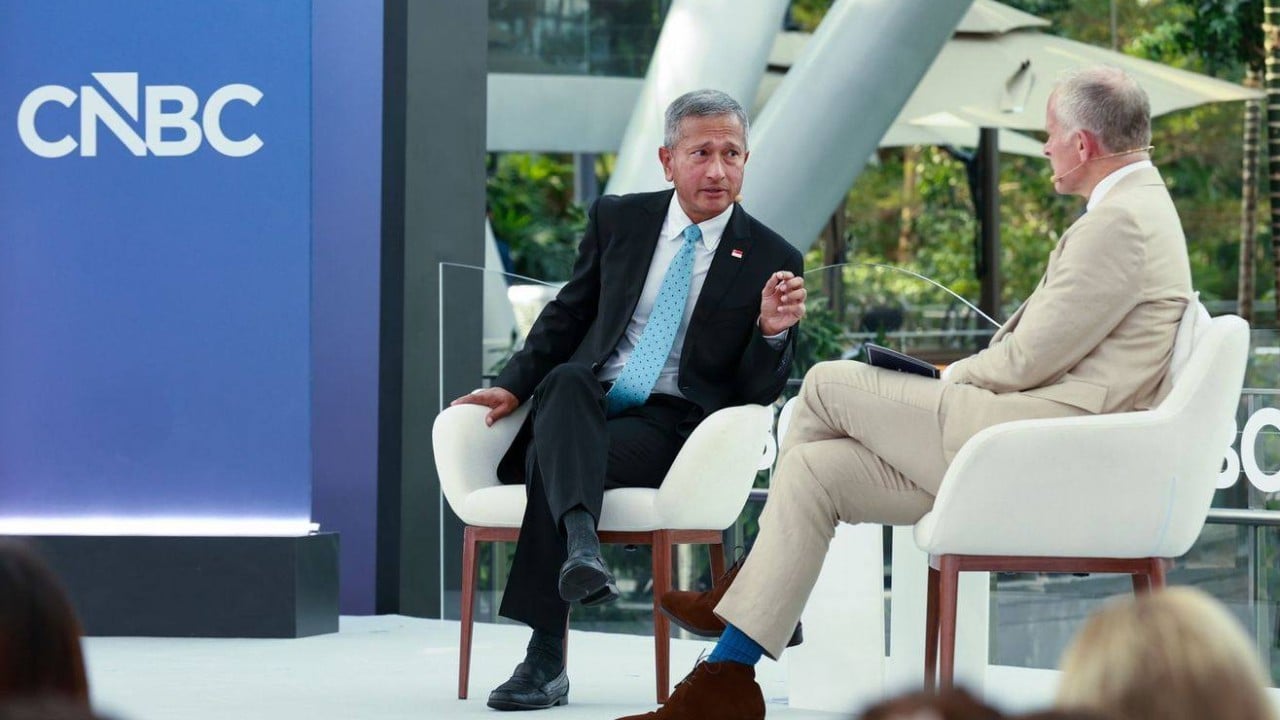
Singapore is a tiny diamond of an island, a place where survival is not a given but a daily act of engineering. When its Foreign Minister, Vivian Balakrishnan, speaks about the Strait of Hormuz, he isn't just talking about a narrow stretch of water thousands of miles away. He is talking about the jugular vein of the modern world. For a different view, consider: this related article.
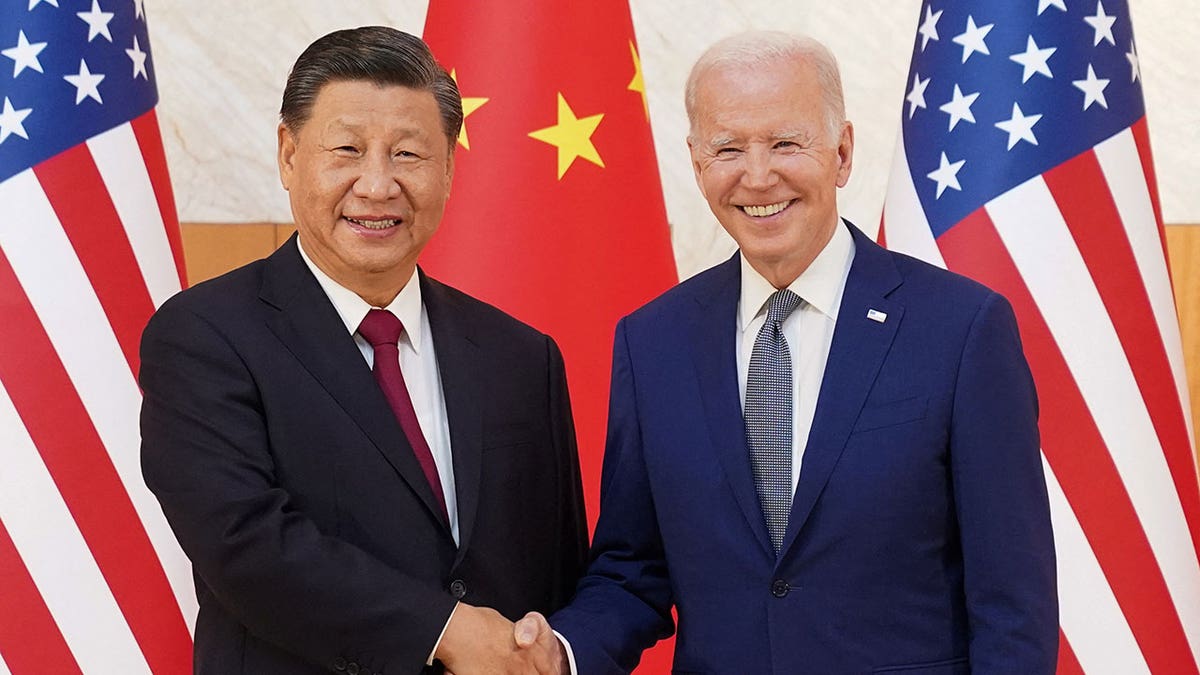
The recent disruptions in the Middle East—drones over the Red Sea, tankers diverted around the Cape of Good Hope—are terrifying to those who understand the math of logistics. But Balakrishnan’s warning carries a sharper edge. He suggests that these skirmishes are merely a "dry run." They are a dress rehearsal for a much darker play: a direct confrontation between the United States and China.
If the world’s two largest powers decide to stop shaking hands and start swinging, that rusted red container in Jurong doesn't just sit still. It disappears. Similar insight on the subject has been shared by The Washington Post.
The Fragile Geometry of the Sea
Think of the global supply chain as a spiderweb. It looks intricate and strong until you realize it is held up by only a few anchor points. One of those is the Strait of Hormuz. Another is the Strait of Malacca. These are the "choke points," geographical bottlenecks where the vastness of the ocean is forced into a narrow lane.
When a regional conflict flares up, we see the immediate symptoms. Insurance premiums for ships skyrocket. Fuel prices at the local gas station tick upward by twenty cents. We feel the pinch, but the system usually bends without breaking. We find workarounds. We reroute.
But a clash between Washington and Beijing is not a regional flare-up. It is a systemic cardiac arrest.
For decades, the "Chimerica" relationship—the symbiotic link where China produced and America consumed—acted as a stabilizer. It was the ultimate insurance policy. No one wanted to go to war because everyone’s wallet was in the same pocket. That pocket is currently being ripped in half.
The rhetoric has shifted from "de-risking" to something that looks suspiciously like a slow-motion divorce. When the world’s two most powerful nations begin to view their interdependence not as a strength but as a vulnerability, the very foundation of global peace begins to crack.
A Tale of Two Cities
Imagine a woman named Lin in Shanghai. She works for a firm that designs high-end server components. Across the Pacific, imagine a man named David in San Jose who manages a data center. For twenty years, Lin and David have been part of the same invisible machine. Lin’s designs are the soul of David’s hardware.
They have never met, but they are closer than neighbors. They are connected by a constant stream of data, trust, and physical goods moving across the Pacific.
Now, imagine the moment the "dry run" ends and the real conflict begins.
Suddenly, the components Lin produces are flagged as national security risks. The software David uses is banned in China. The ships carrying the physical hardware are told to stay in port. This isn't just a "trade war" with tariffs and angry tweets. It is the total balkanization of technology.
In this scenario, the world splits. We are no longer talking about a slight delay in shipping. We are talking about two entirely different realities. Two different internets. Two different sets of standards for everything from the voltage in your wall to the encryption on your bank account.
The cost of this split is not measured in billions of dollars. It is measured in the sudden, violent regression of human progress. We have spent half a century building a world where we could pool our intelligence. To undo that is to decide that we would rather be "right" and alone than prosperous and together.
The Singaporean Perspective
Why is it Singapore that sounds the loudest alarm?
Because Singapore is the world’s canary in the coal mine. It is a nation that produces almost nothing of its own natural resources. It survives on the flow. It lives in the "and"—it needs the US for security and it needs China for trade.
When a Singaporean diplomat warns about a dry run, they are looking at the maps. They see how quickly the "freedom of navigation" can be turned into a "denial of access."
If the US-China relationship collapses, the Strait of Malacca becomes a frontline. The very water that made Singapore wealthy becomes its greatest threat. The island is a microcosm of what happens to the rest of us when the giants fight: the small, the agile, and the interconnected get crushed in the middle.
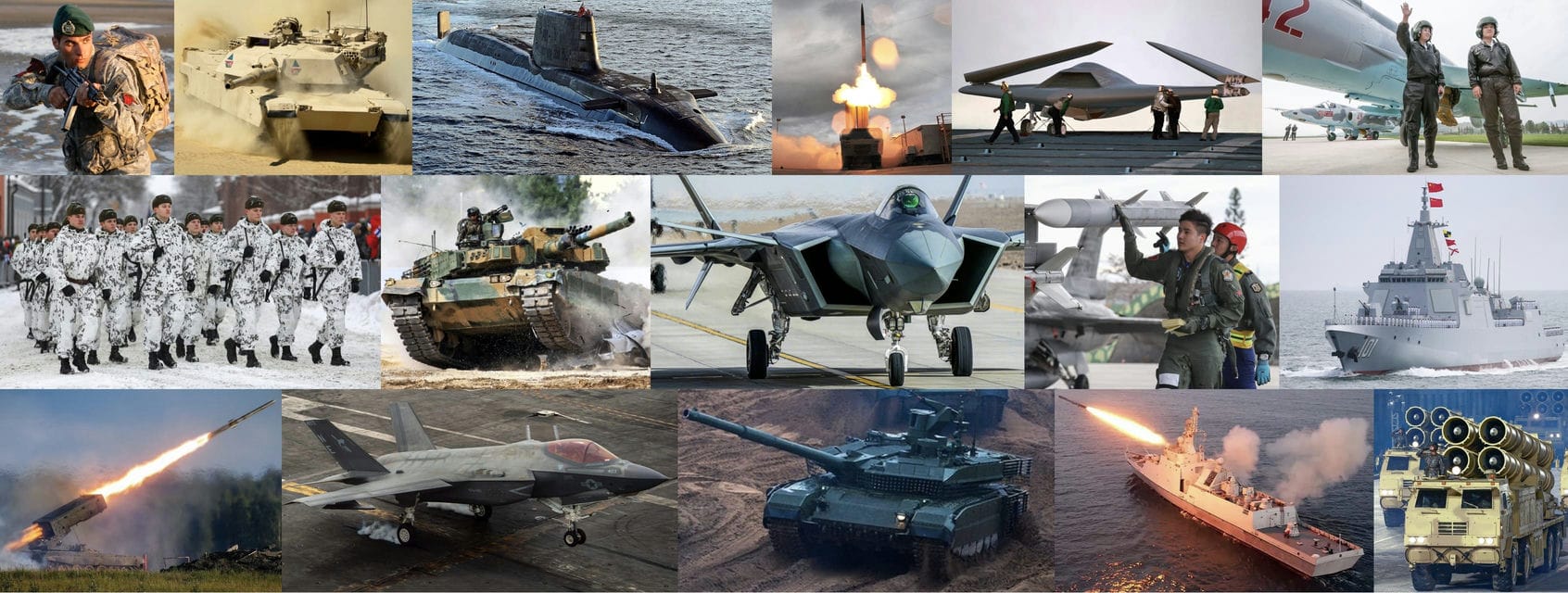
There is a deceptive comfort in thinking that a "clash" would look like a traditional war—tanks, planes, and clear front lines. But a modern clash between superpowers is a war of attrition against the everyday. It is a war against the supermarket shelf. It is a war against the reliability of the power grid. It is a war against the very idea that a product made on one side of the planet will reliably show up on the other.
The Emotional Weight of a Chip
We often talk about "chips" as if they are just tech jargon. In reality, a microchip is the most complex object ever manufactured by human beings. It requires materials from a dozen countries, machines from three others, and intellectual property from five more. It is a miracle of cooperation.
[Image of a semiconductor supply chain map]
If you break the cooperation, you break the miracle.
The "dry run" we see in the Middle East today is a reminder of how easily a few cheap drones can disrupt a multi-billion dollar trade route. It shows us that the "rules-based order" we took for granted is actually quite thin. It relies on a shared agreement that keeping the lights on is more important than settling old scores.
That agreement is fading.
We are moving into an era where "just-in-time" delivery is being replaced by "just-in-case" stockpiling. This sounds like a smart business move, but it is actually a confession of fear. It is the sound of the world hunkering down.
When we stockpile, we stop investing in the future. We start building walls instead of bridges. We trade the possibility of "what if" for the safety of "at least."
The Unspoken Price
There is a specific kind of silence that happens right before a storm.
In the corridors of power in Beijing and Washington, that silence is growing. The diplomats are still talking, but the military planners are the ones getting the bigger budgets. The "dry run" in the Middle East is providing data. How do supply chains react to 30-day delays? How much can a population tolerate an 8% spike in inflation before they start voting for extremists?
The answers to these questions are being filed away, used to calculate the "tolerable" cost of a total break between East and West.
But the "tolerable" cost is a lie.
It ignores the human element. It ignores the fact that David and Lin, our hypothetical engineers, are part of a global middle class that only exists because of this fragile peace. If that peace goes, the middle class goes with it. We return to a world of autarky, where every nation must scramble to provide for its own, and those who cannot are left to rot.
The tragedy of the "dry run" is that it shows us exactly what is going to happen, yet we seem powerless to change the script. We watch the ships burn in the Red Sea and we think, how terrible for them. We don't realize that those flames are reflecting in our own windows.
Beyond the Horizon
The container in Jurong is still there. For now.
It represents a choice. We can view it as a weapon—a way to leverage power over an adversary by withholding goods. Or we can view it as a bond—a reminder that we are physically, economically, and existentially tied to people we will never meet.
The warning from Singapore is not a prediction of doom, but a plea for sanity. It is a reminder that the "dry run" is our last chance to look at the chaos and say, "not here."
If we fail to heed it, we won't be reading about the next crisis in the news. We will be living it in our darkened homes, looking at the empty spaces where the world used to be.
The giants are restless, and the water in the straits is rising. The heartbeat of the world is skipping.
One day soon, that rusted red container might just stay on the dock forever.