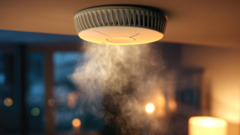
The white plastic disc on your ceiling is likely a relic of the 1970s masquerading as modern technology. Despite the sleek marketing of smart home giants, the fundamental physics of fire detection has remained stagnant for decades, even as the chemistry of our homes has become radically more volatile. We are living in a period where fires burn faster and hotter than at any point in human history, yet the tools we rely on to survive them are struggling to keep pace.
The standard ionization smoke detector, which still occupies millions of hallway ceilings, was designed for a world of solid wood furniture and cotton curtains. It relies on a tiny bit of radioactive material to detect the microscopic particles of a flaming fire. But your modern living room is a warehouse of "solidified gasoline." Polyurethane foam, synthetic textiles, and engineered woods don't just burn; they off-gas. They create thick, black smoke that can fill a room in under three minutes. In this environment, the aging technology of ionization often fails to trigger until it is far too late for a safe exit.
The Lethal Speed of Synthetic Living
Forty years ago, you had an average of 17 minutes to escape a house fire. Today, that window has shrunk to roughly three minutes. This isn't a failure of the fire department. It is a direct result of material science.
When a modern sofa catches fire, the chemical bond of the petroleum-based foam breaks down almost instantly. This produces large, light-scattering particles. Ionization detectors—the cheap, $10 units sold in bulk—are notoriously poor at "seeing" these larger particles. They are tuned for fast-flaming fires, like a wastepaper basket catching light. But most fatal residential fires start as a slow, smoldering burn in upholstered furniture or bedding.
By the time an ionization sensor registers the smoldering smoke of a synthetic mattress, the oxygen levels in the room have often already plummeted to lethal levels. The industry’s shift toward photoelectric sensors—which use a light beam to detect smoke—is a necessary pivot, but it has been slowed by the lobbying power of manufacturers who prioritize low-cost production over maximum safety margins.
The Nuisance Factor and the Battery Grave
The greatest enemy of fire safety isn't a lack of sensors; it's the human finger pressing the "hush" button or, worse, ripping the unit off the ceiling entirely.
Nuisance alarms are the primary reason people disable their detectors. Every time you sear a steak or take a particularly hot shower, a poorly calibrated sensor treats the steam or cooking aerosol as a life-threatening emergency. This creates a "cry wolf" effect. When the alarm chirps at 3:00 AM because of a low battery or a stray dust mote, the homeowner’s instinct isn't fear—it’s irritation.
This has led to the rise of multi-criteria detection. Instead of relying on a single optical or chemical trigger, newer devices use a suite of sensors to analyze the environment. They look for:
- Carbon Monoxide (CO) levels: A sudden spike in CO combined with a rise in particulates is a definitive signature of a fire.
- Heat signatures: Rapid temperature increases help differentiate between a burnt piece of toast and a couch fire.
- Humidity sensors: These can tell the difference between heavy steam from a bathroom and the dry, acrid smoke of a smoldering electrical short.
However, these advanced units are expensive. In a market where builders are looking to shave every penny off a construction budget, the bare minimum requirement usually wins. This creates a safety gap between those who can afford high-end integrated systems and those living in older or lower-income housing where the "chirp" is a soundtrack to a disaster waiting to happen.
The Myth of the Smart Home Savior
Silicon Valley attempted to disrupt this space with internet-connected detectors. These devices promised to send notifications to your phone and use "friendly" voices instead of piercing sirens. While the user interface improved, the core problem remained. A smart detector with a mediocre sensor is just a more expensive way to receive a notification that your house is already gone.
Furthermore, the "smart" revolution introduced a new vulnerability: software stability. A traditional hardwired detector is a simple, closed-circuit machine. It has no operating system to crash and no Wi-Fi signal to lose. When we introduce firmware updates and cloud dependencies into life-safety equipment, we trade a small amount of convenience for a significant increase in complexity. If your detector cannot talk to the server, does it still protect you? Usually, yes, but the integration often creates a false sense of security that overrides basic maintenance.
The Interconnect Mandate
The most significant evolution in home safety isn't actually the sensor type, but the interconnection. If a fire starts in the basement of a large home, a standalone detector in that basement might sound, but the occupants sleeping on the third floor will likely sleep right through it. Sound attenuates quickly through drywall and heavy doors.
Modern building codes now require detectors to be "daisy-chained." When one goes off, they all go off. This is a massive leap forward, but it applies mostly to new construction. The millions of existing homes built before these codes rely on "island" detectors.
Wireless interconnectivity is the retro-fit solution, allowing older units to communicate via radio frequencies. But even here, we see a lack of standardization. A detector from Brand A rarely talks to Brand B. This proprietary lock-in forces consumers to choose between a complete, expensive overhaul of their entire home or a fragmented system that leaves blind spots.
The Problem with 10-Year Batteries
The industry has moved toward sealed 10-year lithium batteries to solve the "dead battery" problem. In theory, this is brilliant. No more midnight chirps, no more dangling wires. However, this has created a new, unintended consequence: the "disposable" mentality.
When a 10-year battery fails—and they frequently do fail at year six or seven due to environmental factors or poor manufacturing—the entire unit must be thrown away. This is an ecological nightmare and a financial burden on the consumer. More importantly, it assumes the sensor itself will last ten years. In reality, dust, spiders, and kitchen grease accumulate inside the sensing chamber, degrading its sensitivity long before the battery dies.
A detector that is "still alive" because the light is green but is effectively "blind" due to dust buildup is the most dangerous object in your house. It offers the illusion of protection without the reality of it.
Beyond the Beep: New Detection Horizons
We are finally seeing the emergence of spectral signatures. Instead of just measuring if light is blocked or if an ion current is interrupted, new research-grade sensors can "smell" the specific chemical markers of burning plastics versus burning wood.
This technology, often referred to as "electronic noses," uses a tin-oxide semiconductor that changes resistance when exposed to specific gases. This could virtually eliminate false alarms while providing near-instant notification of a fire's presence. But these sensors require more power and more processing than a standard 9-volt battery can provide.
Until these become the standard, the burden of safety remains on the individual. You cannot trust that the device on your ceiling is functioning just because it hasn't made noise lately.
Check the manufacture date on the back of your units today. If they are more than a decade old, they are no longer life-safety equipment; they are wall decorations. Replace them with dual-sensor units that combine photoelectric and ionization technology, or better yet, a multi-criteria system that includes CO detection. Do not wait for the "smart" version to go on sale. The chemistry of your home is moving faster than the technology meant to save it, and every second of delay in detection is a second of life you can never get back.
Go to your hallway, get a ladder, and look at the date.