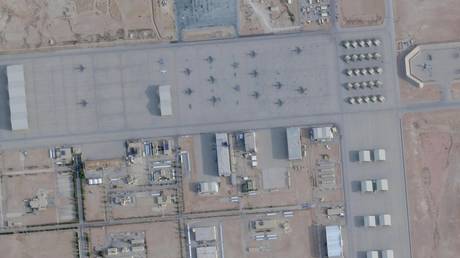
The recent White House directive to restrict satellite imagery over Iran is not a sudden shift in policy, but the violent collision of private enterprise and national security. By invoking "shutter control" or similar informal pressures on commercial providers, the administration has effectively scrubbed the digital record of a pending conflict. This isn't just about hiding troop movements. It is a fundamental reconfiguration of what the public is allowed to know about modern warfare.
When high-resolution images of Iranian airbases and enrichment facilities suddenly revert to 2022 archives or become blurred under the guise of "technical glitches," the mechanism of accountability breaks. We are entering an era where the battlefield is curated.
The Death of Open Source Intelligence
For the last decade, we lived in the golden age of the amateur spy. Using platforms like Maxar or Planet Labs, independent researchers could track Russian tank columns or North Korean missile tests with startling precision. This democratized intelligence. It stripped the state of its monopoly on the truth.
That era is over. The White House now recognizes that commercial satellites are no longer just tools for urban planning or crop yield analysis; they are tactical assets. By restricting access to Iran’s borders, the government is re-establishing a wall of secrecy that existed during the Cold War. The difference now is that the wall is built with code and licensing agreements rather than physical barriers.
The excuse provided is always "operational security." But in reality, these orders prevent the public from verifying government claims about who fired first. When the sensors go dark, we are forced to rely on the official briefing room. History shows that is a dangerous place to be.
The Kyl Bingaman Precedent and the New Legal Loophole
Washington didn't invent this playbook yesterday. The legal framework traces back to the Kyl-Bingaman Amendment of 1997, which restricted the resolution of satellite imagery of Israel. For years, you could see a backyard in Beirut more clearly than the Western Wall in Jerusalem.
The current move against Iranian imagery takes this logic and applies it to an active theater of potential war. However, the government is avoiding formal "shutter control" because that requires a high legal bar and a declaration of a national emergency. Instead, they use "buy-to-blind" tactics.
Under these contracts, the National Geospatial-Intelligence Agency (NGA) simply purchases every available pixel over a specific coordinate. If the government buys the exclusive rights to the data, the provider can’t sell it to the Associated Press or a human rights group. It is censorship by checkbook. It is clean, legal, and utterly devastating to transparency.
Silicon Valley as a Department of Defense Subcontractor
The tension between profit and patriotism has never been thinner. Companies like SpaceX, BlackSky, and Umbra are not just tech firms; they are the new backbone of the American military-industrial complex. Their stock prices depend on federal contracts.
When the Pentagon asks a CEO to "delay" the release of a specific orbital pass over the Strait of Hormuz, the CEO doesn't ask about the First Amendment. They look at their quarterly earnings. This creates a feedback loop where the private sector becomes an extension of the state’s clandestine apparatus.
- Data Latency: Images that used to be available in hours are now held for "review" for days.
- Resolution Caps: Software-side downgrades turn a 30cm sharp image into a 3-meter smear.
- Geofencing: Commercial APIs simply return a "No Data Found" error for sensitive Iranian coordinates.
The result is a sanitized version of reality. We see the world through a lens that the State Department has polished.
Why Iran is the Breaking Point
Iran presents a unique challenge because its defense infrastructure is deeply embedded in civilian areas and rugged terrain. To understand the threat, you need high-fidelity, multi-spectral imagery that can see through camouflage and underground bunkers.
By blinding these satellites, the White House prevents the world from seeing the buildup of assets that suggest an offensive rather than a defensive posture. If the public cannot see the carrier strike groups or the deployment of bunker-buster munitions on the periphery, the narrative of "unprovoked aggression" becomes much easier to sell when the first missiles eventually fly.
The argument that this saves lives is a convenient shield. While it may protect specific units, it also removes the only check on executive power. If the satellites are dark, the government can claim anything is happening on the ground, and no one can prove them wrong until the smoke clears.
The Rise of Non-Western Competitors
Washington’s strategy has a massive, glaring flaw: it only works if you own the cameras. While US-based companies dominate the market, China and Russia are rapidly deploying their own commercial-grade constellations.
A journalist in London or a researcher in Berlin doesn't need a US license to buy imagery from a Chinese firm like Chang Guang Satellite Technology. We are seeing the Balkanization of Earth's orbit. Soon, there will be a "Western" view of the world and an "Eastern" view, each with its own specific set of redacted zones.
This creates a marketplace for disinformation. If the US censors a site in Iran, but China releases a manipulated image of that same site showing a fake atrocity, the truth is lost in the static. By pulling the plug on transparency, the White House has inadvertently invited a flood of unverified propaganda from adversaries who are more than happy to fill the vacuum.
The Technical Reality of Modern Surveillance
We are no longer talking about simple cameras in the sky. Modern satellites use Synthetic Aperture Radar (SAR) which can see through clouds, smoke, and darkness. This is what makes the Iran blackout so significant. You can't hide a troop movement from SAR.
Unless, of course, the company operating the SAR satellite is told to turn the sensor off.
This level of control goes beyond simple photography. It is the manipulation of the electromagnetic spectrum. When we lose access to these data feeds, we lose the ability to monitor environmental disasters, refugee movements, and the collateral damage of economic sanctions. The Iranian people become ghosts in the machine, their daily struggles invisible to the international community because their geography has been deemed a "security risk."
The Erosion of the Public Record
War is the ultimate test of a democracy’s transparency. When the instruments of observation are co-opted by the military, the public record is corrupted at the source. This isn't a temporary measure; it's a blueprint for every future conflict.
The precedent being set today will be applied to the next crisis, whether it's in the South China Sea or Eastern Europe. The "security" excuse is a bottomless well. Once you accept that the government has the right to hide the physical reality of a region, you have accepted the end of independent journalism in the context of foreign policy.
The infrastructure of the "Big Eye" in the sky was promised as a tool for global connectivity and truth. Instead, it is being partitioned into a series of strategic blind spots. The satellites are still up there, circling the globe every ninety minutes, capturing everything. But the feed is being diverted into a basement in Virginia, and the screen you’re looking at is intentionally blank.
The most effective way to win a war is to ensure the public never sees it coming. By the time the images are released, they are no longer evidence—they are history, written by the victors. The blackout over Iran is the first step in making the 21st-century battlefield a private room.
Demand for transparency is often framed as a threat to the troops. In reality, the lack of transparency is a threat to the foundation of an informed citizenry. If we cannot see what is being done in our name, we have no say in whether it should be done at all. The blinding of the satellites is not a tactical necessity; it is a political choice to operate without oversight.



