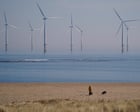
On a bitter, salt-sprayed morning miles off the coast of Yorkshire, a technician hangs from a harness hundreds of feet above the North Sea. To him, the wind is a physical adversary, an endless, roaring pressure pushing against his chest. Below him, the ocean appears dark and chaotic. But beneath that churning surface lies an invisible, silent map—a matrix of legal boundaries that dictates the flow of billions of pounds back on dry land.
Every twist of the massive fiberglass blades above him pays a toll. Not to the energy company that erected the steel tower, and not entirely to the state. The toll is paid to a ghost entity that traces its lineage back to the Norman Conquest of 1066. Read more on a connected issue: this related article.
The British public generally understands that they pay high electricity bills. They know the weather is changing. What few realize is that the very floor of the ocean—the cold, dark mud where the foundations of the green energy transition are anchored—is a highly lucrative corporate engine.
For the third consecutive year, this ancient portfolio has cleared a staggering profit of over £1 billion. Specifically, the Crown Estate just posted a massive £1.2 billion in net revenue profit. It is a financial windfall that feels almost surreal in an era of stretched public services and tightening household budgets. More reporting by MarketWatch delves into related views on the subject.
To comprehend how a medieval land rights concept transformed into an offshore tech cash cow, you have to look past the spreadsheets and step onto the seabed.
The Sovereign Mapmaker
Consider a hypothetical mid-level executive at a major European energy consortium. Let’s call her Elena. Elena does not think about the poetry of the sea. She thinks about capital expenditure, regulatory compliance, and grid connectivity. For Elena’s company to plant a single wind turbine into the ocean floor around England, Wales, or Northern Ireland, she must negotiate with a single, absolute landlord: The Crown Estate.
The Estate is an anomalous beast. It is not the private property of King Charles III, meaning he cannot sell it off to buy a superyacht. Yet, it is not standard government property either. It is a unique corporate estate, managed by an independent board, whose ultimate beneficiary is the nation's treasury.
For centuries, this portfolio meant grand London streets, rolling agricultural land, and the sweeping forests of Windsor. It was an estate defined by soil and stone. But decades ago, an incredibly forward-thinking legal definition handed the Estate the rights to the continental shelf—the territorial seabed stretching out into the ocean.
When the green energy transition accelerated from a niche environmental goal into an industrial necessity, those empty stretches of gray water suddenly became the most valuable real estate on earth.
Elena's consortium did not just buy the right to build. They paid astronomical sums just for the option to exist there. Last year alone, wind developers poured £875 million into the Crown Estate in pure option fees. These are essentially holding deposits, massive financial handshakes paid during the initial leasing rounds just to secure a patch of deep blue mud before a single watt of electricity is ever generated.
It is a high-stakes poker game played on water. The wind developers take the risk; the Crown Estate collects the rent.
The Flow of the Coin
Money, like water, always finds a channel. To understand where these billions go, we must trace a path from the wind-whipped North Sea down to the grand stone facades of Whitehall and Buckingham Palace.
By law, the vast majority of the Crown Estate’s profits are handed directly to the UK Treasury. It enters the public purse, helping to fund the unglamorous, vital infrastructure of daily life—hospitals, schools, road repairs. Over the past decade, this silent mechanism has funneled more than £5 billion into public finances.
But the channel splits.
A specific percentage of these historic profits determines the Sovereign Grant, the official funding mechanism that supports the monarch’s public duties, royal travel, and the ongoing, massive maintenance of crumbling historic palaces. Because of the recent wind energy boom, the payout to the royal household surged from £86.3 million to £132.1 million in the last financial year alone.
It is a juxtaposition that breeds an underlying tension in modern Britain. While a family in a drafty terraced house in Manchester watches their pre-payment energy meter tick downward, a fraction of their monthly utility bill is traveling through the seabed, into a corporate balance sheet, and ultimately helping to fund a £369 million taxpayer-backed renovation of Buckingham Palace.
The system is transparent on paper, yet entirely opaque to the average citizen standing in a supermarket checkout line, wondering why their personal economy feels so fragile when the state’s traditional structures are awash in cash.
The Man at the Helm
Running an empire built on wind and ancient law requires a specific kind of corporate navigator. Dan Labbad, the chief executive officer of the Crown Estate, occupies one of the most uniquely influential seats in global business. He is tasked with balancing commercial ferocity with public responsibility.
The market has noticed his success. Labbad’s annual pay packet recently climbed by nearly 20 percent, landing at £2.33 million for the last financial year. It is a salary that draws sharp intake of breath from critics, especially when contrasted with the £517,000 he received when he first took the role in 2019.
But Labbad’s defenders point to the sheer scale of the operation. He isn't just collecting rent; he is actively shaping the industrial policy of an island nation. He oversaw the introduction of competitive auctions for seabed leases, a masterstroke of market design that forced global energy giants to aggressively outbid one another, triggering the massive windfalls of the last three years.
Yet, even a billion-pound tide eventually recedes.
Consider what happens next: as these massive offshore projects transition from the planning phase into active construction, the financial rules shift. The massive upfront option fees start to expire. The income from the wind industry actually dipped by £198 million this past year precisely because two major windfarms advanced into development, moving to a lower, stabilized payment rate.
Once the turbines are fully operational, the model changes permanently. The developers will stop paying holding fees and instead hand over a steady two percent of the revenue they collect directly from consumer energy bills. Labbad has openly acknowledged that the Estate's profits will begin to normalize and level out in the coming years.
There are political headwinds too. Political movements that openly challenge renewable subsidies threaten to disrupt the investment landscape. But the corporate machinery of the seabed is resilient. If state subsidies falter, the strategy pivots toward structuring direct corporate energy deals between the wind farms and massive industrial buyers. The ocean floor is too vital to fail.
The Quiet Reality
The true story of the Crown Estate is not found in the grand declarations of royal transparency or the defensive press releases of corporate CEOs. It is found in the quiet, structural reality of how modern nations are funded.
We tend to look at the sky when we think about the future—we watch the massive, elegant sweep of turbine blades harvesting the air. But the wealth of that future is anchored deep below, in the dark, unmapped places where the public interest, corporate ambition, and a thousand years of legal history collide.
The wind will continue to blow across the North Sea. The technician will continue to swing from his harness, a tiny speck of orange against an endless expanse of gray and blue. And with every turn of the rotor, the invisible landlord of the deep will continue to collect its due, coin by coin, anchoring an ancient kingdom to a rapidly changing world.