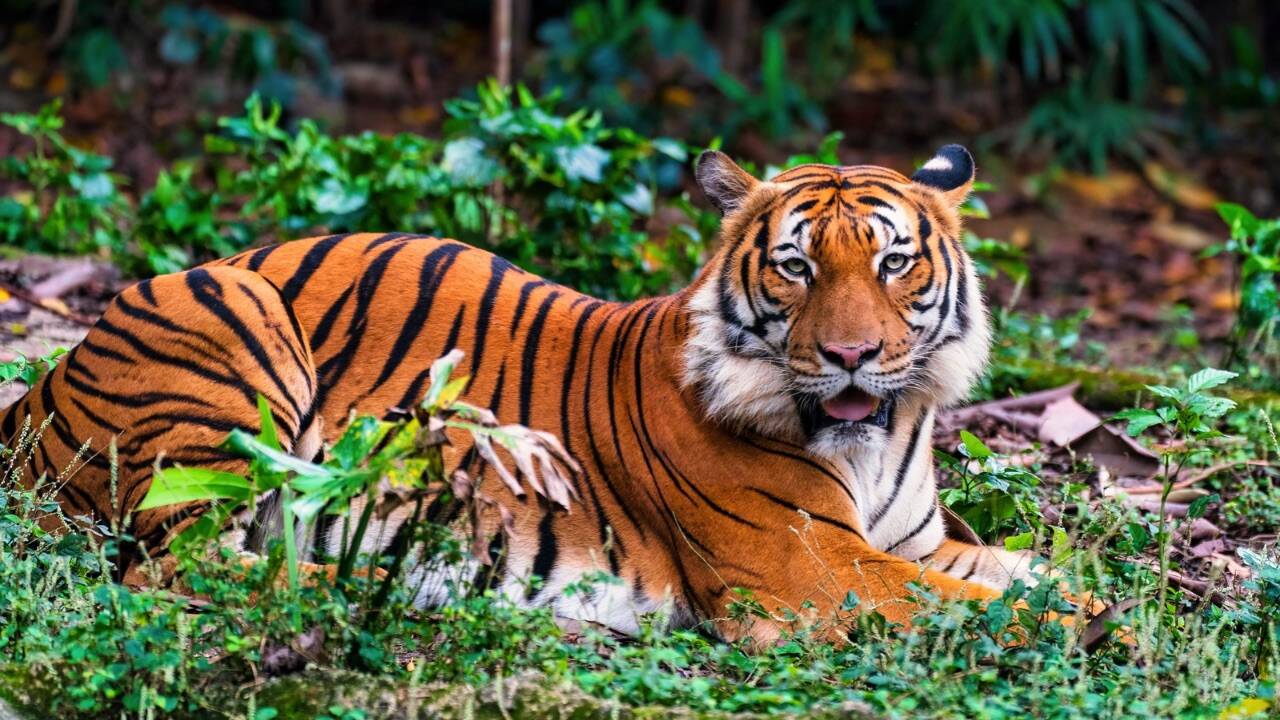
The forest never announces its apex predators.
You can walk for three weeks through the damp, suffocating undergrowth of a South Asian monsoon forest, sweating through your shirt while leeches drop silently onto your collar, and never see a single stripe. You will hear the alarm bark of a sambar deer echoing through the teak trees. You will find a pugmark pressed deep into the red mud beside a drying watering hole, crisp as a plaster cast. And if you are lucky—or deeply unlucky, depending on how close the bushes are—you will catch a sudden, sharp, musky scent hanging in the humid air like burnt buttered popcorn.
For decades, that faint smell and a pile of drying scat on a dusty trail were all wildlife biologists had to go on. They were trying to count ghosts. And for decades, they were guessing.
Consider a hypothetical scenario that plays out in real conservation offices across India, Nepal, and Southeast Asia every single month. Imagine a forest ranger named Vikram, standing over a fresh deposit of feces on a narrow dirt track separating a protected tiger reserve from a bustling agricultural village. Two nights ago, a prize water buffalo was dragged into the tall grass and killed. The villagers are furious, demanding immediate action, compensation, or the lethal removal of a "man-eating" tiger. Vikram looks down at the scat. The size is right. The location is right.
Except it might not be a tiger at all. It could be a large male leopard.
To the untrained eye—and historically, even to seasoned trackers—the physical evidence left behind by a Bengal tiger (Panthera tigris) and an Indian leopard (Panthera pardus) overlaps entirely too often. A young tiger and a massive leopard leave nearly identical footprints in loose gravel. Their feces look remarkably similar, packed with the same undigested hair, bone fragments, and grass. Yet the ecological, legal, and human consequences of confusing the two are staggering. Misidentify a leopard as a tiger, and you waste millions of dollars in conservation funding protecting a phantom population. Misidentify a tiger as a leopard, and you might fail to protect a critically endangered breeding female, or worse, send villagers into the brush unprepared for a predator twice the size they expected.
This is the quiet crisis that has haunted big cat conservation since the first census was attempted. How do you manage a species you cannot see, using evidence you cannot reliably read?
The Illusion of the Footprint
Before modern biochemistry entered the jungle, wildlife monitoring relied heavily on the pugmark census. Developed in India in the 1960s, the method was poetic in its simplicity: trackers would find a tiger's footprint, place a glass plate over it, and trace the outline with a pen. By comparing the shapes and angles of thousands of tracings, officials believed they could identify individual tigers and tally the national population.
It was a comforting illusion.
In 2004, that illusion shattered when conservationists realized that India's official tiger numbers had been wildly inflated. A single tiger walking across mud, then sand, then dry leaves leaves three completely different footprints. A tracker's hand shakes. Soil shifts. Worse still, in forests where tigers and leopards share the same hunting grounds—which is almost everywhere across Asia—their tracks blur together into an unreadable mess.
I remember the first time I knelt beside a seasoned field biologist in the Western Ghats, staring at a smear of dried dung on a mossy rock. I asked him, with the naive confidence of someone who had read too many field guides, whether it belonged to a tiger. He didn't even look up from his sample vial. "If I tell you yes," he said quietly, "I'm lying to you. If I tell you no, I'm still lying. Right now, this is just dirt."
Camera traps eventually arrived to rescue the field, snapping grainy, infrared portraits of cats walking past heat sensors in the dead of night. Stripes are like human fingerprints; no two tigers share the exact same pattern. But camera traps are expensive, easily stolen, prone to failing in monsoon humidity, and completely blind to what happens off the main trails. You cannot put a camera behind every tree in a thousand-square-kilometer reserve.
Biologists needed something the animals couldn't hide, something they left behind deliberately, every single day, as part of their biology. They needed to learn how to read the chemical diary of the forest.
Decoding the Scent of Territory
Big cats do not urinate and defecate merely to relieve themselves. They are broadcasting.
When a tiger sprays a tree trunk with a mixture of urine and anal gland secretions, it is posting a high-resolution billboard. To another cat passing by hours later, that pungent aerosol contains an entire biography: the sender's species, sex, age, reproductive status, health, and exact claim to the territory. That familiar "buttered popcorn" aroma humans detect comes from a specific volatile organic compound called 2-acetyl-1-pyrroline—the exact same chemical responsible for the smell of basmati rice and warm cinema snacks.
For years, scientists knew this chemical language existed, even if human noses were too dull to translate it. The breakthrough came when researchers stopped looking at scat and urine as gross biological waste and started treating them as forensic crime scenes.
By combining non-invasive DNA extraction with advanced gas chromatography and mass spectrometry—tools usually reserved for forensic toxicology and perfume manufacturing—researchers began isolating the exact molecular signatures hidden inside tiger and leopard excretions. They weren't just looking for a single marker anymore. They were mapping the entire chemical profile.
When epithelial cells shed from the lining of a cat's digestive tract onto its scat, they carry intact nuclear and mitochondrial DNA. Even in the brutal heat of the tropics, if collected within a few days, a swab of mucus from the outside of a fecal sample yields a genetic barcode that separates Panthera tigris from Panthera pardus with near-total certainty.
The urine told an even richer story. Researchers analyzing the volatile compounds in tiger and leopard urine discovered distinct chemical ratios. While both species share baseline mammalian compounds, the specific concentrations of fatty acids, alcohols, ketones, and sulfur-containing molecules act like a species-specific fingerprint. Even when the DNA in a sun-baked sample has degraded beyond recognition, the lingering chemical compounds trapped in the soil or bark can still betray whether a tiger or a leopard marked that spot.
What Waste Reveals About a Secret Life
Distinguishing a tiger from a leopard was only the opening chapter. Once researchers realized they could reliably separate the two cats through their waste, they began asking deeper, more urgent questions. If a pile of scat can tell us who was here, what else can it tell us about how they are surviving?
The answers have completely reshaped how we understand big cat ecology.
First, it exposed the hidden diet wars. By washing the scat and examining the undigested hair and bone fragments under a microscope—now paired with DNA metabarcoding of the prey—scientists can see precisely what each predator is eating. In healthy, prey-rich forests, tigers focus heavily on large ungulates like gaur, sambar, and wild boar, while leopards pivot toward smaller chital deer, langurs, and wild pigs. When researchers find tiger DNA in scat packed with domestic livestock hair, or leopard scat filled with village dogs, it acts as an early warning system. It tells conservationists that the forest's natural prey base is collapsing before a single human is attacked.
Second, it unlocked stress and reproductive biology. Scat is a reservoir of steroid hormones. By measuring glucocorticoid metabolites in tiger feces, biologists can gauge how stressed an animal is. A tiger living quietly in the core of a protected park shows baseline cortisol levels. A tiger forced to navigate highway construction, illegal logging, or relentless tourist jeeps shows chronic hormonal spikes that suppress its immune system and halt reproduction. Simultaneously, tracking progesterone and testosterone levels in the same samples reveals which females are pregnant, which males are dominant, and whether a population is actually breeding or slowly aging into extinction.
Third, it mapped invisible corridors. Tigers do not live in isolated islands; they need to travel between forests to find mates and avoid deadly inbreeding. Yet these wildlife corridors often pass through tea plantations, riverbeds, and village outskirts where camera traps are quickly smashed or stolen. Scat surveys require no expensive hardware left behind. Teams simply walk the corridors, bag the samples, and let the lab reconstruct the genetic family tree of the traveling cats.
The Human Stakes on the Forest Edge
It is easy to get lost in the elegance of the laboratory science—the sterile vials, the mass spectrometers, the neat phylogenetic trees glowing on computer monitors. But the true value of this research isn't measured in academic citations. It is measured in the tense, dusty spaces where wild carnivores and rural communities collide.
Return for a moment to Vikram, our hypothetical forest ranger standing over that fresh kill near the village edge.
In the real world, human-wildlife conflict is the single greatest threat to big cats outside protected reserves. When a farmer loses a cow, he loses a year's worth of milk, draft power, and financial security. Anger flares fast. Retaliatory poisoning—lacing a carcass with cheap agricultural pesticides—can wipe out an entire family of tigers in forty-eight hours.
Before forensic scat and urine analysis, wildlife departments were often flying blind during these crises. When a predator began stalking a village, authorities had to guess which species they were dealing with, how many individuals were involved, and whether the culprit was a transient sub-adult passing through or a wounded, desperate resident cat.
Today, rapid genetic and chemical profiling changes the response entirely. If field teams collect urine swabs from sprayed bushes and fresh scat along the village perimeter, lab technicians can confirm within days whether the predator is a tiger or a leopard. More than that, they can match the DNA profile to existing databases of known individuals.
Consider what happens next: authorities can tell anxious villagers, with hard scientific proof, that the animal taking their goats is a young male leopard that has already moved ten kilometers north, rather than a resident tigress with cubs. That precision prevents panic. It stops wildlife officials from setting traps in the wrong locations, saves innocent animals from being captured or killed, and ensures that financial compensation reaches the affected families swiftly and accurately.
A Quieter Kind of Conservation
There is a strange humility required in this work. For centuries, human beings have approached nature with a desire to conquer, capture, and physically possess it. Even early conservationists felt the need to tranquilize big cats, drag their heavy, limp bodies onto tarps, clamp radio collars around their necks, and draw blood from their veins just to gather basic data.
Every time you dart a tiger, you risk killing it. The anesthesia can fail; the animal can stagger into a river and drown; the stress can permanently alter its behavior.
Non-invasive monitoring turns that dynamic upside down. The tiger never knows it is being studied. It walks through the bamboo at dusk, marks a mossy boulder, leaves a pile of dung on a ridge trail, and vanishes back into the shadows. Hours later, a researcher walks by with a plastic bag, a pair of latex gloves, and a vial of ethanol.
It isn't glamorous. Nobody makes thrilling wildlife documentaries about biologists hunched over piles of drying feces in the pouring rain, carefully labeling sample tubes while mosquitoes feast on their ankles. There are no dramatic helicopter chases, no close-up shots of snarling teeth.
Yet in those unassuming vials lies the clearest picture we have ever had of Asia's most elusive predators. By learning to read the subtle chemical signatures left behind in urine and scat, scientists have stripped away the guesswork that plagued conservation for generations. They have found a way to tell the tiger from the leopard, the stressed from the thriving, the transient from the resident—all without ever disturbing a single blade of grass in the cat's path.
The next time a tiger steps silently across a forest trail in the dead of night, pauses beside a familiar tree, and leaves its pungent, musky mark in the damp air, it is no longer just speaking to its rivals in the dark. We are finally listening, too.