The air at nine hundred feet doesn’t move like the air on the ground. Down here, we experience wind as a push or a pull, a rustle in the trees, or a slammed door. Up there, inside the wicker basket of a hot air balloon, the wind is an absolute. You don't feel it because you are it. You are a passenger in a giant silk lungs, breathing with the atmosphere, drifting in a silent, golden suspension.
Then the silence breaks.
It starts with a sound that shouldn’t exist in the sky: the metallic screech of high-tension power lines. In an instant, the romantic notion of flight evaporates. It is replaced by the cold, hard physics of a disaster in progress. When a hot air balloon tangles with power lines, the basket becomes a conductor, the sky becomes a trap, and the people inside are no longer travelers. They are occupants of a cage suspended between life and a very grounded reality.
The Physics of a Panic
To understand the weight of a rescue at this altitude, you have to understand the fragility of the craft. A balloon is essentially a giant bubble of hot air held together by nylon and hope. When that bubble hits an obstacle, it doesn't just stop. It crumples. It swings.
Consider the pilot, let’s call him Elias. Elias has spent hundreds of hours reading the invisible rivers of the sky. He knows how to use a propane burner to dance with gravity. But when the wind shifts—a sudden, malicious downdraft—and the basket snags on a utility tower, his expertise is suddenly irrelevant. He is now a man standing in a laundry basket, looking down at a drop that would take roughly seven seconds to travel.
The passengers aren't thinking about the seven seconds. They are thinking about the hum.
Power lines carry enough voltage to turn a human heart into a stalled engine. The danger isn't just the fall; it's the bridge. If the basket touches the ground while still in contact with the lines, the electricity finds its shortest path to the earth. Through the wicker. Through the metal frame. Through the people.
They are stuck in a state of electrical purgatory.
The First Responders Who Don't Look Down
When the call goes out, the atmosphere on the ground changes. For the rescue teams, this isn't a standard "man down" scenario. This is a high-wire act where the stage is made of energized copper and the performers are terrified civilians.
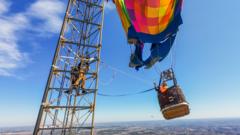
Think about the technician tasked with the climb. We’ll call him Sarah. Sarah has climbed towers before, but usually, the towers aren't being shook by a multi-ton nylon sail caught in a gale. As she hooks her carabiner into the cold steel, she can feel the vibration of the lines. It’s a low-frequency growl that tells her the dragon is awake.
She has to move with a deliberate, agonizing slowness. In a world of "move fast and break things," the high-altitude rescuer lives by the mantra of "move slow and stay alive." Every clip of the safety line is a heartbeat. Every step up the rung is a negotiation with the wind.
The bystanders below see a dramatic silhouette against the clouds. They see a "hero." Sarah sees a series of technical problems:
- How much tension is the balloon fabric putting on the top wire?
- Is the basket's weight distributed evenly, or will it tip the moment a passenger shifts?
- Can the power be cut without plunging a nearby hospital into darkness?
The rescue is a jigsaw puzzle where the pieces are made of lightning and the board is wobbling nine hundred feet in the air.
The Human Geometry of the Basket
Inside the basket, the social contract changes. On the ground, these people might have been strangers—a couple on an anniversary, a solo traveler with a bucket list, a pilot just doing his job. Now, they are a single organism.
Fear has a specific smell. It’s metallic, like old pennies. It mixes with the scent of scorched nylon and the faint, lingering odor of propane.
They have to stay still. That is the hardest part. Every instinct in the human brain screams to move, to jump, to do something, anything, to escape the precariousness. But to move is to risk shifting the center of gravity. To move is to potentially brush against a line that is singing with lethal intent.
They talk to each other. Not about the view, not anymore. They talk about their kids. They talk about what they want for dinner if they ever get back down. They weave a web of mundane conversation to mask the sheer, vertical terror of their situation. This is the invisible thread. It’s not made of nylon or steel; it’s made of the desperate, shared need to remain human while dangling in the void.
The Technical Nightmare of the Reach
A bucket truck—the kind you see fixing streetlights—usually caps out at sixty or seventy feet. To reach nine hundred, you need specialized equipment or, more often, a daring helicopter extraction.
But helicopters create downdraft.
Imagine a rescue chopper hovering above a snagged balloon. The rotors push air down at incredible speeds. If the chopper gets too close, it might actually push the balloon off the lines before the passengers are secured. It’s a delicate, lethal ballet. The pilot of the rescue craft has to hover in a "sweet spot," fighting the same winds that trapped the balloon in the first place, while a winch operator lowers a cable.
The cable swings. The wind gusts. The passengers look up, eyes squinting against the grit kicked up by the blades.
At this moment, the rescue isn't about technology. It's about a hand reaching for a hand. It’s the moment Sarah, or whoever has made the climb or the descent, makes physical contact with the basket. That first touch is the most dangerous. If there’s a static buildup, that first touch can be a shock. But it’s also the first moment the passengers realize they aren't alone in the sky.
The Slow Descent to Earth
One by one, they are harnessed. One by one, they are lifted or lowered.
The silence returns, but it’s a different kind of silence now. It’s the silence of exhaustion. When the last passenger is cleared and only the pilot remains, the balloon—now a ghost ship—often begins to deflate further. It sags like a tired giant.
The pilot is usually the last to leave. It’s a tradition, yes, but it’s also practical. He knows the craft's temperament. He knows which ropes are holding and which are fraying. When he finally steps out of that wicker cage and into the rescue harness, he isn't looking at the horizon. He’s looking at his hands. They’re shaking. They always shake once the adrenaline starts to ebb.
Down on the grass, the paramedics are waiting. The sirens are a welcome noise now. They represent the ground. They represent the end of the vertical world.
We look at the headlines the next day and see a "dramatic rescue." We see a blurred photo of a colorful balloon caught in a gray tower. We read the altitude—900 feet—and we whistle at the number. But the number doesn't tell the story.
The story is in the muscle ache of the rescuer who climbed into the danger zone. It’s in the whispered prayers of the passengers who had to learn how to stand perfectly still while their world tilted. It’s in the terrifying realization that we are all, at any given moment, just a few feet away from the thin line between a beautiful drift and a desperate scramble for survival.
The balloon is eventually removed. The power lines are repaired. The sky goes back to being an empty, blue expanse. But for the people who were in that basket, the sky will never be empty again. It will always be filled with the memory of the hum, the smell of the copper, and the incredible, heavy beauty of the solid ground beneath their feet.
Gravity is a cruel master until you’ve spent an hour wishing it would just let you come home.
The next time you see a hot air balloon drifting on the horizon, a speck of color against the sunset, don't just see a ride. See the balance. See the silence. And remember that sometimes, the most heroic thing a person can do is hold onto a wire and wait for a hand to reach out from the blue.