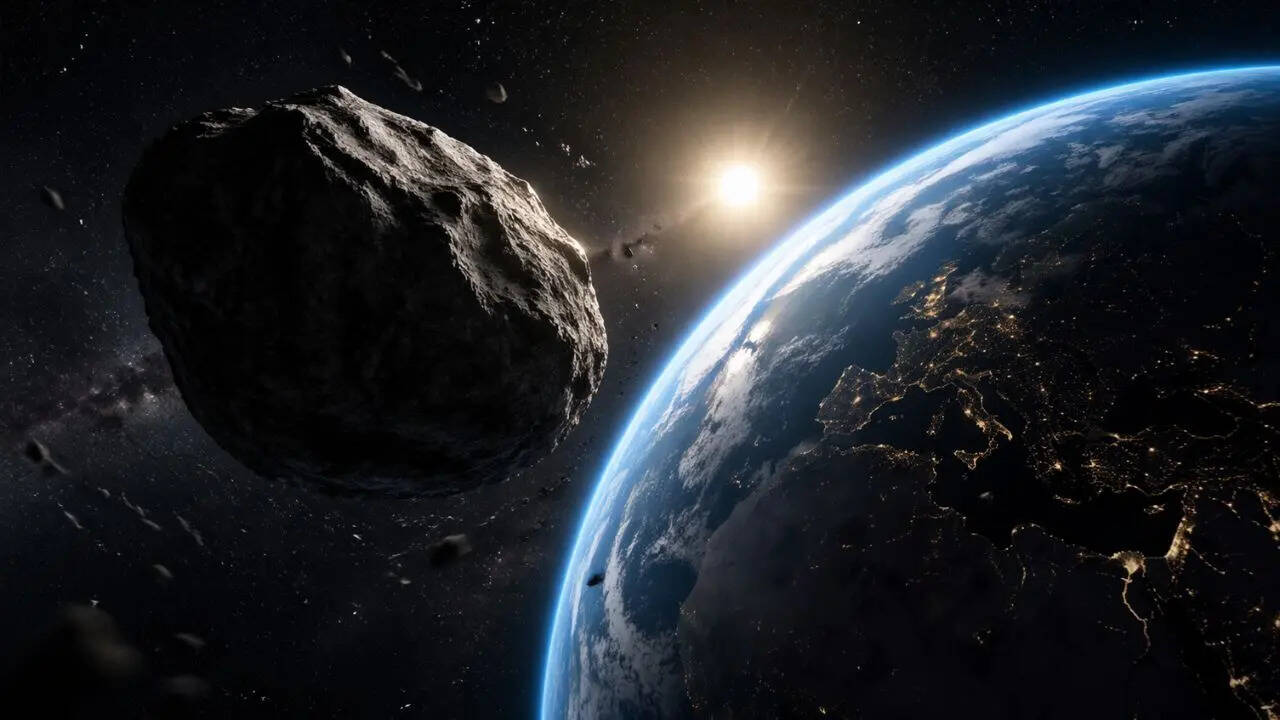
On April 21, 2026, the asteroid known as 2026 HJ1 made its closest approach to Earth, passing within a distance that triggered automated alerts across the global astronomical community. While social media headlines screamed about a "monster" rock, the reality is far more clinical and, in many ways, more concerning. This object is roughly the size of a city bus—approximately 10 to 12 meters in diameter—and while it didn't hit us, it served as a live-fire drill for a planetary defense system that remains dangerously underfunded and reactive.
The asteroid moved at a relative velocity of roughly 28,000 kilometers per hour. At that speed, even a "small" rock carries the kinetic energy equivalent to several Hiroshima-style atomic bombs. Had it entered the atmosphere, it likely would have resulted in an airburst similar to the 2013 Chelyabinsk event, shattering windows and injuring thousands with a shockwave rather than a crater-forming impact.
The Geometry of a Near Miss
We often think of space as an empty void, but the inner solar system is actually a shooting gallery of debris left over from the formation of the planets. 2026 HJ1 is a Near-Earth Object (NEO), a classification for any small solar system body whose orbit brings it into proximity with Earth. What makes 2026 HJ1 a specific point of interest for analysts isn't just its size, but the timing of its detection.
Many of these smaller asteroids are discovered only days or even hours before they reach their perigee (the closest point to Earth). In the case of 2026 HJ1, the window between "first sight" and "closest approach" was razor-thin. This lag exists because these objects are dark, often reflecting less light than a piece of coal, making them nearly invisible against the blackness of space until they are practically on top of us.
The Albedo Problem
Astronomers use the term albedo to describe how much light an object reflects. Most asteroids have a very low albedo. When you combine a low-reflectivity surface with a small physical cross-section—like that of a bus—you get a ghost. We aren't looking for bright lights; we are looking for the absence of light, or the slight heat signature these rocks emit.
Current ground-based telescopes are limited by the atmosphere and the sun. We cannot easily see asteroids coming from the direction of the sun, which is exactly how the Chelyabinsk meteor caught the world off guard. Until we have a dedicated constellation of infrared space telescopes stationed at different points in Earth's orbit, we are effectively playing a game of cosmic blind man's buff.
Why the Monster Narrative Misses the Mark
The sensationalism surrounding 2026 HJ1 obscures the real technical challenge. Calling it a "monster" is hyperbole; in the grand scale of celestial threats, a 12-meter rock is a pebble. The real monsters are the kilometer-wide "planet killers" that we have mostly mapped. We know where 95% of the massive asteroids are, and none of them are hitting us in the next century.
The danger lies in the mid-sized gaps.
Objects between 10 and 140 meters are large enough to level a city but small enough to slip through our current survey nets. 2026 HJ1 falls into the lower end of this "Goldilocks zone" of destruction. It is big enough to cause a local disaster but small enough to be ignored by systems designed to find the world-enders. This is the "Grey Swan" of planetary defense: a known risk that we are choosing not to fully mitigate because the cost of total surveillance is perceived as too high.
The Cost of Vigilance
Building a planetary defense grid isn't just about launching a few satellites. It requires a massive, coordinated effort to manage data. Every night, automated surveys like the Catalina Sky Survey or Pan-STARRS generate terabytes of data. Sorting through that data to find a moving dot that might be a rock heading for London or Tokyo requires immense computing power and human verification.
Currently, we rely heavily on a network of amateur astronomers to follow up on these detections. It is a fragmented system. While the Minor Planet Center does an admirable job of centralizing this data, the infrastructure is aging. We are essentially defending the planet with the equivalent of a volunteer fire department when we need a professional, globalized strike force.
Beyond Detection the Reality of Deflection
If 2026 HJ1 had been on a collision course, what could we have actually done? The honest answer is: nothing.
With only a few days of warning, there is no technology currently sitting on a launchpad capable of intercepting a small, fast-moving asteroid. The DART (Double Asteroid Redirection Test) mission proved that we can change an asteroid's orbit by slamming a spacecraft into it. However, that mission required years of planning and a very specific target.
To stop something like 2026 HJ1, we would need:
- Rapid-Response Launch Capability: Rockets standing by, ready to go within 24 hours.
- Pre-positioned Interceptors: Spacecraft already in orbit, waiting for a target.
- Political Consensus: A global agreement on who is allowed to "nudge" an asteroid, as changing its path could potentially move the impact site from one country to another.
The third point is the most contentious. If an asteroid is headed for the United States, and a deflection attempt shifts the projected impact site to Russia or China, we have moved from a natural disaster to a geopolitical crisis. We do not have a treaty for this. We don't even have a formal handshake.
The Infrastructure Gap
We are currently seeing an explosion in the number of satellites in Low Earth Orbit (LEO). While companies like SpaceX and OneWeb provide global internet, their "mega-constellations" are creating a new problem for asteroid hunters: optical interference.
Every time a satellite streak crosses a telescope's field of view, it can mask a faint asteroid. Astronomers are now forced to write complex algorithms to "clean" their images, but this adds another layer of potential error. We are effectively cluttering our front window while trying to look for incoming threats. It is a classic case of commercial interests outstripping basic safety requirements.
Infrared is the Only Answer
To truly secure the planet, we must move away from visible-light telescopes for detection. Objects like 2026 HJ1 emit heat. An infrared telescope in space, like the planned NEO Surveyor mission, would see these asteroids as bright beacons against the cold background of space.
The delay of such missions is a failure of policy, not science. We have the blueprints. We have the sensors. What we lack is the collective will to prioritize a threat that doesn't have a quarterly earnings report or an election cycle attached to it.
The Probability Game
Statistically, an event like the one 2026 HJ1 represents happens several times a year. Most of these rocks hit the ocean or uninhabited parts of the wilderness. We get lucky. But relying on luck is not a strategy.
The Chelyabinsk event in 2013 was a wake-up call that the world hit the snooze button on. 2026 HJ1 is the alarm going off again. The "monster" isn't the rock itself; it's the complacency of a civilization that knows exactly how to protect itself but refuses to pay the bill.
If we want to avoid being the first species to document its own extinction via high-definition camera, we need to stop treating these flybys as curiosities and start treating them as warnings. The physics of kinetic impact don't care about our budgets or our political borders.
The next rock is already on its way. We just haven't seen it yet.
Invest in the survey. Build the interceptors. Formalize the treaties.
Otherwise, we are just waiting for our turn in the cosmic lottery, and the house eventually wins.