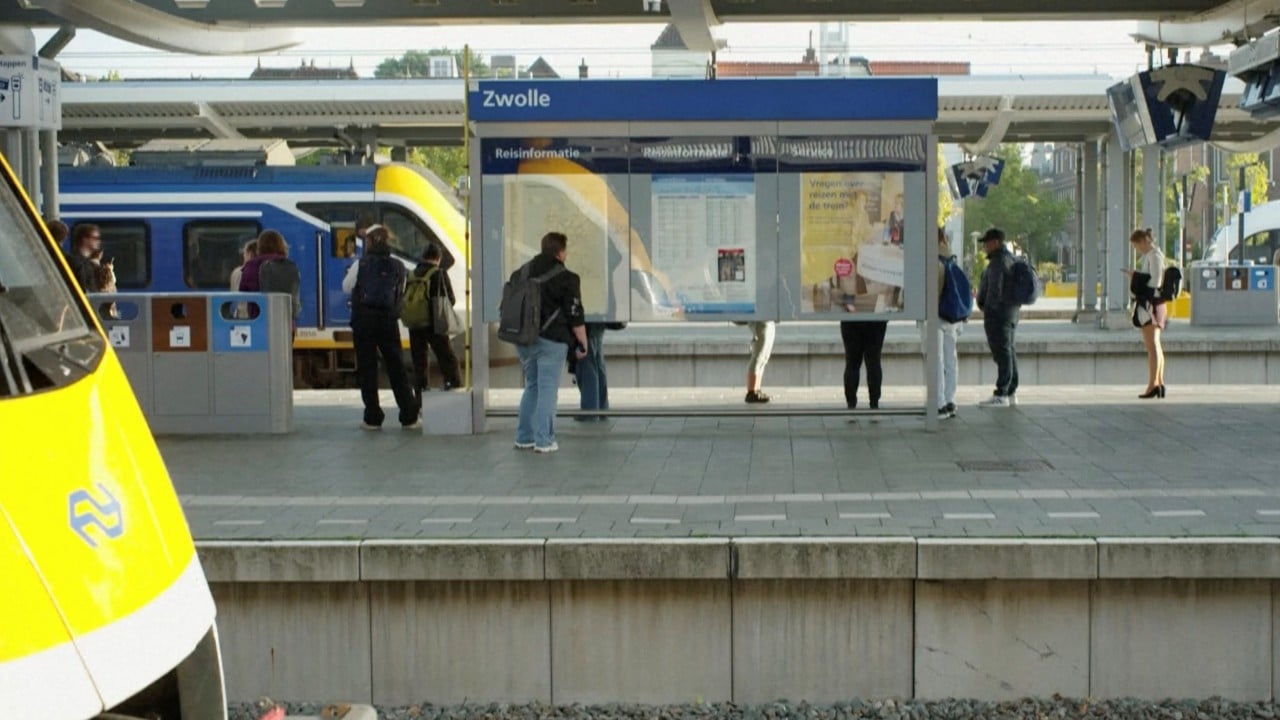
The coffee in the paper cup was still hot when the platform announcements began to stutter, dissolving from crisp digital promises into a rhythmic, electronic sigh of confusion.
At Utrecht Centraal, thousands of people stood shoulder-to-shoulder in the damp chill of a Tuesday morning, their eyes fixed upward on departure boards that were rapidly bleeding red. Trains did not arrive. Trains did not depart. In a country where time is measured not in hours, but in the exact synchronization of seconds—where commuters can time their marriages, their promotions, and their children's bedtimes to the reliable pulse of the Sprinter and Intercity services—the silence was deafening. If you liked this post, you might want to read: this related article.
It was not a storm. The skies over the Netherlands were clear, washed in that pale, indifferent grey peculiar to the North Sea. There were no fallen trees across the overhead wires, no winter ice seizing the switches. Something much more quiet had happened beneath the ballast and the concrete.
Somewhere in the dark conduits and signal hubs, the nervous system of the Dutch railway had been severed. For another look on this development, check out the recent coverage from NPR.
To understand what happened when the Dutch rail network ground to a halt under the shadow of suspected sabotage, one must first understand how deeply an entire population trusts the invisible. We live our lives leaning against structures so massive and pervasive that we forget they are there. We step onto a train platform, swipe a card, and surrender our autonomy to a machine weighing hundreds of tons, trusting that an unseen web of copper, fiber optics, and automated logic will guide us safely across rivers, through tunnels, and past bustling suburbs with the precision of a Swiss watch.
That trust is a fragile architecture.
When ProRail engineers descended into the technical chambers and maintenance pits, they did not find the typical wear-and-tear of a heavily utilized transit grid. They found clean cuts. They found deliberate interruptions. They found evidence that someone—or some group—knew precisely where to strike to paralyze the circulation of people and goods without ever showing their face.
Consider the anatomy of a modern railway. It is often imagined as steel tracks stretching across green fields, but tracks are merely the skeleton. The soul of the network is information. Every switch, every signal light, every speed restriction and braking command flows through kilometers of delicate wiring running alongside the tracks. These arteries carry the vital signals that keep two-ton steel leviathans from colliding, that tell an engineer whether the path ahead is clear or blocked.
When those lines are cut, the system does not fail loudly. It fails by freezing. Safety protocols, hardwired into the machinery to prevent catastrophe, instantly drop all signals to red. The entire network locks its joints. It chooses paralysis over peril.
For Bram, a veteran signaling technician with twenty-two years on the tracks, the call came at four in the morning. He pulled his jacket on in the dark, kissing his sleeping wife’s forehead with the quiet efficiency of a man accustomed to nocturnal emergencies. He expected a blown transformer, a lightning strike, maybe a mechanical fatigue fracture in a decades-old relay box.
Instead, standing inside a junction box outside of Rotterdam with his flashlight cutting through the damp morning mist, he saw the truth. The thick bundles of communication cables were not frayed. They had been sliced with surgical precision.
"It’s like walking into a hospital and finding that someone has neatly disconnected every monitor in the intensive care unit," Bram would say later, his hands stained with grease and coffee as he wiped his brow with a rag. "You don't need to break the walls down to kill the patient. You just need to know which wires to snip."
The immediate economic and social shockwaves were immediate and profound. Within hours, the arteries of the Netherlands were blocked. Freight trains carrying vital industrial goods sat stalled on sidings. Passengers spilled out of stations and onto overflowing buses, clogging arterial motorways that were never designed to absorb the sudden transfer of millions of rail commuters. University lecture halls sat half-empty. Business meetings were postponed across borders.
Yet the true cost was not measured in euros, though the economic toll was staggering. It was measured in the sudden, jarring realization of vulnerability.
We have built a civilization optimized for efficiency, velocity, and interconnectedness. We have trimmed the fat from our supply chains, our public services, and our transit grids. Every mile of track is maximized; every timetable is shaved down to the microsecond to accommodate the maximum possible throughput. This hyper-optimization creates wealth, mobility, and freedom. But it also creates a terrifying fragility. When you remove redundancy in the name of progress, you leave yourself defenseless against the surgical strike of a pair of wire cutters.
Who benefits from plunging a peaceful nation into transit chaos?
That was the question hanging in the briefing rooms of intelligence agencies and law enforcement officials as federal investigators fanned out across the country. Was it a foreign actor testing the resilience of Western critical infrastructure? Was it domestic extremism, an eco-terrorist cell, or a group of nihilistic actors seeking the cheap thrill of national disruption?
As of yet, definitive answers remain elusive, obscured by the very nature of modern sabotage. In the digital and mechanical age, attacks on physical infrastructure do not require grand manifestos or public claims of responsibility. They require only anonymity, patience, and a basic understanding of where society is most vulnerable. A man with a pair of shears can cause more economic damage and public anxiety in ten minutes than an army could achieve in a pitched battle along a border.
The investigation has pushed counter-terrorism units and cyber-security experts into an uneasy alliance. Rail networks are no longer just mechanical systems of steel and steam; they are cyber-physical hybrids. They rely on digital routing, automated switches, and centralized dispatch centers that communicate over wide-area networks. While the immediate attack was physical—a pair of blades meeting copper—the ripples affected digital control panels hundreds of kilometers away.
In the days following the disruption, as crews worked around the clock under floodlights to splice thousands of individual copper and fiber-optic strands back together, a strange mood settled over the Dutch public. It was not panic. The Dutch are a people whose national identity has been forged through centuries of engineering battles against the sea; they understand that infrastructure is a constant, exhausting negotiation with nature and human error.
Instead, the mood was one of quiet, unsettled reflection.
People looked at the railway tracks running past their backyards with new eyes. Those ordinary grey ribbons of steel, previously ignored as background noise or cursed when delayed by a minute or two, suddenly appeared what they truly were: fragile lifelines holding together a complex, high-density society.
We take our safety so completely for granted that we mistake it for a law of nature. We assume that the water will flow from the tap, that the electricity will hum in the walls, that the train will arrive at 8:14 and deposit us at our destination by 8:49. We build our lives, our cities, and our economic futures upon this bedrock of assumptions.
When those assumptions fail, the shock is visceral.
By the end of the week, the lines were spliced, the testing protocols were verified, and the first trains rolled slowly across the repaired junctions at reduced speeds. Commuters trickled back onto the platforms. The electronic boards stopped bleeding red and returned to their comforting, predictable green. The coffee cups were hot again.
And yet, nothing was quite the same.
The technicians are still stationed at vulnerable junctions across the country. Intelligence officers are still reviewing security camera footage from rural grade crossings where no train is scheduled to stop. And millions of travelers now carry a quiet, persistent thought in the back of their minds as they watch the Dutch countryside blur past their windows at one hundred and forty kilometers per hour.
They know now how thin the wire is. They know how easily the dark can reach in and stop the world in its tracks.
The train moves forward through the twilight, slicing smoothly through the flat, green polders under a vast, indifferent sky. Inside the carriage, passengers read their phones, sip their coffee, and lose themselves in the hum of the engine. But outside, in the shadows beneath the signals, the night is long, and the wires run deep through the earth, waiting for dawn.