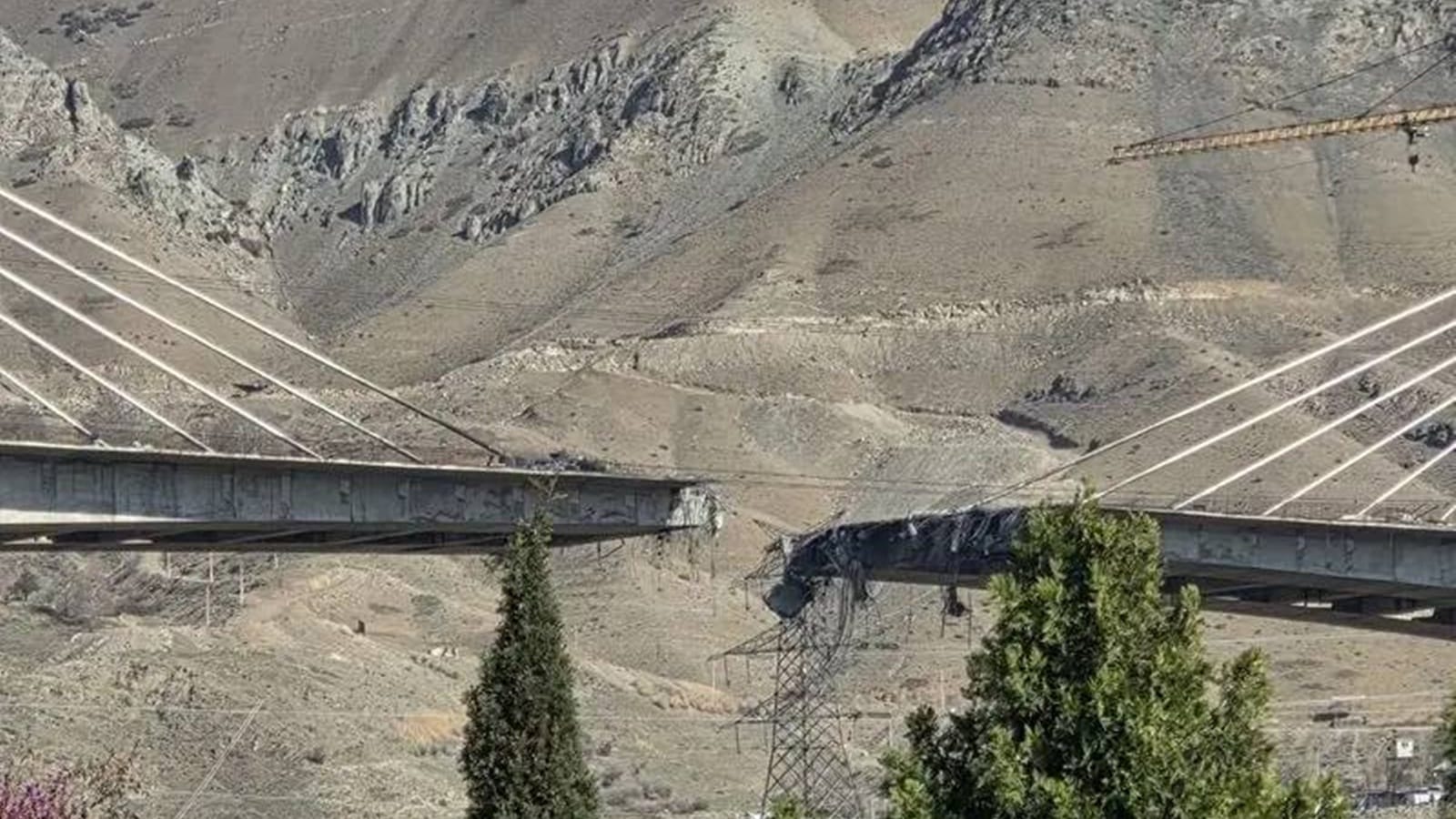
The headlines are screaming about a "shattering blow." They point to the twisted steel of Iran’s tallest bridge and the stern warnings from the White House as evidence of a shift in the Middle Eastern power dynamic. They are wrong. This wasn't a masterstroke of deterrence. It was a billion-dollar fireworks display that highlights exactly how obsolete traditional kinetic warfare has become in the face of asymmetric resistance.
If you think blowing up a bridge stops a regional power in 2026, you are still living in the 1940s. The obsession with "hard targets"—infrastructure, physical spans, concrete monoliths—is a relic of a mindset that equates rubble with results. It doesn't.
The Logistics Fallacy
Every armchair general on cable news is currently obsessed with "cutting supply lines." It sounds smart. It sounds like something Sun Tzu would say. But in the modern theater, logistics aren't tethered to a single span of concrete.
Iran has spent the last three decades perfecting the art of the workaround. They don't move critical assets in massive, vulnerable convoys that require six-lane highways. They use decentralized networks, subterranean tunnels, and civilian-integrated transport that a Hellfire missile can’t touch without causing a PR disaster.
Dropping a bridge is a minor inconvenience. It’s a traffic jam, not a structural collapse of a military strategy. When the US strikes a high-profile target like this, they aren't hitting the enemy's heart; they are hitting their own taxpayers' pockets to achieve a temporary "mission accomplished" visual.
The Math of Failed Deterrence
Let's look at the actual physics and economics of this strike. To drop a structure of that magnitude, you aren't just using a single drone. You are looking at a coordinated strike involving:
- Multiple munitions (likely GBU-31 JDAMs or similar penetrators).
- Support sorties for electronic warfare to jam local air defenses.
- Real-time satellite loitering for BDA (Battle Damage Assessment).
The total cost of the operation, when factoring in flight hours and intelligence assets, likely exceeds $50 million. The cost to Iran? The price of a few dozen pontoon units or a redirected shipping route.
In a war of attrition, the side that spends $50 million to cause $5 million in property damage is the side that is losing, regardless of who has the bigger flag. We are witnessing the ultimate "sunk cost" fallacy played out on a global stage.
Why Bridges Are "Safe" Targets for Weak Leaders
Politicians love bridges. Why? Because they are easy to film.
A strike on a digital infrastructure node—like a localized server farm or a financial clearinghouse—doesn't look like anything on CNN. It’s just a silent screen. But a bridge falling into a ravine? That’s gold for a campaign ad.
This strike was designed for domestic consumption, not foreign policy impact. It allows the administration to look "tough" without actually dismantling the internal mechanisms that allow Iranian-backed groups to operate. It’s the military equivalent of a "security theater" at the airport. It makes you feel safe while the real threats walk through the side door.
The Human Capital Miscalculation
The reports claim eight killed. In the cold, hard logic of geopolitical chess, that number is statistically irrelevant to the IRGC.
The US military establishment continues to treat "personnel loss" as a metric of success. It isn’t. In an ideological conflict, every casualty at a high-profile site becomes a recruiting tool. We didn't "eliminate" eight combatants; we potentially radicalized eight hundred more.
If you want to dismantle a regime’s capability, you don’t target the laborers on a bridge. You target the technical specialists, the financiers, and the middle-tier logistics officers who actually understand how to bypass sanctions. We are killing the wrong people for the wrong reasons, and then acting surprised when the "threat" doesn't diminish.
The Asymmetric Reality
Imagine a scenario where a $500 drone, piloted by a teenager in a basement, disables a $2 billion aircraft carrier by hitting a specific sensor array during a launch cycle. That is the world we live in.
The US is still trying to fight this war with "The Big Stick." But the stick is heavy, slow, and expensive to swing. Iran and its proxies are fighting with "The Thousand Needles."
By focusing on the tallest bridge, the US is telegraphing its own insecurity. It shows that we are desperate for a "win" that the average person can understand. We are prioritizing optics over effectiveness.
Stop Applauding the Rubble
The "lazy consensus" is that this strike "sent a message."
Here is the real message: The US is willing to burn millions of dollars to destroy a target that can be bypassed in 48 hours.
If you want to actually win a conflict in the 21st century, you don't look for the tallest bridge. You look for the smallest wire. You look for the bank accounts. You look for the software vulnerabilities in their drone command-and-control.
Blowing up a bridge is what you do when you have no idea how to actually stop your opponent. It’s a temper tantrum in the form of a precision-guided bomb.
The next time you see a video of a structure collapsing in a cloud of dust, don't ask "How big was the explosion?" Ask "Why was that the only thing we could think to hit?"
Until we stop measuring victory by the height of the debris pile, we will continue to lose the wars that actually matter.