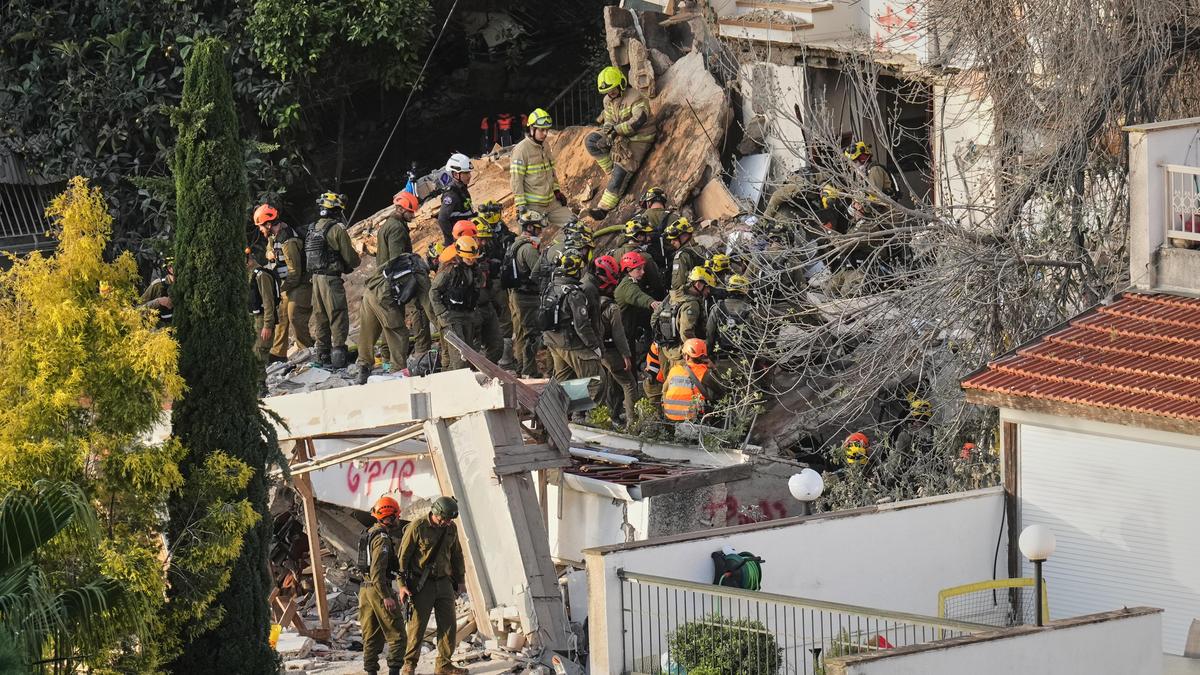
The headlines are predictable. They focus on the rubble, the sirens, and the tragic body count of two. Media outlets treat an Iranian missile strike on a civilian building as a singular, shocking breach of security. They frame it as a failure of defense or a sudden escalation. They are wrong.
This isn't a failure of technology. It is a failure of the narrative we have built around "defense." We have spent a decade huffing the fumes of our own propaganda, believing that sophisticated interceptors and early warning systems can permanently decouple a nation from the physical reality of war. They cannot. When a missile hits a building in Tel Aviv or central Israel, the story isn't the rescue effort. The story is the collapse of the "Iron Dome Doctrine"—the dangerous belief that you can manage a conflict indefinitely through superior engineering.
The Myth of Total Interception
The public has been conditioned to expect a 100% success rate. This is a mathematical absurdity. In any high-volume saturation attack, the physics of probability eventually favor the aggressor. The competitor articles focus on the two lives lost as an anomaly. In reality, they are the statistical inevitability of a strategy that prioritizes "mowing the grass" over decisive resolution.
We talk about interceptors like they are magic wands. They are not. They are finite resources. Every Tamir or Arrow missile fired is a debit against a dwindling inventory. Iran knows this. Their strategy isn't to outsmart the software; it’s to outproduce the interceptor. By focusing on the "missing in the rubble," the media misses the broader industrial attrition. We are trading $50,000 to $2 million interceptors for "dumb" rockets and cheap ballistic frames. That isn't a defense strategy. It's a bankruptcy plan.
The Rescue Industrial Complex
Watch the cameras zoom in on the search and rescue teams. It is visceral. It is heroic. It is also a massive distraction. By hyper-focusing on the humanitarian response, we ignore the strategic paralysis that allowed the missile to be fueled, aimed, and launched in the first place.
The "lazy consensus" suggests that as long as the Home Front Command is efficient, the status quo is sustainable. I have seen military planners fall into this trap for years. They begin to view civilian resilience as a resource to be spent rather than a duty to be protected. When you praise a population for "getting back to work" twenty minutes after a strike, you aren't praising their bravery. You are normalizing their victimization to avoid making the hard political decisions required to end the threat.
Kinetic Reality vs. Digital Hubris
The technology sector loves to talk about "smart borders" and "automated detection." But a building collapse is a brutal reminder that kinetic energy doesn't care about your venture capital-funded algorithm.
- The Velocity Problem: When an Iranian Fattah or Kheibar missile re-enters the atmosphere, it is traveling at speeds that shrink the decision-making window to seconds.
- The Shrapnel Fallacy: Even a "successful" interception over a populated area results in hundreds of pounds of hot metal raining down at terminal velocity.
- The Psychological Decay: The "Red Alert" app has turned existential dread into a push notification. We have gamified survival.
The competitor piece treats the strike as a tragedy. I treat it as a data point proving that "defensive superiority" is an oxymoron in the age of proliferation. You cannot defend your way out of a rainstorm; you either find cover or stop the clouds.
The Sovereignty of the Strike
We need to stop asking "How did it get through?" and start asking "Why was it allowed to be launched?" The global community obsesses over "proportionality," a term usually defined by people who aren't currently sitting in a reinforced safe room. This obsession has created a perverse incentive structure.
If Israel intercepts 99% of missiles, the world demands restraint because the damage was "minimal." If the 1% gets through and kills people, the world demands restraint to "prevent escalation." It is a win-win for the aggressor. The building strike isn't a sign of Iranian strength; it’s a sign of Western indecision. We have granted Iran a "sovereignty of the strike," where they can fire from their soil with the expectation that the response will be confined to their proxies' soil.
The Engineering Trap
Engineers are the worst people to put in charge of national security policy. They see a problem—a missile—and they build a solution—an interceptor. It’s elegant. It’s quantifiable. It also ignores the human element of deterrence.
I’ve sat in rooms with defense contractors who brag about "closing the loop" on incoming fire. They show slick PowerPoints of lasers and kinetic kill vehicles. What they never show is the 10-year-old child who now develops a panic attack every time a motorcycle revs its engine. You cannot engineer a solution to psychological warfare. The "success" of the Iron Dome has actually weakened Israeli long-term security by providing a false sense of safety that allowed the underlying political rot to fester. It turned a boiling pot into a pressure cooker.
Stop Asking if the Building was Fortified
The "People Also Ask" sections of the internet are filled with questions about building codes and bomb shelter requirements. This is the wrong question. It’s like asking if a stabbing victim was wearing a thick enough sweater.
The focus on "passive defense"—reinforced concrete, laminated glass, internal shelters—is a surrender. It accepts that the sky will occasionally fall and places the burden of survival on the architect rather than the general. While these measures save lives, they also signal to the enemy that you have accepted their right to fire at you. You are essentially building a more comfortable cage.
The Cost of the "Wait and See" Approach
We are told that waiting for international consensus is the "responsible" move. It isn't. In the Middle East, silence is not seen as dignity; it is seen as exhaustion.
Every hour spent "searching for the missing" without a devastating, disproportionate response on the source of the launch is an invitation for the next battery to fire. The media frames the rescue as the climax of the story. It isn't. It’s the intermission.
The true cost of these strikes isn't measured in the two lives lost today or the price of the concrete. It is measured in the erosion of the belief that a state can actually provide security for its citizens. Once that belief is gone, no amount of high-tech interceptors can buy it back.
The rubble isn't just a building. It's the wreckage of the idea that technology can replace a spine.
Pick up the wreckage. Stop building better shelters. Start making it impossible for them to fire.
Anything else is just waiting for the next building to fall.