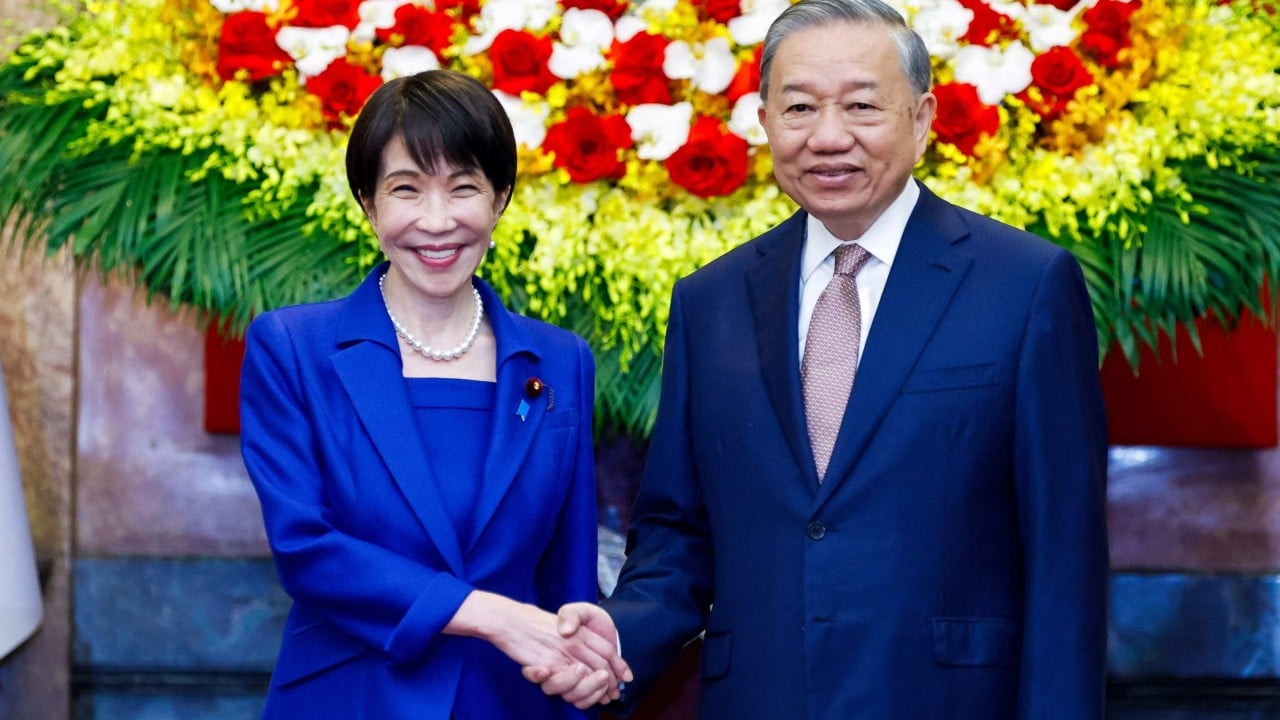
Tokyo has spent the last decade lecturing the Indo-Pacific on the sanctity of a rules-based international order, human rights, and democratic governance. Yet when it comes to Hanoi, those principles vanish at the water’s edge. Japan is aggressively expanding its security, economic, and diplomatic ties with Vietnam’s one-party authoritarian state, prioritizing raw geopolitical survival over its stated values.
This is not a diplomatic accident. It is a calculated, cold-blooded trade-off designed to counter Chinese maritime expansion in the South China Sea and secure supply chains away from Beijing. By elevating Vietnam to a Comprehensive Strategic Partner and pouring defense hardware into the country without human rights preconditions, Tokyo is exposing the fundamental hypocrisy at the core of its foreign policy.
The Geopolitical Math Behind the Handshake
Look at a map of the South China Sea and the logic becomes brutally clear. Japan is an island nation entirely dependent on maritime trade routes for its energy and food. Roughly eighty percent of Japan’s crude oil imports pass through the South China Sea, a body of water Beijing increasingly treats as its private lake.
Vietnam sits directly on the western flank of those shipping lanes. It possesses the longest coastline facing the disputed waters and maintains the most battle-hardened military in mainland Southeast Asia. For defense planners in Tokyo, Vietnam is not just another trading partner. It is an indispensable geographic cork in the bottle of Chinese naval expansion.
When Chinese coast guard vessels ram Philippine supply boats or harass Vietnamese oil exploration rigs, Tokyo sees a direct rehearsal for a future blockade of Taiwan or the Senkaku Islands. Consequently, Japan has systematically dismantled its post-World War II pacifist constraints to arm its neighbors. Through programs like Official Security Assistance, Tokyo is transferring patrol vessels, radar systems, and defense technology directly to Hanoi.
The transaction is straightforward. Japan provides the hardware, the financing, and the diplomatic backing. Vietnam provides a resilient, fiercely independent buffer state that refuses to bow to Beijing’s territorial claims. Values simply do not enter the equation.
The Myth of Value-Based Diplomacy
For years, Japanese leadership championed the concept of a Free and Open Indo-Pacific. In diplomatic communiqués from Washington to Brussels, this phrase is deployed as shorthand for a coalition of democracies standing against authoritarian coercion. Western audiences hear "rules-based order" and assume it includes protections for free speech, independent courts, and political pluralism.
In Tokyo, the definition is far narrower.
When Japanese officials talk about rules, they mean freedom of navigation, respect for international maritime arbitration, and the non-use of force to alter territorial borders. They do not mean the internal governance of their partners.
This distinction allows Japan to maintain seamless relations with states that would otherwise fail every democratic litmus test. Consider the reality inside Vietnam today:
- Political Monopoly: The Communist Party of Vietnam holds absolute power, criminalizing opposition parties and independent labor unions.
- Media Control: Every newspaper, television station, and radio outlet is state-owned or strictly censored by the Ministry of Information and Communications.
- Crackdown on Dissent: Over the past several years, Hanoi has imprisoned dozens of environmental activists, independent bloggers, and civil society leaders under vague national security statutes.
While the United States and the European Union periodically attach human rights riders to trade deals or issue sharp diplomatic rebukes when Hanoi jails prominent dissidents, Tokyo remains conspicuously silent. Japanese prime ministers visit Hanoi, sign multi-billion-dollar infrastructure agreements, and praise bilateral friendship without ever publicly uttering the words "political prisoner."
Supply Chains Over Civil Society
Security is only half the story. The other half is cold, hard economics.
For three decades, Japanese corporations built their manufacturing empires on cheap Chinese labor and massive Chinese consumer markets. That era is dead. Rising wages, unpredictable lockdowns, sweeping anti-espionage laws, and escalating US-China tech wars have forced Japanese boardrooms into a frantic search for an exit strategy.
They call it "China Plus One." In practice, it means Vietnam.
From electronics giants to automotive parts suppliers, Japanese capital has flooded into industrial parks around Haiphong, Hanoi, and Ho Chi Minh City. Japan is consistently one of Vietnam’s largest foreign direct investors and its single largest provider of Official Development Assistance. Japanese taxpayers fund Vietnam’s subways, bridges, power plants, and port expansions.
To protect those investments, Tokyo needs absolute political stability in Hanoi. In the eyes of Japanese bureaucrats and corporate executives, an authoritarian government that guarantees labor discipline, suppresses strikes, and fast-tracks land clearances for foreign factories is not a liability. It is a feature.
Imagine a hypothetical scenario where a Japanese electronics conglomerate faces a sudden labor strike or local environmental protests over a new factory site in northern Vietnam. Under a noisy, unpredictable democracy, court injunctions and local elections could stall the project for years. Under Hanoi’s centralized command, local party officials clear the dispute quietly and swiftly to keep foreign capital flowing. Tokyo knows this, and it quietly benefits from the exact authoritarian mechanisms it condemns elsewhere.
The Labor Pipeline Nobody Wants to Discuss
There is a domestic angle to this alliance that rarely makes international headlines, yet it binds Tokyo to Hanoi even tighter. Japan is shrinking. Its population is aging faster than almost any other developed nation, creating catastrophic labor shortages in construction, agriculture, shipbuilding, and elder care.
Japan refuses to open its doors to permanent immigration. Instead, it relies on a rotating underclass of temporary foreign workers through its Technical Intern Training Program and Specified Skilled Worker visas.
Vietnamese nationals now make up the largest bloc of foreign workers in Japan, numbering over half a million people. Without Vietnamese hands, Japanese convenience stores would close, fishing fleets would stay docked, and nursing homes would collapse.
This dependency creates massive diplomatic vulnerability for Tokyo. If Japan were to lecture Hanoi on human rights or impose sanctions over domestic repression, the Vietnamese government could easily throttle the flow of labor recruits or direct them toward South Korea and Taiwan instead. Japan’s demographic survival depends on keeping the Communist Party of Vietnam happy.
How Hanoi Plays Both Sides
Critics who view Vietnam as a passive recipient of Japanese generosity fundamentally misunderstand Vietnamese statecraft. Hanoi is not signing up to be Japan’s junior partner in an anti-China coalition.
Vietnam practices what its diplomats call Bamboo Diplomacy—deeply rooted in national self-interest, yet flexible enough to bend with prevailing geopolitical winds without ever snapping.
Hanoi’s ultimate goal is regime survival and strategic autonomy. To achieve that, it adheres strictly to its Four Nos defense policy:
- No military alliances.
- No siding with one country against another.
- No foreign military bases on Vietnamese soil.
- No using force or threatening to use force in international relations.
Notice the friction here. Japan wants a reliable security partner to help contain China. Vietnam wants Japanese money, Japanese technology, and Japanese coast guard cutters, while simultaneously maintaining warm party-to-party ties with Beijing.
In fact, Vietnam maintains the exact same Comprehensive Strategic Partnership status with China, Russia, and the United States as it does with Japan. When Chinese President Xi Jinping visits Hanoi, Vietnamese leaders pledge a "shared future" with Beijing. Months later, they shake hands in Tokyo and affirm a commitment to a free and open maritime order.
Hanoi extracts maximum concessions from Tokyo while offering zero binding commitments in return. If a shooting war ever broke out between China and the US-Japan alliance over Taiwan, Vietnam would almost certainly declare neutrality to avoid devastating Chinese retaliation across its northern land border.
The Erosion of Credibility in Southeast Asia
By bending its rules for Vietnam, Japan risks undermining the very international order it claims to defend.
Diplomatic credibility is an exhaustible resource. When Tokyo condemns Russia’s invasion of Ukraine or criticizes Chinese coercion in the East China Sea by invoking universal norms and international law, other nations listen closely. Across Southeast Asia—from Jakarta to Kuala Lumpur—leaders watch how major powers apply their principles.
If the rules-based order is enforced selectively, depending entirely on whether a country happens to border a strategic rival, then it is not a rules-based order at all. It is simply traditional great-power sphere-of-influence politics dressed up in modern legalistic language.
Furthermore, turning a blind eye to domestic governance in partner nations carries long-term strategic risks. Authoritarian regimes often appear rock-solid until the exact moment they fracture. History is littered with powers that bet heavily on strongmen and single-party states—from the Shah in Iran to Mubarak in Egypt—only to watch their investments and alliances evaporate overnight when suppressed populations finally erupt.
Vietnam’s economic miracle relies on continuous export growth and rising living standards to justify the Communist Party’s monopoly on power. If global trade slows or internal corruption scandals destabilize the party elite, Tokyo will find itself deeply entangled with a regime that has no democratic safety valves.
The Uncomfortable Reality of Modern Realpolitik
Does Japan actually have a better alternative?
If Tokyo insisted on strict democratic standards before selling radar systems or building ports in Southeast Asia, its diplomatic footprint in the region would shrink to almost nothing. Aside from a handful of fragile democracies, the Indo-Pacific is largely governed by authoritarian regimes, hybrid monarchies, and military-backed governments.
A foreign policy built purely on ideological purity is a luxury reserved for nations that do not live next door to aggressive superpowers. Japan lives directly in China’s shadow, with North Korean missiles flying over its airspace and Russian warships patrolling its northern straits. Under those conditions, realism always defeats idealism.
Yet acknowledging that reality requires stripping away the comforting rhetoric. Tokyo is not building a coalition of like-minded democracies in Southeast Asia. It is assembling a pragmatic bloc of convenience united solely by a shared fear of Chinese dominance.
Japan’s deepening embrace of Vietnam proves that when survival is on the line, international rules are merely guidelines—and the strongest alliances are forged not by shared values, but by shared enemies.