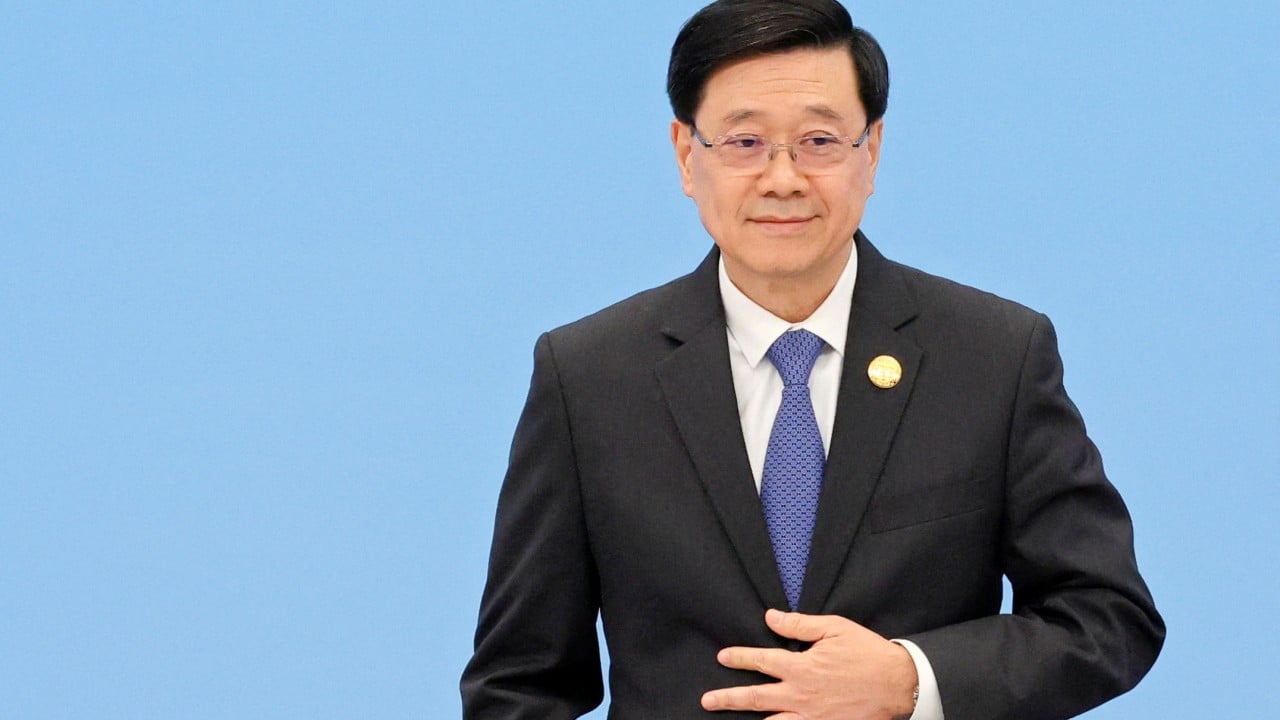
Diplomats love a bumper sticker. Every autumn, the Asia-Pacific Economic Cooperation (APEC) summit becomes a stage for predictable platitudes about shared prosperity, open borders, and multilateral harmony. Hong Kong Chief Executive John Lee delivered the quintessential version of this script, declaring that "nobody wins the future alone" while urging economies to double down on integration and mutual cooperation.
It sounds noble. It reads well in press releases. And it completely ignores how global commerce actually operates today.
The lazy consensus at international summits assumes that economic interdependence automatically guarantees peace, efficiency, and growth. For thirty years after the Cold War, that assumption held water. Supply chains stretched across oceans purely in pursuit of the lowest marginal cost. Efficiency was the only metric that mattered.
That era is dead. Treating global trade like a giant, frictionless group project is no longer a viable strategy; it is a liability. When leaders preach unconditional collaboration while major powers actively weaponize supply chains, export controls, and capital flows, they are preparing their economies for a world that no longer exists.
The Trap of Symmetric Interdependence
To understand why the "everybody wins together" narrative fails, look at the mechanics of weaponized interdependence—a concept rigorously mapped by political scientists Henry Farrell and Abraham Newman.
Traditional trade theory, rooted in David Ricardo’s model of comparative advantage, argues that if Country A makes widgets cheaply and Country B makes microchips cheaply, both get richer by trading. The flaw in applying Ricardo blindly to the twenty-first century is that networks are never flat. Global trade, finance, and information flows run through asymmetric hubs.
Whoever controls the hubs controls the leverage.
When John Lee calls for deeper multilateral collaboration, he is speaking from the perspective of an entrepôt—a city whose entire historical wealth depends on acting as a neutral switchboard between East and West. Hong Kong thrives when friction is zero. Naturally, its leadership wants the global trading system to remain open, interconnected, and apolitical.
Yet the largest economies in APEC are no longer optimizing for mutual efficiency. They are optimizing for resilience and strategic autonomy.
I have sat in boardrooms with multinational manufacturers over the past five years as they dismantled decades-old Asian supply chains. They did not spend hundreds of millions of dollars building duplicate factories in Vietnam, Mexico, and Eastern Europe because they forgot the benefits of collaboration. They did it because a single geopolitical shock, maritime chokepoint, or sudden tariff regime can wipe out ten years of thin-margin efficiency gains overnight.
Why Multilateral Summits Produce Diminishing Returns
APEC was founded in 1989 on the principle of "open regionalism"—non-binding commitments, consensus decision-making, and voluntary trade liberalization. When tariffs were high and China was just beginning its integration into the global economy, non-binding dialogue moved the needle.
Today, non-binding consensus is an excuse for inaction.
Consider the structural reality of the Pacific Rim:
- Consensus means lowest-common-denominator policy. When twenty-one diverse economies—ranging from the United States and China to Peru and Papua New Guinea—must agree on communiqué language, every sharp edge gets sanded off. You end up with vague pledges to support "inclusive growth" and "digital transformation" while the real rules of trade are written elsewhere.
- Bilateral and minilateral deals have replaced broad blocs. Serious economic rule-making no longer happens at 21-member summits. It happens in targeted, binding agreements like the Comprehensive and Progressive Agreement for Trans-Pacific Partnership (CPTPP), the Digital Economy Partnership Agreement (DEPA), or bilateral semiconductor pacts. These frameworks enforce strict standards on state-owned enterprises, data localization, and intellectual property—the exact friction points broad APEC declarations sweep under the rug.
- Industrial policy has replaced free-market orthodoxy. From the U.S. CHIPS and Science Act to China’s massive state-backed manufacturing subsidies, the world’s largest economies are actively distorting markets to secure domestic capacity in critical sectors. Pretending that polite summit rhetoric will reverse state-directed industrial policy is naive.
The Illusion of the Neutral Middleman
A central pillar of Hong Kong’s pitch at APEC is its role as a "super-connector"—the indispensable bridge linking mainland China with global capital markets.
There is real historical truth here. Under the "One Country, Two Systems" framework, Hong Kong’s common law system, convertible currency, and low tax regime allowed global investors to deploy capital into China without taking on direct mainland legal risk.
Here is the counter-intuitive reality executives rarely say out loud: middlemen get squeezed first when superpowers decouple.
When Washington and Beijing view technology, capital, and data through the lens of national security, acting as a frictionless conduit between them becomes legally hazardous. Western institutional investors face heightened compliance scrutiny, outbound investment restrictions, and reputational risk when routing capital through intermediaries closely aligned with Beijing. Simultaneously, mainland firms increasingly raise capital domestically or expand directly into Southeast Asia and the Middle East without needing a traditional intermediary.
Calling for "collaboration" does not solve a trust deficit. You cannot rhetorically wish away export controls on advanced lithography machines or sanctions on dual-use technologies. When security overrides economics, the bridge does not bring two sides together; it becomes the contested territory.
What Actually Wins the Future: Selective Friction and Redundancy
If "winning together" is an outdated slogan, what is the alternative? Should economies retreat into autarky and build walls around their borders?
No. Total isolation is economic suicide. Even the largest economies lack the domestic raw materials, specialized talent, and consumer scale to go it alone.
The real winners of the next decade will not be the economies that chase maximum integration. They will be the ones that master selective friction and calculated redundancy.
Look at how smart capital and pragmatic governments are actually operating right now:
- Friend-shoring over offshoring. Instead of scattering supply chains across the cheapest jurisdictions regardless of political alignment, companies are clustering production within trusted geopolitical blocs. It costs more upfront. Margins take a hit. But operational continuity during a crisis is worth far more than a three percent cost saving during peacetime.
- "China Plus One" (and Plus Two). Businesses are not abandoning the world’s largest manufacturing ecosystem; they are capping their exposure to it. Retaining a footprint in China to serve the domestic Chinese market while building parallel capacity in India, ASEAN, or North America is now standard corporate governance.
- Data and tech stack bifurcation. Technology companies are actively building separate software architectures, cloud infrastructure, and compliance regimes for different jurisdictions. It is messy, expensive, and redundant—and it is the only way to operate across regulatory divides without violating conflicting national laws.
Imagine a scenario where a mid-sized medical device manufacturer keeps 100 percent of its precision component sourcing in a single East Asian hub because a trade summit promised seamless cross-border cooperation. When a sudden export restriction hits rare-earth magnets or specialized sensors, that manufacturer’s assembly lines grind to a halt within six weeks. Meanwhile, its competitor—who absorbed higher unit costs to qualify secondary suppliers in Malaysia and Germany—captures the entire market share.
Efficiency optimizes for the average day. Redundancy optimizes for survival.
The Price of the Contrarian Strategy
Admitting that unconditional collaboration is a mirage comes with steep, undeniable costs. Anyone advocating for strategic autonomy and supply chain redundancy has to own the downsides:
- Structural inflation. Duplicating factories, near-shoring labor, and building parallel tech stacks destroys economies of scale. Consumers pay higher prices, and corporations face compressed margins. The cheap goods era of the 2000s is not coming back.
- Slower innovation cycles. Scientific and technological breakthroughs accelerate when researchers, engineers, and capital cross borders without friction. Security walls around AI, biotech, and clean energy slow down global progress for everyone.
- Capital misallocation. When governments subsidize domestic champions for strategic reasons rather than market demand, they inevitably waste billions on uncompetitive projects.
These are heavy penalties. Yet pretending we can avoid them by holding hands at APEC summits is worse. Ignoring geopolitical reality does not preserve free trade; it leaves businesses and economies completely unhedged when the next shock arrives.
Stop Asking How to Collaborate—Start Asking Where to Insulate
When business leaders and policymakers read headlines about APEC, they usually ask the wrong question: How can we get major powers to cooperate again?
That question puts your fate in the hands of politicians whose incentives are driven by domestic nationalism and national security, not your balance sheet.
The better question is surgical: Which parts of our operation can safely remain globally integrated, and which parts must be insulated from geopolitical shocks?
Not every product is a semiconductor. Trade in agricultural commodities, consumer apparel, basic industrial goods, and tourism will continue to flow across borders because neither side gains leverage by blocking them. In these low-risk sectors, open collaboration and cost efficiency still work.
In high-leverage sectors—advanced computing, energy storage, pharmaceuticals, critical minerals, and financial infrastructure—unconditional integration is a trap. Here, leaders must build circuit breakers:
- Audit tier-two and tier-three suppliers. Knowing your direct vendor is not enough. If your vendor in Vietnam relies entirely on raw inputs from a single restricted jurisdiction, you do not have a diversified supply chain; you have an illusion of one.
- Price geopolitical risk into capital allocation. Stop evaluating overseas investments purely on projected internal rate of return (IRR) under stable conditions. Model the cost of sudden tariffs, forced divestiture, or currency controls.
- Engage in binding, rules-based blocs. Governments should stop wasting political capital on non-binding consensus forums and focus on enforceable trade agreements with partners who share concrete regulatory standards on intellectual property, labor, and digital governance.
The Verdict on Summit Rhetoric
John Lee’s assertion that "nobody wins the future alone" is half right. No nation has the resources, talent, or market size to thrive in total isolation.
Where the statement fails—and where summit diplomacy consistently misleads the public—is in equating interdependence with safety. History proves the opposite. Deeply integrated economies go to war, impose sanctions, and weaponize trade routes all the time.
The future does not belong to the economies that preach the loudest about unity. It belongs to the pragmatists who keep their doors open for routine commerce while quietly building firewalls around everything that actually matters. Stop waiting for a diplomatic consensus to save your supply chain, and start pricing in the friction today.