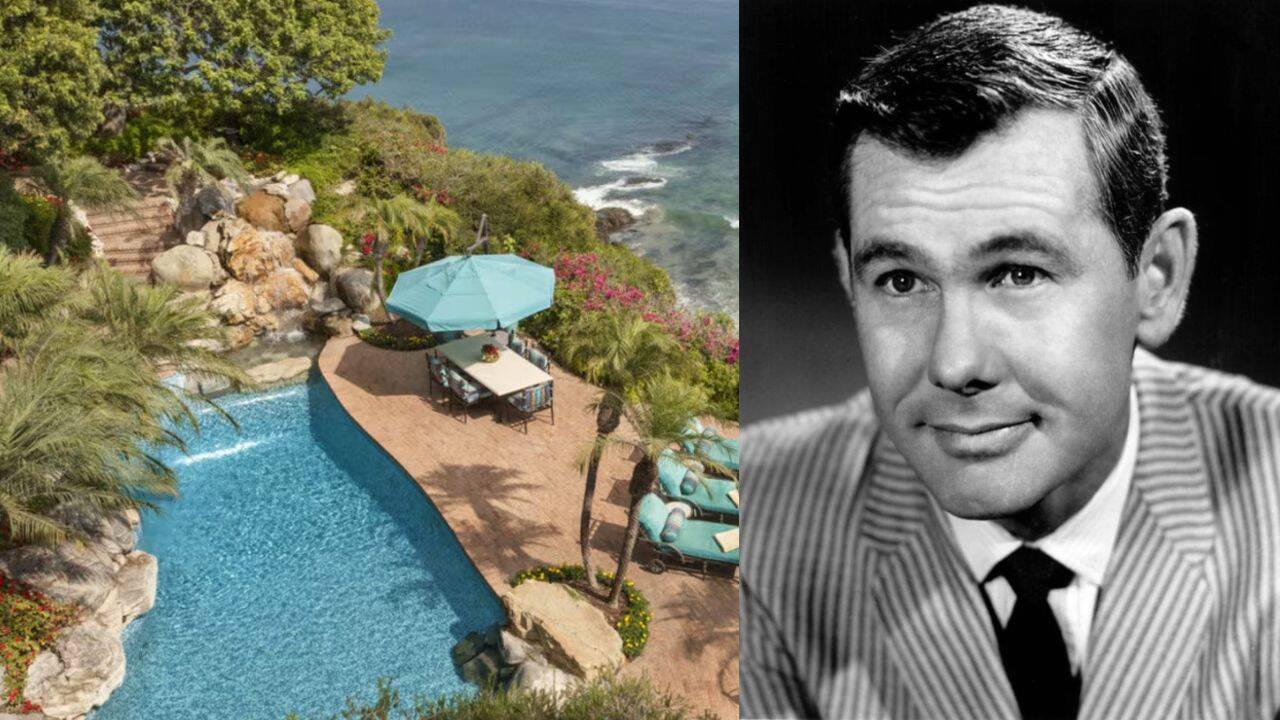
Every financial journalist in America just lost their collective mind over Johnny Carson's old Malibu blufftop compound clearing a staggering $110 million. They call it proof of an unstoppable luxury surge. They call it the ultimate validation of prime coastal real estate. They are lying to you, or worse, they genuinely do not understand how money works at the top of the food chain.
Let us clear the air immediately. That nine-figure price tag has nothing to do with the architectural genius of Cliff May, the sound of the Pacific crashing against Point Dume, or the historical ghost of late-night television. It is a symptom of systemic monetary rot. When an asset jumps like that in an environment where commercial real estate is bleeding out and regional banks are sweating bad loans, you are not looking at a triumph of capitalism. You are looking at a lifeboat.
For years, the financial media has spun a lazy, seductive fairy tale about ultra-prime residential property. The script goes like this: billionaires multiply, land on the ocean is finite, and therefore prices only move in one direction—straight up, forever, driven by the pure, unadulterated passion of the ultra-wealthy for trophy homes.
It is absolute garbage.
If you peel back the glossy veneer of the $110 million transaction, you find a very different reality. You find a market driven not by lifestyle aspirations, but by capital flight, currency devaluation fears, and a desperate race to find any tangible asset that cannot be easily frozen, taxed, or inflated away by central bank policies.
The Liquidity Illusion
To understand why Carson's former estate commands a price that defies basic economic gravity, you have to stop thinking like a homebuyer and start thinking like a distressed sovereign fund manager.
Normal real estate is priced on utility, rental yield, and local median income comparisons. Ultra-prime coastal property operates in an alternate dimension where none of those metrics matter. A house that costs $110 million does not generate a return through rent. Even if you leased the compound out at $200,000 a month—an astronomical sum for normal mortals—the yield wouldn't cover the property taxes, insurance premiums, and basic maintenance of maintaining four acres on a eroding coastal cliff.
So why pay nine figures for it? Because for the buyer, this is not an investment in cash flow. It is a store of value. It is a giant, concrete-and-glass safety deposit box.
When global capital markets grow volatile, institutional debt tightens, and regulatory nooses around offshore accounts start to choke, billionaires need places to park massive pools of money where governments cannot easily slap a wealth tax on them or watch them evaporate in a market correction. Real estate in marquee zip codes functions as a decentralized asset class for wealth preservation.
The $110 million price tag is not a sign of organic demand. It is a price discovered in a vacuum of alternative safe havens. When cash is losing purchasing power, you trade it for physical dirt, no matter how absurd the sticker price looks on paper. The media calls this a "surge." Anyone with a basic grasp of macroeconomics calls it monetary inflation manifesting in coastal masonry.
The Zoning Cartel and Manufactured Scarcity
The lazy consensus loves to parrot the old adage: they aren't making any more land.
True. But they are also actively preventing anyone from building anything new, and that is where the real scam lies. Malibu is not expensive because nature made it scarce; it is expensive because local zoning laws, coastal commission regulations, and hyper-litigious neighborhood associations have built an impenetrable moat around the entire coastline.
Try building a modern compound on Point Dume today. You will spend a decade fighting environmental impact reports, battling public access advocates, and navigating a bureaucratic maze designed to drain the will of anyone who isn't a multi-billionaire or a seasoned developer with an army of lawyers.
This artificial restriction of supply creates a closed-loop economy. The existing stock of architectural masterpieces becomes a protected cartel. When an estate like Carson's trades at a record-shattering price, it resets the baseline for every other property owner on the ridge. It is a managed market disguised as a free one.
The brokers love this. Every time a record breaks, they use it as ammunition to convince the next seller that their mid-century tear-down is worth fifty million dollars. It is a self-fulfilling prophecy fueled by press releases and ego-driven marketing campaigns.
The California Insurance and Climate Time Bomb
Here is the part of the luxury real estate narrative that the industry PR machine will never, ever mention in print: the entire Malibu coastline is sitting on an ecological and financial powder keg.
While billionaires are shelling out nine figures for blufftop estates, insurance carriers are actively fleeing the state of California. Wildfire risks, mudslides, and relentless coastal erosion are making traditional property insurance either entirely unavailable or financially ruinous.
Imagine buying a $110 million home only to find that major international insurance syndicates refuse to write a policy on it, or the annual premium costs more than a commercial airliner. While ultra-high-net-worth individuals can self-insure—absorbing millions in losses out of pocket—the sheer existence of this risk destroys the fundamental liquidity of the asset.
An asset that cannot be insured at scale is not a stable store of value; it is a high-stakes gamble against nature and municipal policy. The cliffside erosion along the Pacific Coast Highway is not slowing down. Sea levels are rising, and no amount of architectural genius can stop the relentless physics of coastal geology.
Yet, the headline-chasing media reports the sale as a triumph without asking a single question about the long-term viability of insuring a massive coastal compound against climate volatility. They want you to see the glamour. They refuse to show you the cracks in the foundation.
The Broker Industrial Complex
We need to talk about the people orchestrating these deals, because the luxury real estate brokerage business is one of the most brilliant marketing operations in modern capitalism.
In standard industries, price discovery is transparent, liquid, and governed by public market mechanics. In ultra-prime real estate, price discovery is a theatrical performance. Transactions are shrouded in LLCs, trust structures, and non-disclosure agreements. You never truly know if a sale at $110 million was an arm's-length transaction between independent parties, or a carefully orchestrated financial arrangement designed to prop up collateral values for a portfolio of leveraged loans.
Real estate agents in this tier do not sell houses. They sell status, access, and narrative. They convince insecure fortunes that owning a specific patch of dirt grants them membership into an exclusive club of cultural titans. They turn a pile of lumber, glass, and Malibu dirt into a wearable status symbol, exactly like a luxury watch or a mega-yacht.
And the commissions? On a $110 million transaction, the standard commission structure translates into a payday that could fund a small tech startup. Is it any wonder why every major brokerage firm treats a record-breaking sale as a holy holiday? They have a vested financial interest in convincing the world that prices only go up, that every market dip is a buying opportunity, and that real estate is the only game in town.
The Reality of Trophy Assets
If you are an everyday investor or an aspiring homeowner looking at these headlines and thinking you need to chase high-end real estate trends, wake up. You are playing a different sport with entirely different rules.
Trophy real estate is an ego play for the global elite. It is a tax strategy, a capital flight mechanism, and a vanity project wrapped into one. It has zero connection to the fundamentals that drive normal housing markets. When a tech entrepreneur or foreign magnate drops nine figures on a Malibu compound, they are not buying a home. They are buying an exit strategy from fiat currency devaluation.
If you evaluate these transactions through the lens of traditional investment theory, they make zero sense. The carrying costs are astronomical, the liquidity is virtually non-existent during a credit crunch, and the regulatory and environmental headwinds in California are worsening by the year.
Stop treating these billionaire toys as indicators of healthy economic growth. They are symptoms of a financial system flooded with liquidity looking for any permanent parking spot before the music stops.
The next time you read about a record-shattering sale on the California coast, remember what you are actually looking at. It is not a surge of prosperity. It is a monument to monetary anxiety, built on a crumbling cliff, orchestrated by brokers who need you to believe the fairy tale so they can collect their next multi-million-dollar check.
Ignore the hype. Look at the balance sheet. And stop confusing a financial lifeboat for a winning investment.