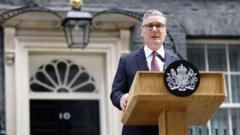
Winning a landslide victory in British politics apparently guarantees you about two years of survival before your own party devours you. Keir Starmer found that out the hard way outside 10 Downing Street on Monday morning. Less than two years after crushing the Conservatives, Starmer stood at the podium, voice cracking with emotion, to announce his resignation as leader of the Labour Party.
The immediate trigger wasn't an economic collapse or a sudden scandal, though a stagnant economy and poor local election results laid the groundwork. It was cold, hard math. Over the weekend, more than half a dozen cabinet ministers privately told him his time was up. When former Manchester Mayor Andy Burnham won the Makerfield by-election on Friday, securing a route back into parliament, the game was over. The parliamentary party had its alternative, and Starmer knew it.
The Speech and the Brutal Reality of the Execution
Starmer did not go quietly into the night without defending his record. He spent a significant chunk of his speech listing what he viewed as his core achievements since 2024. He pointed to falling small boat crossings, faster wage growth relative to inflation, and lifting half a million children out of poverty. He explicitly reminded the public of the state he found the Labour Party in six years ago when he took over from Jeremy Corbyn, calling it "politically, financially and morally bankrupt."
But the core of his statement came down to a simple admission of internal defeat.
"The question my party is asking now is whether I am best placed to lead us into the next general election," Starmer said. "I have heard the answer of my parliamentary party to that question, and I accept that answer with good grace."
He confirmed he spoke to King Charles III on Monday morning to inform him of the decision. Starmer will remain in post as Prime Minister through the summer until a successor is chosen, meaning he will still represent the UK at the upcoming NATO summit in July.
The Timetable for a New Prime Minister
The process to replace Starmer will move fast. The outgoing prime minister is asking Labour’s National Executive Committee to open nominations on July 9, 2026. The goal is to wrap up the contest before the summer recess, ensuring a new leader is inside Downing Street before parliament returns in September.
If the party unites behind a single candidate, Britain could have its seventh prime minister in ten years as early as July 16 or 17.
Why the Labour Landslide Dissolved So Quickly
How does a leader go from a historic majority to a forced exit in under 24 months? Starmer’s approval rating hit a dismal minus 46 before his announcement. The fundamental problem was that the 2024 election victory was less an endorsement of Starmerism and more a total rejection of 15 years of Conservative rule. Voters projected their desire for change onto a blank canvas, and the reality of governing quickly disappointed them.
Starmer faced constant pressure from both sides of the political spectrum. On one flank, Nigel Farage’s Reform UK kept gaining momentum, weaponizing immigration and the sluggish economy to terrify northern Labour MPs. On the other flank, internal critics viewed Starmer as an uninspiring communicator who repeatedly dropped his own policy commitments when things got tough. When Anas Sarwar, the Scottish Labour leader, called for him to quit back in February, the cracks became impossible to hide.
The Rapid Shift to Andy Burnham
The political landscape changed completely within minutes of Starmer leaving the podium. Andy Burnham immediately confirmed he will run for the leadership, promising a "positive process of renewal."
The real shock came from former Health Secretary Wes Streeting. Streeting had spent weeks gathering the 81 signatures needed from Labour MPs to launch his own challenge. Instead of fighting Burnham, Streeting pulled out and threw his full weight behind the former Manchester mayor. Streeting argued that a long, divisive summer of infighting would only help nationalist forces. By backing Burnham, Streeting effectively ended the contest before it officially started, paving a smooth path for the man often nicknamed the "King of the North."
Next Steps for the Transition
Watching Westminster over the coming weeks requires focusing on policy shifts rather than just the personalities. Burnham represents a distinct shift away from Starmer's cautious, managerial centrist style toward a more populist, regional approach to economic growth.
To track how this transition impacts British policy, keep an eye on these specific indicators:
- Look for early policy manifestos from Burnham regarding regional wealth distribution and progressive capitalism.
- Watch the Labour National Executive Committee meeting on July 9 to see if any late challenger tries to force a ballot.
- Monitor the value of the British pound and market reactions during the NATO summit in July, which serves as Starmer's final international appearance.