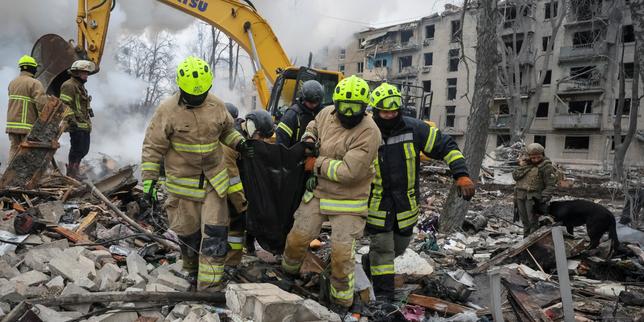
The smoke rising from the Kharkiv printing house is more than a local tragedy. It is a calculated message. Seven civilians are dead and at least 15 are wounded because a Russian S-300 missile battery, positioned just across the border, operated with the impunity of a protected asset. This strike on the Factor-Druk printing house—one of the largest book-binding facilities in Europe—highlights a brutal reality. Ukraine is fighting with one hand tied behind its back while its second-largest city becomes a laboratory for a new kind of urban erasure.
The numbers provide the grim immediate context, but the geography explains the slaughter. Kharkiv sits roughly 30 kilometers from the Russian border. At that distance, an S-300 missile, originally designed for air defense but repurposed by Moscow for blunt-force ground terror, has a flight time of less than a minute. Residents have no time to reach shelters. The sirens often start after the explosion.
The Geography of Attrition
Russia's current strategy in the northeast is not necessarily a grand conquest of territory. It is about the creation of a "gray zone" where civilian life becomes untenable. By hitting a printing house, the Kremlin targets the cultural infrastructure of Ukraine. This was not a military objective. It was a site where schoolbooks and novels were produced.
The strike follows a pattern of systematic pressure. For weeks, the energy grid in the region has been hammered. Subsurface power stations and distribution hubs are being picked apart by "double-tap" strikes—hitting a target, waiting for first responders to arrive, and then hitting it again. It is a primitive, effective method of draining a city's will.
The Sanctuary Across the Border
The most frustrating element for Ukrainian commanders is not a lack of courage, but a lack of permission. The Russian batteries firing on Kharkiv are often parked in the Belgorod region. For months, Western allies, particularly the United States and Germany, have maintained a strict prohibition on using donated long-range weapons to strike targets inside Russian territory.
This creates a sanctuary for Russian artillery and missile launchers. They can roll out of a forest, fire a salvo at a Ukrainian supermarket or apartment block, and roll back into cover, knowing that an ATACMS or a Storm Shadow missile won't be coming their way.
Military analysts on the ground describe it as an "asymmetric cage." While Ukraine can use its own domestically produced drones to strike Russian oil refineries hundreds of miles away, those drones lack the kinetic punch and speed to take out mobile missile launchers in real-time. The heavy lifting requires Western precision, which remains locked behind a wall of diplomatic caution.
The Logistics of Terror
The S-300 is an aging system, but in the hands of a regime with deep stockpiles, it is a weapon of mass exhaustion. Because these missiles are technically interceptors, they carry a heavy fragmentation warhead designed to shred aircraft. When they hit a building, they don't just collapse walls; they turn the environment into a storm of high-velocity shrapnel.
Hard Targets and Soft Lives
- Factor-Druk Facility: The destruction of this plant wipes out a significant percentage of Ukraine's printing capacity, impacting the educational system for years to come.
- The Energy Deficit: Continuous strikes on the Kharkiv power grid have forced rolling blackouts, making it impossible for hospitals to operate without constant generator support.
- The Evacuation Pressure: By making the city unlivable, Russia forces a mass migration toward the west, straining the resources of cities like Lviv and Kyiv.
This is a war of logistics disguised as a war of maneuvers. If you can force a million people to move, you win a victory without ever having to march a tank through the city center.
The Failure of Air Defense Saturation
There is a common misconception that more Patriot batteries will solve the Kharkiv problem. While the Patriot is a world-class system, using a $4 million interceptor to stop a cheap, repurposed S-300 missile is a losing game of math. Furthermore, the proximity of the border means the radar "horizon" is extremely tight.
To truly protect Kharkiv, the solution is not more shields, but the ability to break the sword. This requires a shift in the rules of engagement that many in NATO have been slow to embrace. The argument for "de-escalation" through restriction is looking increasingly hollow to the families searching for bodies in the rubble of a printing press.
A City of Resilient Ghosts
Despite the daily bombardment, Kharkiv refuses to empty. The "Hero City" status is earned every morning when workers go out to sweep the glass from the sidewalks and repair the trolley lines. But resilience is a finite resource.
The strike that killed seven workers this week was not a fluke or a "miss." It was a demonstration of what happens when a frontline city is treated as a secondary concern in the halls of global power. The Russian military has realized that as long as they stay behind their own border, they can treat Kharkiv as a firing range.
If the goal of Western support is truly to ensure Ukrainian survival, the policy of geographic restriction must be weighed against the mounting body count in the northeast. You cannot win a fight if you are legally barred from swinging back.
The employees at Factor-Druk weren't soldiers. They were people making books. Their deaths are the direct result of a strategic gap that Moscow is now exploiting with surgical cruelty. Until that gap is closed, the sirens in Kharkiv will continue to be a post-script to the explosions.
Demand a reassessment of the "red lines" that only seem to apply to the side being invaded.