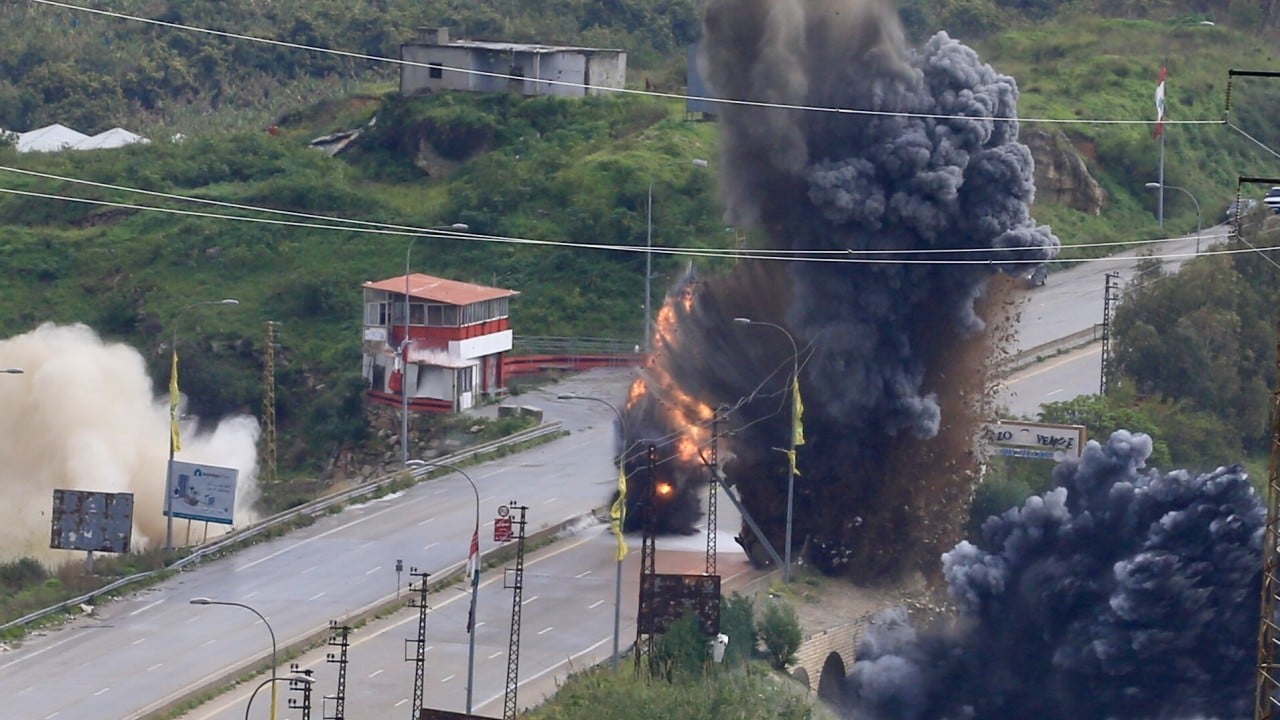
Israel’s current military campaign in Lebanon functions as a high-velocity attrition mechanism designed to decouple Hezbollah’s operational capacity from its political intent. While conventional reporting focuses on individual strike counts and immediate casualties, the strategic objective is the systematic liquidation of the "Firewall of Deterrence" that Iran has constructed over four decades. This is not a reactive skirmish; it is a clinical restructuring of the regional security architecture through the targeted destruction of logistics, command hierarchies, and launch infrastructure.
The Triad of Hezbollah’s Defense Architecture
To understand the efficacy of recent strikes, one must first categorize Hezbollah’s assets into three distinct functional layers. The current Israeli Air Force (IAF) operations target the intersection of these layers to induce systemic collapse.
- Hardened Strategic Reservoirs: These include long-range precision-guided munitions (PGMs) and heavy rockets (Zelzal, Fateh-110) stored in deep-mountain tunnels or reinforced subterranean bunkers.
- Tactical Distribution Nodes: The mid-tier infrastructure consisting of local weapon depots, command and control (C2) centers, and intelligence outposts located within civilian urban fabrics.
- The Kinetic Surface: The mobile launch teams (Radwan Force) and short-range rocket arrays (Katyusha/Burkan) that provide the high-volume, low-precision saturation fire used to overwhelm Iron Dome interceptors.
The IAF’s "Fresh Strikes" represent a shift from retaliatory "tit-for-tat" exchanges to a proactive suppression of enemy air defenses (SEAD) and offensive counter-air (OCA) logic. By targeting the Tactical Distribution Nodes, Israel is effectively severing the nervous system that connects the strategic brain (Tehran/Beirut) to the kinetic limbs (the launch teams).
The Mechanics of Escalation Dominance
Israel’s strategy relies on the principle of Escalation Dominance—the ability to increase the stakes of a conflict to a level where the opponent cannot match the intensity or the cost. Hezbollah’s primary constraint is its inability to defend its internal communications and supply lines against superior signals intelligence (SIGINT) and aerial surveillance.
The degradation of Hezbollah’s leadership—facilitated by the penetration of encrypted communication networks—creates a Command Vacuum. When a battalion commander is neutralized, the lateral communication required to coordinate a multi-front rocket barrage breaks down. This forces Hezbollah into decentralized, "blind" firing patterns, which are significantly easier for missile defense systems to track and intercept.
The cost-exchange ratio also favors the aggressor in this specific phase. While an Iron Dome interceptor (Tamir) costs approximately $40,000 to $50,000, the destruction of a multi-million dollar PGM warehouse or a specialized drone assembly plant represents a massive capital loss for the Iranian proxy. The IAF is not just hitting targets; it is depleting a finite, difficult-to-replace inventory during a period of maximum economic pressure on the Iranian patron.
Logistical Strangulation and the Syrian Conduit
The strikes in Lebanon cannot be analyzed in isolation from the concurrent operations in Syria. The "Land Bridge" extending from Tehran through Baghdad and Damascus to Beirut is the lifeblood of Hezbollah’s long-term endurance.
- The Al-Bukamal Bottleneck: Israel frequently targets the border crossing between Iraq and Syria to intercept shipments of PGM kits and drone components.
- The Damascus Hub: Storage facilities at Mezzeh Airbase and other military sites serve as the "Inland Port" for Iranian equipment before it is transferred to the Bekaa Valley.
- The Lebanese Ridge Lines: Once cargo enters Lebanon, it is dispersed. Recent strikes have focused on the Al-Hermel and Bekaa regions to catch these shipments during the "Transition Phase"—the moment when they are most vulnerable and least protected by heavy anti-air assets.
The Geography of Attrition: Why South Lebanon is the Friction Point
The Litani River serves as the critical psychological and tactical boundary. Under UN Resolution 1701, Hezbollah is prohibited from maintaining a military presence south of this line. However, the reality of the last decade has been the "Fortress Village" model—the integration of anti-tank guided missile (ATGM) nests and rocket launchers into residential structures.
The current strikes utilize a Pre-emptive Neutralization Logic. Instead of waiting for a launch to occur, the IAF uses high-resolution thermal imaging and acoustic sensors to identify "active" houses—homes where walls have been modified to allow for hidden rocket rails. By striking these locations, Israel is effectively "clearing the board" of short-range threats that could support a ground incursion or provide cover for a larger strategic strike.
The Paradox of Precision and Civil Displacement
A critical friction point in this strategy is the displacement of the civilian population. As the IAF moves from high-altitude strategic bombing to "close-in" tactical strikes in dense areas, the risk of collateral damage increases. However, from a cold military perspective, the resulting mass displacement of the Shia population from South Lebanon creates a Political Leverage Variable.
Hezbollah’s legitimacy is tied to its ability to protect its constituency. If it can neither prevent the strikes nor provide security for its base, the social contract begins to fray. This internal pressure acts as a secondary front, forcing the organization to divert resources from military operations to civil management and emergency response.
Calculating the Threshold of Full-Scale War
There is a measurable threshold where "Fresh Strikes" transition into "Total War." This threshold is defined by the Deployment of Strategic Depth. If Hezbollah utilizes its heavy, long-range PGMs against Tel Aviv or Haifa’s petrochemical infrastructure, Israel will likely move to the "Dahiya Doctrine" 2.0—the total destruction of Lebanese state infrastructure (power grids, ports, airports) to hold the Lebanese government accountable for Hezbollah’s actions.
Current data suggests both parties are operating within a "High-Tension Equilibrium." Israel is testing the limits of how much infrastructure it can destroy without triggering a regional conflagration, while Hezbollah is testing how many losses it can absorb before its deterrent capability becomes a historical footnote.
Strategic Recommendations for Post-Strike Stabilization
The kinetic destruction of targets is only 40% of the required effort; the remaining 60% must be the diplomatic and economic isolation of the supply chain.
- Interdiction of Dual-Use Components: International monitoring must focus on the smuggling of civilian electronics (GPS chips, high-end sensors) that are repurposed into PGM kits.
- Infrastructure Decoupling: Lebanon’s state institutions must be incentivized to decouple their logistics (electricity and fuel) from Hezbollah-controlled networks to prevent total state collapse during further escalation.
- Intelligence Synchronization: Western allies must synchronize maritime surveillance in the Mediterranean to block the "Sea Route" (Latakia to Beirut), which serves as the primary alternative when the Land Bridge is under heavy fire.
The current campaign is not a temporary flare-up but a systematic dismantling of a decades-old investment. The success of these strikes will be measured not by the number of rockets fired, but by the permanent reduction in Hezbollah's ability to regenerate its specialized technical corps and its high-end munitions inventory.