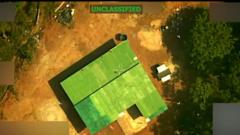
The utilization of a U.S. Southern Command kinetic strike to eliminate Héctor Rusthenford Guerrero Flores (known as "Niño Guerrero") in Bolívar State, Venezuela, represents a structural shift in foreign policy and transnational counter-gang operations. By treating a transnational criminal organization (TCO) as an active combatant in an asymmetric conflict, the operation applies a decapitation strategy typically reserved for ideological terrorist networks. This intervention, executed through strategic coordination with Venezuelan security forces, tests the operational theory that neutralizing leadership can dismantle a decentralized network.
An analytical assessment reveals the systemic vulnerabilities of the Tren de Aragua (TdA) infrastructure, the mechanical framework of the strike, and the structural risks of organization fragmentation.
The Transnational Network Framework
Evaluating the impact of the operation requires defining the structural architecture of Tren de Aragua. Unlike traditional hierarchical cartels characterized by rigid, top-down command chains, TdA operates as a franchise-based, decentralized conglomerate.
[Core Leadership Unit (Guerrero Flores)]
          │
          ├──> Plaza Franchise A (Extortion / Human Trafficking)
          │
          ├──> Plaza Franchise B (Cocaine Supply / Maritime Logistics)
          │
          └──> Plaza Franchise C (Retail Distribution / Urban Crime hubs)
The organization's operational model relies on three structural mechanisms:
- The Hub-and-Spoke Model: A central leadership cell, historically operating from Tocorón Prison, coordinates macro-logistics, major financial laundering, and strategic alliances, while regional "plazas" retain high autonomy over localized revenue generation.
- The Migrant Stream Exploitation Variable: TdA systematically scaled its operations by embedding its extortion, human trafficking, and narcotics networks directly into regional migration corridors across South, Central, and North America.
- Arbitrage of State Collapse: The network leveraged the institutional degradation of the Venezuelan state to secure physical safe havens, capitalizing on corrupt prison systems to establish operational command centers.
Guerrero Flores functioned as the primary arbitrator and institutional anchor of this network. His indictment in a New York federal court for racketeering conspiracy and providing material support to terrorists highlighted his role in bridging local criminal operations with international networks. The $5 million State Department bounty underscored his position as the central node holding these disparate franchises together.
Operational Mechanics of the Kinetic Strike
The execution of the strike in Bolívar State reveals an unprecedented level of tactical and diplomatic alignment between Washington and Caracas following the removal of Nicolás Maduro earlier this year. The mechanics of the operation can be broken down into three phases:
Intelligence Synchronization
The identification of Guerrero Flores' location inside a fortified compound required an optimization of signals intelligence (SIGINT) and human intelligence (HUMINT). Tracking an asset who had eluded capture since escaping Tocorón Prison in September 2023 involved mapping financial footprints and tracking key associates within the Americas Counter Cartel Coalition (A3C) framework.
Bilateral Coordination
The U.S. Southern Command strike was executed as a "combined operation" alongside Venezuelan security services. This operational alignment indicates a major shift in hemispheric security policy, where the post-Maduro transitional framework allows direct U.S. military power projection inside Venezuelan territory to neutralize mutual security threats.
Precision Neutralization
The strike utilized a localized, low-collateral kinetic delivery mechanism—evidenced by declassified footage showing the targeted destruction of a single structure. This specific deployment indicates highly accurate targeting meant to minimize regional blowback while ensuring complete structural destruction.
The Network Fragmentation Hypothesis
The strategic objective of leadership decapitation is to induce systemic failure across the target organization. However, the structural characteristics of TdA introduce variables that may complicate a straightforward degradation process.
The Power Vacuum and Horizontal Violence
When the central node of a decentralized network is removed, the immediate systemic response is localized instability. In a rigid cartel, a clear line of succession exists. In a franchise model like TdA, the elimination of the central arbitrator removes the primary mechanism for resolving territory disputes among regional plazas. The short-term result is highly likely to be horizontal violence as competing sub-leaders attempt to consolidate authority over lucrative trafficking routes.
The Degradation of Financial Synergy
Guerrero Flores managed the macro-alliances that allowed local street-level cells to access transnational supply chains, including maritime cocaine distribution networks in the Caribbean and Eastern Pacific. Striking the leadership cell creates an immediate operational bottleneck. While local extortion and human trafficking operations in individual cities will continue functioning due to their low-barrier reliance on local infrastructure, their capacity to execute large-scale, capital-intensive transnational operations is severely diminished.
Operational Risk Profile and Systemic Limitations
While the strike demonstrates significant tactical capability, a comprehensive analysis requires identifying the structural limitations inherent in military decapitation strategies against criminal networks.
- The Hydra Effect: Striking the leadership node does not erase the underlying economic drivers of the illicit enterprise. The demand functions for narcotics, human smuggling, and illicit retail markets remain unchanged. New actors or breakaway factions will naturally move to fill the supply deficit.
- Dispersal and Deepening of Local Footprints: Deprived of a central command structure in Venezuela, regional factions operating abroad—including cells established within the United States—may sever ties with the home country entirely. This creates highly insulated, autonomous local gangs that are harder to track via international intelligence frameworks.
- Diplomatic Over-Reliance: The success of this specific operation was heavily contingent on the willingness of Venezuelan authorities to open their airspace and provide ground-level intelligence synchronization. This operational model cannot be easily replicated in regions where state actors are actively hostile or thoroughly compromised by criminal networks.
Strategic Reconfiguration of Regional Security
The implementation of the wartime Alien Enemies Act of 1798 against TdA, combined with ongoing maritime blockades that have neutralized over 200 individuals on smuggling vessels, establishes a firm precedent. Transnational gangs are no longer viewed through a standard domestic law enforcement lens; they are treated as hostile, non-state military actors.
To prevent the decentralized fragments of Tren de Aragua from morphing into hyper-violent autonomous entities, security frameworks must shift focus from leadership targeting to asset and logistics isolation. This requires the Americas Counter Cartel Coalition to execute simultaneous financial freezes on regional franchise nodes while systematically targeting the mid-tier operational commanders who manage local distribution networks. Decapitation is an effective tool to disrupt coordination, but permanent containment requires the systematic erosion of the network's local cash flows.