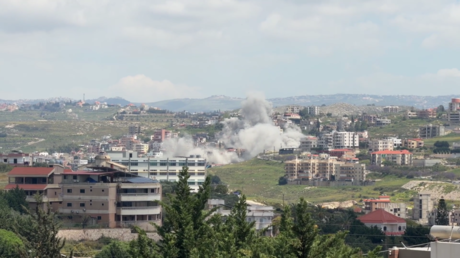
The persistence of kinetic strikes during a negotiated cessation of hostilities reveals a fundamental breakdown in the chain of command or, more likely, a calculated exploitation of "gray zone" ambiguities. When a state actor executes an airstrike against a non-state actor during a U.S.-mediated truce, it signifies that the tactical objectives outweigh the diplomatic risks of non-compliance. This friction suggests that the truce is not a binary state of "war" or "peace," but a dynamic equilibrium where both parties test the threshold of international tolerance.
The Triad of Tactical Justification
Three distinct operational requirements drive the continuation of strikes despite a formal agreement to pause.
- Immediate Threat Neutralization: The most common justification involves the "imminent threat" doctrine. If an adversary is observed positioning long-range assets or preparing an offensive maneuver, the defending state prioritizes immediate risk mitigation over diplomatic optics.
- Infrastructure Degradation Prior to Withdrawal: Truces often include a timeline for withdrawal. A military force may use the final hours or the early stages of a truce to destroy remaining hardpoints or logistical hubs that were previously out of reach, ensuring the adversary cannot re-occupy the territory with the same level of lethality.
- The Sovereignty Paradox: A state may continue strikes to signal that its security operations are not dictated by foreign mediators. This maintains domestic political capital and warns the adversary that the truce is a choice, not a constraint.
The Mechanism of Mediation Failure
A U.S.-mediated truce often fails at the margins because of the "Incentive-Constraint Gap." The mediator provides incentives (economic aid, diplomatic recognition) and constraints (threat of sanctions, loss of military support). However, these levers are often macro-economic or long-term, whereas the military necessity is micro-tactical and immediate.
When a strike occurs, it highlights a failure in the Verification Mechanism. Without a third-party observer on the ground with the authority to adjudicate "who fired first," both sides can claim defensive action. This creates a feedback loop:
- Party A observes a perceived violation (real or manufactured).
- Party A launches a "retaliatory" strike.
- Party B views this as an unprovoked breach of the truce.
- The mediator, lacking real-time data, is forced into a cycle of "calls for restraint" that carry no tactical weight.
Quantifying the Cost of Non-Compliance
The decision to strike during a truce is a cost-benefit calculation. The "Cost of Violation" includes:
- Diplomatic Degradation: The erosion of trust with the mediator, in this case, the United States. This can lead to a slowing of intelligence sharing or the delayed delivery of precision-guided munitions.
- Escalation Risk: The probability that a single strike triggers a full-scale return to high-intensity conflict.
- Media Asymmetry: Non-state actors often have a more agile narrative-generation machine. Every strike during a truce is framed as a war crime, regardless of the target's military value, shifting international public opinion.
The "Benefit of Action" is usually the destruction of a high-value target (HVT) or a strategic weapon system. If the HVT is deemed a "strategic pivot point"—meaning its removal significantly alters the adversary's long-term capability—the state will accept the diplomatic cost.
The Buffer Zone Fallacy
Most truces rely on the concept of a buffer zone or a "Blue Line" style demarcation. The logic is that physical distance reduces the chance of accidental engagement. This framework is increasingly obsolete in the era of stand-off munitions and drone warfare. A truce that defines "hostilities" only as ground incursions ignores the reality of modern kinetic operations. If an aircraft can strike from 50 kilometers away, the buffer zone is a psychological construct rather than a physical security measure.
This leads to a "Definition Conflict." The state may define "hostilities" as offensive ground movements, while the non-state actor defines it as any kinetic event. This misalignment ensures that the truce is broken the moment it is signed because the parties are operating under different sets of definitions.
Strategic Recommendation for Escalation Management
To move beyond the cycle of fragile truces, mediators and participants must shift from a "Time-Based Pause" to a "Trigger-Based De-escalation."
The first step is the establishment of a Joint Verification Cell (JVC) that utilizes real-time satellite imagery and signal intelligence (SIGINT) to confirm the nature of a threat before a strike is launched. If a strike is deemed necessary, the JVC must be notified of the "Defensive Intent" within a predetermined window.
The second requirement is the implementation of Incremental Penalties. Instead of the "all or nothing" approach where a single strike ends the truce, the mediator should apply tiered diplomatic or financial consequences. This creates a "sliding scale" of escalation that allows for minor tactical friction without collapsing the entire regional security framework.
Future negotiations must account for the fact that a truce is a tool for regrouping as much as it is a path to peace. Without a mechanism to address the tactical incentives for "truce-breaking strikes," the theater will remain in a state of permanent volatility, where the only certainty is the eventual failure of the current agreement.