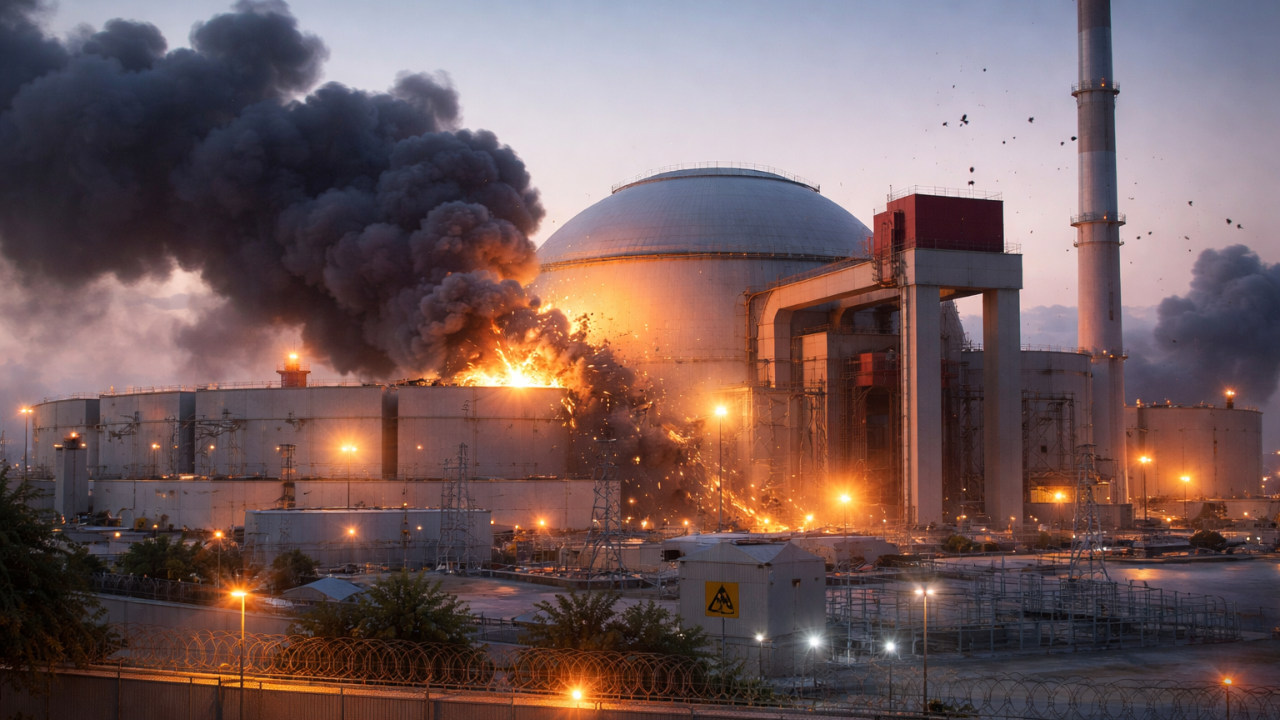
The physical proximity of a kinetic strike to a light-water reactor is not merely a geographic measurement; it is a direct stress test of the global nuclear non-proliferation architecture and the specific containment engineering of the VVER-1000 design. When a projectile detonates 350 meters from a critical facility like the Bushehr Nuclear Power Plant, the technical assessment must shift from "near-miss" rhetoric to a quantified evaluation of seismic coupling, fragmentation patterns, and the degradation of external support systems. The 350-meter offset represents a breach of the psychological exclusion zone while remaining—by a narrow margin—outside the immediate thermal and overpressure radius required to compromise a double-walled containment structure.
The Triple Convergence of Nuclear Risk
To analyze the implications of a strike at this distance, the event must be deconstructed through three distinct analytical layers: structural integrity, operational continuity, and the escalation ladder of the International Atomic Energy Agency (IAEA) Safeguards.
1. The Structural Limit State
The Bushehr reactor utilizes a reinforced concrete containment vessel designed to withstand specific Design Basis Accidents (DBA). At a 350-meter distance, the primary threat to the reactor core is not the direct impact of the projectile but the Ground-Induced Shock (GIS).
The peak ground acceleration (PGA) generated by a conventional high-explosive payload at this distance is generally insufficient to crack a 1.2-meter thick reinforced concrete shell. However, the internal components—specifically the coolant pumps and the control rod drive mechanisms—are sensitive to high-frequency vibrations. A strike within this radius tests the seismic dampers of the secondary systems. If the vibration exceeds the operational limit, the plant triggers an automatic SCRAM (emergency shutdown). This transition from a steady state to a transient state is where the highest probability of human or mechanical error resides.
2. External Infrastructure Fragility
A nuclear plant is an island of high-tech engineering dependent on a sea of "soft" infrastructure. While the reactor building is hardened, the following auxiliary systems are significantly more vulnerable to fragmentation at the 350-meter mark:
- Switchyards and Transformers: These are unshielded. A strike at this distance can sever the connection to the external power grid, forcing the plant to rely on onsite Emergency Diesel Generators (EDGs).
- Ultimate Heat Sink (UHS) Access: Bushehr relies on seawater for cooling. Damage to the intake pumping stations or the piping gallery—often located outside the primary hardened perimeter—creates a "loss of ultimate heat sink" scenario.
- Personnel Access and Control: Damage to the physical security infrastructure or the command-and-control center complicates the rotation of essential staff during a crisis.
3. The IAEA Regulatory Breach
The IAEA’s expression of concern follows the "Seven Indispensable Pillars of Nuclear Safety and Security." A strike at 350 meters violates Pillar 1 (physical integrity) and Pillar 3 (operating staff ability to fulfill duties). This proximity effectively turns the facility into a geopolitical hostage, where the "near miss" serves as a calibrated signal of capability rather than an accidental drift.
Quantifying the Margin of Safety
The safety margin of a nuclear facility during a kinetic event is defined by the Probabilistic Risk Assessment (PRA). In a standard PRA, the "Initiating Event" would be the strike itself.
The probability of a core melt (Large Early Release Frequency - LERF) increases exponentially as the strike radius decreases. At 1,000 meters, the risk is negligible. At 350 meters, the risk enters the "Zone of Uncertainty."
The fragmentation of a standard cruise missile or long-range drone can travel up to 500-800 meters. At 350 meters, the "fragmentation density"—the number of high-velocity shards per square meter—is high enough to perforate thin-walled structures like fuel storage tanks for backup generators. If the backup fuel is lost, the "Station Blackout" (SBO) clock begins ticking. This is the exact sequence that led to the Fukushima Daiichi disaster, though the trigger there was hydraulic rather than kinetic.
The VVER-1000 Vulnerability Profile
Bushehr’s unique history as a hybrid German-Russian project introduces specific complexities. The original Siemens-KWU design was adapted to house a Russian VVER-1000 pressurized water reactor.
- The Containment Volume: The large interior volume of the Bushehr containment is an asset, providing more time for pressure management during a transient event.
- The Spent Fuel Pool: Unlike some Western designs where the spent fuel pool is located inside the hardened containment, many older or modified designs have fuel storage in adjacent, less-hardened buildings. If the 350-meter strike had impacted the spent fuel storage rather than the reactor building, the radioactive release potential would be significantly higher due to the lack of a secondary containment shell.
The Logistics of a "Near Miss" Signal
In military and strategic terms, an impact at 350 meters is rarely an accident of guidance. Modern Precision-Guided Munitions (PGMs) typically have a Circular Error Probable (CEP) of less than 10 meters.
A 350-meter offset suggests a Calibrated Kinetic Warning.
It demonstrates the ability to bypass air defense layers (the S-300 or Tor-M1 batteries typically stationed around Bushehr) without crossing the "red line" of a radiological catastrophe. However, this strategy ignores the "Butterfly Effect" of technical failure. A projectile intended to hit a nearby military radar or communication hub could, through mid-flight malfunction, easily veer into the reactor’s dome.
Strategic Deterrence and the Normalization of Proximity
The danger of the 350-meter strike lies in its potential to normalize kinetic activity near nuclear sites. When these events occur without immediate catastrophe, the perceived risk of future strikes is lowered—a phenomenon known as the Normalization of Deviance.
As regional actors observe that a strike 350 meters away did not cause a meltdown, the "Safety Buffer" in future mission planning may be reduced to 200 meters, then 100 meters. Each reduction narrows the margin for mechanical error or atmospheric interference (wind shear, GPS jamming) to zero.
The tactical reality is that there is no such thing as a "safe" strike near a nuclear facility. The complexity of a pressurized water reactor means that the secondary and tertiary effects—dust ingestion in air intakes, shock-sensitive electronics failing, or the psychological collapse of the control room staff—can initiate a disaster even if the containment building remains pristine.
The operational response must prioritize the hardening of the "Last Mile" infrastructure. This includes subterranean diesel fuel lines, shock-mounting all switchyard components, and establishing a demilitarized "Technical Safety Zone" that extends at least 5 kilometers from the reactor center. Anything less treats the 350-meter gap as a permanent shield, when in reality, it is a thinning membrane that is one guidance failure away from total collapse.
Facilities in high-tension corridors must now transition their safety protocols from "Seismic Resistance" to "Kinetic Resilience." This involves treating a near-miss strike as a mandatory 48-hour cool-down and inspection period, regardless of apparent lack of damage. The failure to treat 350 meters as an "Impact Event" rather than a "Near Miss" ensures that the next failure will be assessed not in meters, but in millisieverts.
The immediate strategic priority for the IAEA and the operator is to conduct a Blind Vibration Audit. This involves ultrasonic testing of the primary coolant loop welds to identify micro-fractures induced by the 350-meter shockwave. Ignoring the invisible structural degradation caused by the ground-transmitted energy of the strike creates a latent failure point that will only be revealed during the next period of high thermal stress. If the welds are not verified now, the plant enters a period of unquantified risk where the "Safety Margin" exists only on paper.