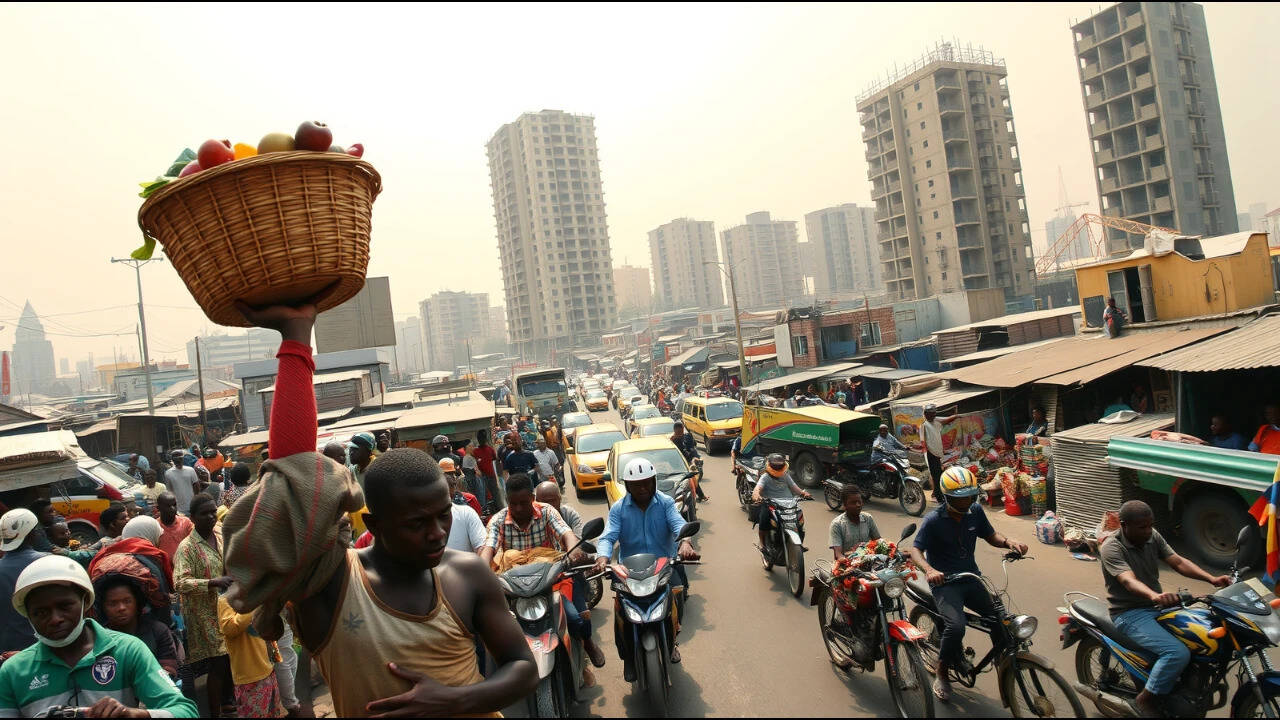
Rapid demographic expansion without corresponding industrial productivity creates a structural economic trap. Kinshasa, the capital of the Democratic Republic of the Congo, is scaling at an annual population velocity exceeding 5 percent, tracking toward a projected population of 26 million by 2030. Yet, empirical data from World Bank household surveys reveals that this demographic surge has coincided with an expansion of urban poverty rather than broad-based wealth creation.
To understand why hyper-urbanization in Central Africa destroys purchasing power instead of generating prosperity, analysts must deconstruct the mechanics of local capital allocation, labor market informality, and spatial expansion.
The Dual Engines of Migration and Spatial Sprawl
Urban expansion is generally categorized by two distinct mechanisms: pull factors, where individuals migrate toward high-productivity industrial clusters, and push factors, where demographic surplus or rural instability forces movement. In Kinshasa, migration flows are heavily decoupled from industrial pull. Survey data indicates that primary drivers of movement into the capital include family consolidation and education, rather than immediate industrial labor demand.
This creates a structural mismatch. Millions of new residents arrive annually, expanding the physical footprint of the city by roughly five hectares per day. However, this spatial expansion occurs without concurrent investments in foundational municipal infrastructure.
- The Topography of Informal Settlement: Unplanned urban sprawl forces incoming populations onto unstable, sandy soils in the southern and eastern peripheries.
- The Erosion Cost Function: Lack of engineered drainage systems triggers severe soil erosion during extreme precipitation events. Residential assets built on these slopes face recurrent destruction, systematically eroding household capital.
- Service Deficit: Municipal utility networks fail to scale alongside the geographic perimeter, leaving over half of the population in precarious neighborhoods without formalized water, sanitation, or electrical grids.
The Informal Labor Trap and Productivity Stagnation
The macroeconomic trajectory of any urban center depends on its ratio of tradable to non-tradable economic output. Cities that integrate into regional and global trade networks produce high-value goods and services, injecting external capital into the local monetary ecosystem.
Kinshasa functions predominantly as a local, consumption-driven economy rather than an export-oriented industrial hub. International trade integration remains low, and a vast majority of economic activity stays confined to localized commerce.
Consequently, the labor market cannot absorb incoming workers into high-productivity formal sectors. Institutional tracking indicates that formal employment accounts for a minuscule fraction of the national workforce, driving over 90 percent of urban laborers into the informal economy.
Informal micro-commerce and subsistence trading provide immediate survival lifelines but fail to generate cumulative capital. Because these enterprises operate outside the tax base, municipal governments lack the revenue required to finance public goods. A reinforcing feedback loop emerges: low productivity yields low tax revenue, which prevents infrastructure investment, which in turn stifles industrial scaling.
Purchasing Power Erosion and Macroeconomic Shocks
The deterioration of living standards in Kinshasa is heavily tied to macroeconomic volatility and purchasing power parity shifts. Longitudinal studies tracking household welfare between 2012 and 2018 documented a measurable contraction in real income across the lower eighty-five percent of urban households.
This contraction is accelerated by several structural vulnerabilities:
- Currency Depreciation: Sharp exchange rate depreciations rapidly inflate the cost of imported food and basic commodities, directly reducing real wages for non-salaried urban workers.
- Labor Income Volatility: Because informal workers lack employment contracts or social safety nets, external shocks—such as regional supply chain disruptions or public health crises—trigger immediate collapses in daily cash flow.
- Asset Poverty: The bottom quartile of the urban population holds virtually no liquid assets, making micro-shocks catastrophic to household survival metrics.
Strategic Interventions for Urban Equilibrium
Reversing the trend of impoverished megacities requires moving away from palliative aid and focusing entirely on structural economic re-engineering. Municipal planning must transition from managing humanitarian fallout to enabling industrial agglomeration.
The immediate operational priority involves formalizing land titles and deploying nature-based engineering solutions—such as terraced vegetation matrices and controlled drainage networks—to stabilize vulnerable peripheries and protect household capital from environmental degradation. Simultaneously, economic policy must incentivize export-adjacent manufacturing and value-chain processing within special economic zones. By connecting local labor pools to international trade corridors, Kinshasa can convert its demographic mass from an economic liability into an engine of high-productivity output.