The heavy steel gate of the logistics base groaned on its hinges, sealing shut against the desert wind for the final time.
Outside, the highway stretched toward the southern border under a pale, dust-choked sky. Inside, the silence was absolute. For twenty-three years, the hum of generators, the rhythmic thrum of rotor blades overhead, and the chatter of radio traffic had formed the ambient soundtrack of this sprawling compound on the outskirts of Baghdad. Now, there was only the sound of boots scraping over gravel and the rattling of empty corrugated metal hangars where armored vehicles once stood in endless rows. Meanwhile, you can read similar events here: Why The Narrative Around Forced Videos Is Masking A Brutal Truth About Modern Information Warfare.
The twenty-three-year American chapter in Iraq has ended.
To understand what this departure means, you cannot simply look at a map, or tally up troop counts, or read diplomatic communiqués issued from air-conditioned conference rooms in Green Zones. You have to look through the eyes of people like Tariq. To see the bigger picture, check out the excellent report by The Washington Post.
(Note: Tariq is a hypothetical composite character, built from interviews and documented experiences of Iraqi merchants who have lived through the entire arc of the post-2003 era.)
Tariq runs a worn, narrow bookstore in the bustling Karrada district of Baghdad. In the spring of 2003, when columns of American tanks first rolled past his father's shop, Tariq was twenty-two years old, full of frantic hope and terrifying uncertainty. He watched statues fall. He watched his city fracture. He watched the euphoria of liberation curdle into the bitter smoke of sectarian civil war. He watched neighborhoods wall themselves off behind twelve-foot blast walls of gray concrete, turning every street into a potential checkpoint. He watched the black banners of the Islamic State sweep across a third of the country in 2014, and he watched young men from his own street march off under the banners of Iran-backed militias to fight them back.
Today, at forty-five, Tariq is tired.
"Every time they say they are leaving, or every time they say they are staying, the ground shakes under our feet," Tariq says, wiping dust from a stack of Arabic translations of European philosophy. "We are not worried about who leaves. We are worried about who is left behind."
That is the question haunting the region as the final American transports lift off. The departure marks the official close of a military engagement that began in March 2003 under the banner of Operation Iraqi Freedom. It represents the end of an era defined by boots on the ground, direct combat support, and the constant, suffocating weight of foreign intervention. But history does not stop because an army packs its bags. It simply shifts gears, leaving behind a complex, volatile arena where local ambitions and regional proxies collide.
To grasp the magnitude of this moment, we must rewind to the foundations of the current order.
When the United States led the coalition that toppled Saddam Hussein in 2003, it dismantled not just a regime, but the entire machinery of the Iraqi state. The military was dissolved overnight. The ruling Baath party was purged from every level of administration. In the institutional vacuum that followed, sectarian divisions that had been suppressed by decades of brutal authoritarian rule exploded into the open.
By 2006 and 2007, Baghdad was bleeding. Neighborhoods were ethnically cleansed street by street. Makeshift morgues overflowed with unidentified bodies bearing the marks of sectarian death squads. The American military, initially cast as liberators, found themselves bogged down in a grinding counterinsurgency against a multi-sided civil war. The subsequent surge of American troops in 2007 temporarily beat back the violence through brute force and local alliances, but it did not heal the underlying political fractures that poisoned the state.
When the bulk of U.S. forces withdrew the first time in late 2011, under the Obama administration, the underlying rot remained unaddressed. Sectarian exclusion by the government in Baghdad alienated the Sunni population, creating fertile soil for radicalism. Within three years, that alienation metastasized into the Islamic State. ISIS seized Mosul, Tikrit, and nearly marched on the capital itself, rolling across the border from Syria with captured American Humvees and U.S.-supplied Iraqi military stockpiles.
That catastrophe forced a reluctant return. In 2014, American warplanes and military advisors returned at the invitation of the Iraqi government, spearheading an international coalition to crush the territorial caliphate. By 2017, the physical caliphate was declared defeated in Iraq, reduced to rubble in the pulverized streets of West Mosul, where families dug through concrete tombs to find their loved ones.
Yet, defeating a territorial state is not the same as eradicating an ideology or resolving the grievances that birthed it.
Today, ISIS remnants remain scattered in the desolate wastelands of the Anbar desert, the rugged ridges of the Hamrin mountains, and the remote valleys stretching toward Syria. They operate not as an army holding cities, but as ghosts—cells of shadow fighters launching hit-and-run ambushes, extorting rural farmers for protection money, and waiting patiently for the state’s attention to waver. They are diminished, yes. But they are enduring.
Simultaneously, the other half of the security equation has grown into a towering colossus: the Iran-backed militias.
Often operating under the institutional umbrella of the Popular Mobilization Forces, or Hashd al-Shaabi, these armed groups were formally integrated into the Iraqi state security apparatus following the fatwa issued by Grand Ayatollah Ali al-Sistani in 2014 to fight ISIS. Over the past decade, however, these factions have evolved into something far more expansive than auxiliary units. They are political kingmakers, economic empires controlling ports and trade routes, and armed networks with deep ideological and logistical ties to Tehran’s Islamic Revolutionary Guard Corps.
For years, these militias coexisted in a tense, violent dance with American forces stationed in Iraq. Rocket attacks targeted coalition bases across the country. Drone strikes retaliated against militia commanders on darkened roads. It was a low-intensity shadow war fought in the margins of the broader campaign against ISIS, keeping the region in a state of perpetual, jittery suspension.
Now, with the American military departure finalized, that shadow war loses its primary foreign friction point, leaving local actors to wrestle directly for the soul of the Iraqi state.
Consider what happens next from the perspective of a young security analyst sitting in an office in Erbil, the capital of the Kurdish autonomous region in northern Iraq.
(Note: This hypothetical scenario illustrates the strategic calculations currently dominating regional security briefings.)
The analyst looks at a digital dashboard of the country. To the south, Baghdad is governed by a fragile coalition heavily influenced by parties and armed factions aligned with Iran. To the west and north, sleeper cells of ISIS maintain rural networks of extortion and terror. To the east, Tehran watches every political appointment, every oil contract, and every movement of security forces with proprietary interest. To the north, Turkey continues cross-border military operations against Kurdish militant positions, treating Iraqi sovereignty as a secondary concern to its own domestic security.
Iraq is not an independent actor in a vacuum. It is the geopolitical fulcrum of the Middle East.
When the last American logistics convoy crosses the southern border into Kuwait, it does not mean the United States is washing its hands of the region entirely. Diplomatic channels remain. Intelligence-sharing agreements, economic ties, and regional partnerships will persist in altered forms. But the era of direct military arbitration—the days when an American commander could pick up a phone in Baghdad and dictate terms to Iraqi political leaders or deploy battalions to stabilize a failing district—is decisively over.
What fills that vacuum will determine the fate of millions.
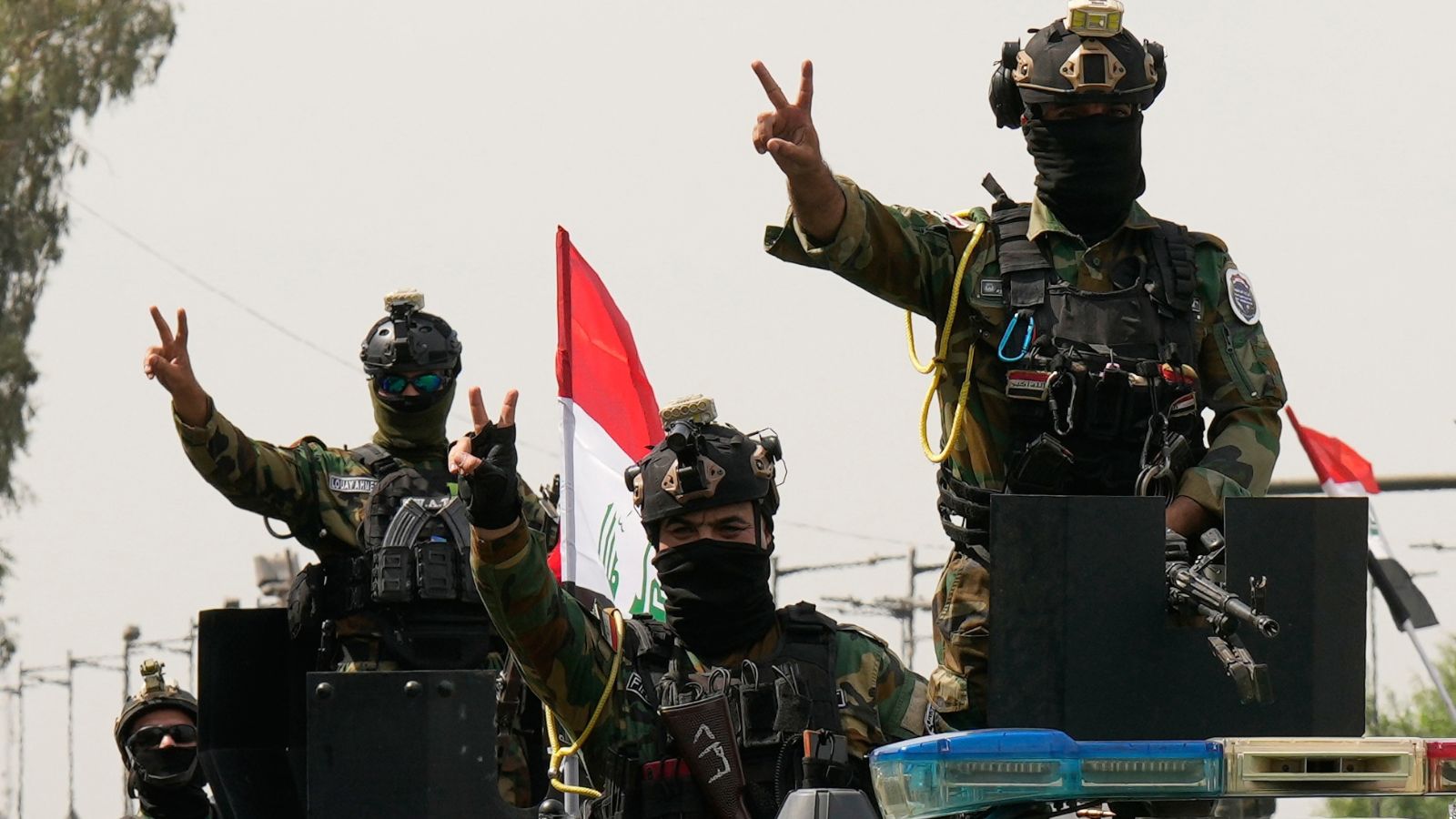
The Iraqi government, led by Prime Minister Mohammed Shia al-Sudani, has spent months projecting confidence. State television broadcasts footage of modernizing infrastructure, newly paved roads, and international investment conferences in the heart of Baghdad. Officials insist that the Iraqi Security Forces—the Counter-Terrorism Service, the federal police, and the regular army—have matured through two decades of combat and are fully capable of holding the line against both ISIS and rogue armed factions.
And in many ways, they have improved. The Iraqi forces that collapsed in front of a few thousand ISIS fighters in 2014 are not the same forces patrolling the streets today. They possess better equipment, sharper tactical coordination, and hard-won battlefield experience forged in the crucible of urban warfare.
Yet, capability is only half the equation. The other half is political will and institutional cohesion.
Can the central government in Baghdad enforce the rule of law over powerful militias that operate outside state command, even when those militias nominally wear state uniforms? Can a state plagued by systemic corruption, water scarcity, and a youth unemployment rate that borders on the explosive build an economy that offers its people a future beyond patronage and sectarian loyalty?
These are questions that no foreign army can answer for Iraqis.
For twenty-three years, the presence of foreign troops acted as both an inflammatory catalyst for insurgency and a heavy, clumsy stabilizing weight. It was a crutch that allowed Iraqi politicians to defer difficult compromises, blaming foreign occupiers for the country's ills while simultaneously relying on them to keep the state from tearing itself apart at the seams.
Now, the crutch is gone.
Back in Karrada, Tariq pulls down the metal shutter of his bookstore as the evening heat begins to break. The neon signs of the capital flicker to life, casting long, bruised shadows across the pavement. Down the street, young men sip tea at a sidewalk café, arguing loudly over football matches and government job announcements, their laughter cutting through the hum of private diesel generators that keep the city powered through rolling blackouts.
They are resilient. They have had to be.
They have survived foreign invasions, economic embargoes, civil wars, sectarian car bombings, the terror of extremist caliphates, and the endless geopolitical chess matches of foreign powers. They have buried their dead, rebuilt their storefronts, and learned to read the subtle shifts in the political wind with the precision of meteorologists.
The last convoy has rolled out into the dark. The dust kicked up by the heavy armored vehicles is settling back onto the desert floor. The headlines will move on to other wars, other crises, other flashpoints across a restless globe.
But Iraq remains.
And in the quiet spaces between the concrete blast walls, beneath the sprawling orange glow of Baghdad at dusk, a new chapter begins—written entirely in the ink of local hands.