The air in Goodwood doesn’t move like the air anywhere else. It is heavy with the scent of damp cedar and the invisible weight of three centuries of aristocracy. When you stand in the courtyard of the Rolls-Royce Atelier, you expect the mechanical theater of a cold start—the physical cough of an internal combustion engine waking up, the vibration through the soles of your shoes, the faint smell of high-octane gasoline.
But the Nightingale arrived in a way that felt predatory.
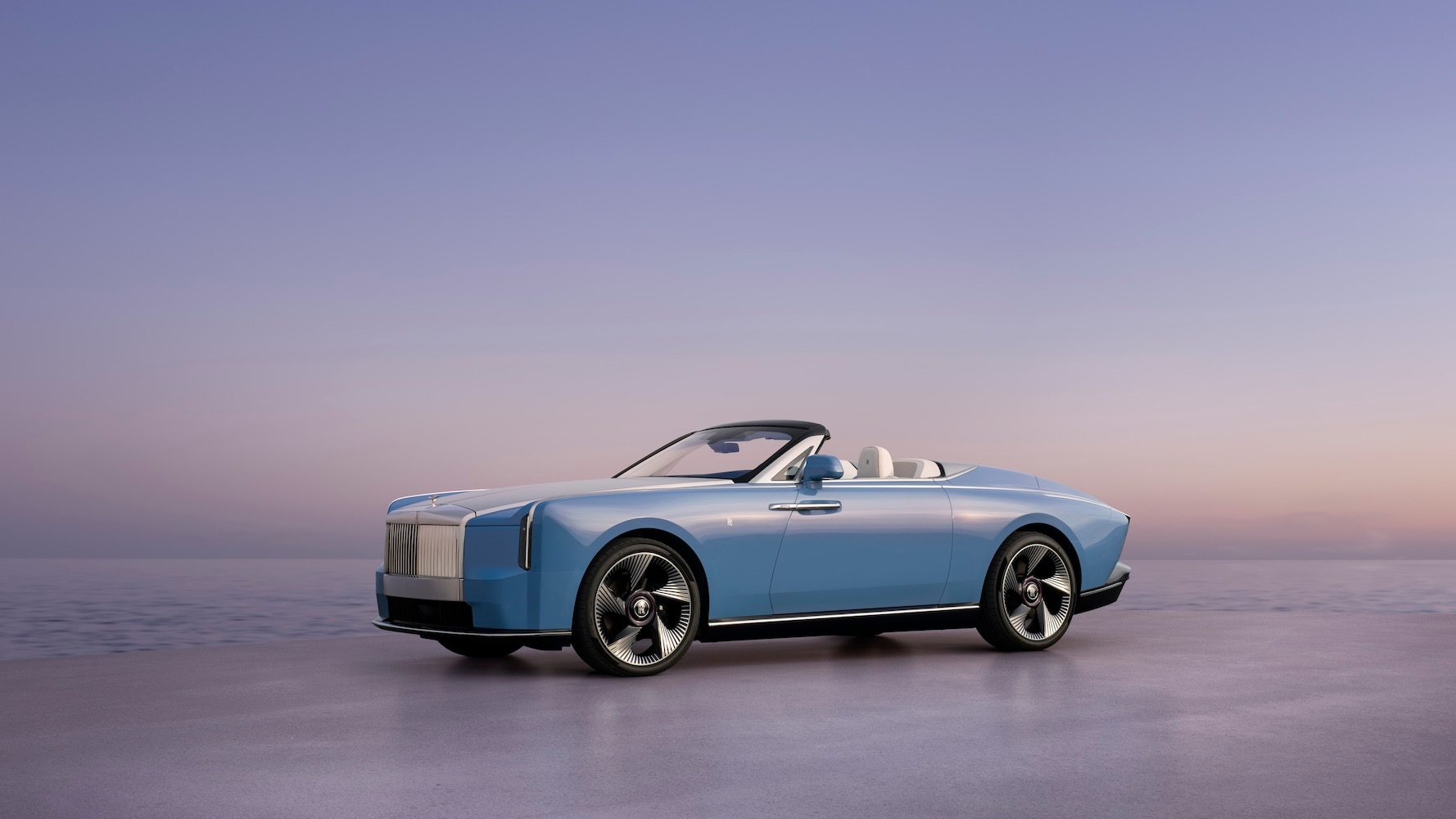
There was no sound. Only the crunch of gravel beneath bespoke rubber. It slid into view like a ghost ship entering a harbor, a long, low silhouette of liquid metal that seemed to absorb the morning light rather than reflect it. This is the third chapter of the modern Coachbuild movement, following the nautical sweep of the Boat Tail and the floral romance of the Droptail. Yet, the Nightingale feels different. It feels like an ending and a beginning occurring in the exact same heartbeat.
This is the first time the storied marque has allowed its most elite division to embrace the electric revolution. It is a two-seater sanctuary, limited to just one hundred units globally, designed for a client base that views a three-million-dollar price tag as a mere entry fee for a conversation about art.
The Weight of a Whisper
Engineers at Rolls-Royce often talk about "waftability." It is that specific sensation of being disconnected from the road, as if the car is floating on a cushion of pressurized air. In a traditional V12, this is achieved through layers of sound deadening and mechanical wizardry. In the Nightingale, the silence is inherent.
Consider the hypothetical owner—let’s call him Elias. Elias is a man whose life is defined by noise. He manages global portfolios, navigates the cacophony of boardrooms, and spends his days under the constant hum of jet engines and data centers. For him, the Nightingale isn't a vehicle. It’s a sensory deprivation chamber.
When Elias steps into the cabin, the doors close with a motorized soft-touch that sounds like a heavy book being shut in a library. The interior is a cathedral of midnight-blue leather and open-pore wood. Because there is no transmission tunnel—a benefit of the dedicated electric architecture—the floor is a flat expanse of deep-pile wool. It changes the geometry of how you sit. You aren't "in" a car; you are "upon" a piece of furniture that happens to travel at high speeds.
The transition to electric power in the ultra-luxury space was always inevitable, but the Nightingale proves it was also desirable. Physics tells us that electric motors provide instantaneous torque. In a common EV, this feels like a gut-punch. In the Nightingale, the power delivery has been mapped to mimic the steady, relentless swell of a tidal wave. It doesn't jerk. It simply displaces the world around you.
The Invisible Architecture of Exclusivity
The "Coachbuild" designation is a return to the 1920s, a time when a manufacturer provided the engine and the chassis, and the owner commissioned a specialized artist to build the body. Rolls-Royce has revived this practice for the one percent of the one percent.
The Nightingale’s bodywork is constructed from massive, hand-beaten sheets of aluminum. There are very few shut lines. If you run your hand from the front wheel arch all the way to the tapering "boat tail" rear, you will find almost no gaps. This isn't just for aesthetics. Gaps create wind noise. Wind noise ruins the sanctuary.
One hundred units. That is the hard cap. In a world of mass production, where even Ferraris and Lamborghinis are produced by the thousands, one hundred represents a vanishingly small footprint. This scarcity creates a psychological gravity. To own a Nightingale is to possess a piece of history that most people will never see in the flesh, let alone sit inside.
The stakes for Rolls-Royce were higher than they seemed. If they failed to make the electric transition feel "regal," they risked alienating the very people who fund their most ambitious projects. They had to prove that a battery pack could carry as much soul as a twelve-cylinder masterpiece of engineering.
A Dialogue of Wood and Voltage
The dashboard of the Nightingale is devoid of the clutter found in modern luxury SUVs. There are no massive, glowing iPad-clones dominate the center stack. Instead, the technology is "shy." Screens stay hidden behind rotating veneers until they are summoned.
The centerpiece is a physical clock, commissioned by a Swiss horologist specifically for this run of one hundred cars. Its ticking is the only consistent sound you hear when the car is stationary. It serves as a reminder that while the drivetrain is the future, the experience is anchored in the analog past.
There is a specific metaphor the designers used during the unveiling: a swan. Above the waterline, the swan is the picture of effortless grace. Beneath the surface, there is a complex, powerful machinery working to maintain that image. The Nightingale’s battery system—a massive $100$ kWh unit—is that hidden machinery. It allows for a range that covers the distance between London and the Scottish Highlands, or a slow crawl through the winding streets of Monaco, without ever needing to acknowledge its own exertion.
Critics often point to the loss of the "soulful" engine note as the death of the luxury car. They are wrong. They are missing the point of what true luxury has always been: the removal of effort.
The Ghost in the Machine
Driving the Nightingale along the coast, the experience becomes meditative. Without the vibration of pistons, your heartbeat actually slows down. You become hyper-aware of the world outside the glass—the way the light hits the waves, the shifting colors of the autumn leaves. The car becomes a lens through which you view the world, rather than a barrier between you and it.
This is the hidden cost of the EV revolution that no one talks about. It isn't just about the lithium or the charging grids. It’s about the psychological shift from "driving" to "being moved." The Nightingale is the ultimate expression of this shift. It recognizes that in the future, the loudest statement you can make is to remain perfectly silent.
We are moving into an era where power is no longer defined by volume. For a century, the roar of an engine was a signal of status. It was an intrusion on the public space, a demand to be noticed. The Nightingale flips the script. It moves through the world like a secret.
As the sun began to dip below the horizon during the reveal at Goodwood, the car seemed to change color. The dark iridescent paint, inspired by the feathers of its namesake, shifted from a deep charcoal to a shimmering indigo. It sat there, plugged into a discreet charging bollard, drinking energy as quietly as it spent it.
There were no speeches about "disruption" or "synergy." There was just the car, the silence, and the realization that the greatest luxury in the twenty-first century isn't more information, more speed, or more noise.
It is the ability to disappear into the hum of the road and let the world wait for you.
The Nightingale isn't just a car. It is a one-hundred-part poem about the end of the mechanical age, written in leather, wood, and a whisper that carries further than any scream.