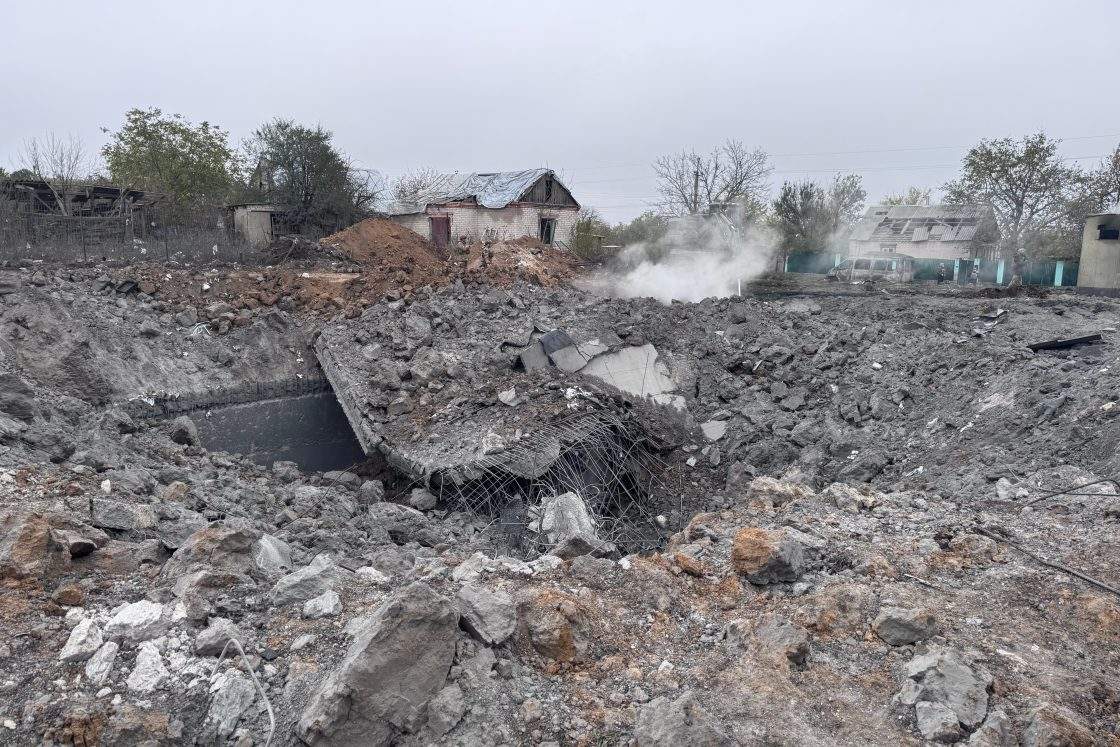
Thirty-one people are dead, and dozens are still buried under concrete and twisted rebar. That is the grim reality after a Russian strike hit a humanitarian aid site in Ukraine, turning a lifeline for desperate civilians into a mass casualty scene.
When a missile hits a location explicitly meant to keep non-combatants alive, the news cycle usually treats it as just another tragic statistic in a years-long war. I find that reaction infuriating. You can't look at an attack on an aid distribution center as a random accident of the battlefield when patterns like this keep repeating across eastern and southern Ukraine.
Right now, emergency crews are digging through the rubble with heavy machinery and bare hands, racing against time to find survivors among the dozens still unaccounted for. Local authorities and international observers are scrambling to verify the exact munitions used, while families wait near the cordon hoping for a miracle that rarely comes after the first 24 hours.
Why Humanitarian Aid Sites Become Targets in Ukraine
If you've spent any time analyzing conflict zones or tracking open-source intelligence from Ukraine, you know that aid sites aren't hidden. They can't be. For civilians to get food, clean water, medical supplies, and evacuation assistance, these hubs have to be accessible, well-known, and often marked with visible insignia.
That visibility is a double-edged sword. Under International Humanitarian Law, specifically the Geneva Conventions, humanitarian relief operations and civilian infrastructure are strictly protected. Attacking them isn't just frowned upon—it's a textbook war crime.
Yet, we've seen this play out repeatedly since 2022. Think back to the strikes on the Mariupol drama theater, the Kramatorsk railway station where thousands waited to evacuate, or the countless local distribution points in Kherson and Kharkiv. Why does it keep happening?
There are three uncomfortable realities behind these strikes:
- Targeting the social fabric. When an invading force struggles to break military lines, it often shifts to breaking civilian morale. Destroying the places where elderly residents and families gather for basic survival supplies sends a brutal message that nowhere is safe.
- Weapon inaccuracy and indifference. Russia frequently uses converted air-defense missiles (like the S-300) or older Soviet-era munitions for ground attacks. These weapons weren't built for pinpoint precision, and launching them near populated areas shows a complete disregard for collateral damage.
- Disrupting logistics by proxy. Moscow routinely claims that civilian aid warehouses are secretly storing Ukrainian military hardware or housing troops. Even when independent monitors find zero evidence of military presence, the accusation alone is used to muddy the informational waters.
Honestly, whether an attack is driven by deliberate terror or reckless negligence doesn't matter to the families pulling loved ones out of the debris. The result on the ground is identical.
The Brutal Math of Rescue Operations After a Missile Strike
News headlines give you a single snapshot—31 dead, dozens missing—but they rarely explain why those numbers shift so dramatically over the days following a strike. Having followed rescue operations in heavily shelled Ukrainian cities, I can tell you that the first 48 hours are absolute chaos.
When a ballistic missile or glide bomb hits a concrete building, the structure doesn't just collapse; it pancakes. Heavy floor slabs crush everything beneath them, trapping people in small air pockets while cutting off communication.
Rescue workers from Ukraine's State Emergency Service (DSNS) face a nightmare scenario every single time. They have to balance speed with extreme caution. Move a massive slab of concrete without stabilizing the surrounding debris, and you risk triggering a secondary collapse that kills both the trapped victims and the rescuers.
Then there is the threat of the "double-tap" strike. Russian forces have become notorious for hitting a civilian target, waiting 20 to 40 minutes for ambulances, firefighters, and volunteers to arrive, and then striking the exact same coordinates again. First responders in Ukraine don't just fight fire and rubble; they work under the constant threat of a second missile falling on their heads.
Because of this, counting the missing is agonizingly slow. Aid centers don't always keep digital manifests of every person who walks through the door for a loaf of bread or a bottle of water. Authorities have to cross-reference missing person reports from frantic relatives with local municipal records and DNA samples recovered from the site. That is why a death toll of 31 often climbs higher days after international cameras have packed up and left.
What Most People Get Wrong About International Law and Accountability
Whenever a strike like this hits the front page, social media fills up with calls for immediate prosecution at The Hague. People assume that because the evidence is sitting right there in high-definition video, justice will be swift.
It won't be. That's a hard pill to swallow, but you need to understand how international war crimes investigations actually work so you don't fall for cynical narratives claiming "nothing is being done."
Organizations like the United Nations Human Rights Monitoring Mission in Ukraine (HRMMU), Human Rights Watch, and the International Criminal Court (ICC) don't rely on viral tweets. To build a case that holds up in an international court, investigators have to establish a chain of custody for physical missile fragments, analyze satellite imagery before and after the blast, interview dozens of eyewitnesses, and prove beyond a reasonable doubt that no legitimate military target was operating inside that aid site.
This process takes years, not weeks. We saw this with the MH17 shootdown investigation, which took nearly a decade to reach a verdict.
The real danger isn't that investigators are ignoring the strike. The danger is donor fatigue and political distraction. When global attention shifts to other crises, the funding for forensic teams, air defense interceptors, and humanitarian reconstruction starts to dry up.
How Aid Organizations Are Forced to Adapt on the Ground
You might wonder why humanitarian groups keep operating large distribution hubs if they keep getting hit. The short answer is that without them, thousands of people in frontline communities would starve or freeze.
Still, the days of setting up a single massive warehouse with a giant Red Cross or UN flag on the roof are basically over in high-risk zones. Local Ukrainian volunteer networks and international NGOs have completely changed how they operate to survive:
- Decentralized micro-distribution. Instead of bringing 500 people to one building at 10:00 AM, volunteers now break supplies into smaller loads and drop them at multiple undisclosed neighborhood points.
- Staggered delivery windows. Civilians are notified via encrypted messaging apps just minutes before a mobile aid van arrives, minimizing the time people spend gathered in one spot.
- Underground and reinforced hubs. Whenever possible, aid storage and medical triage are moved into reinforced Soviet-era basements or subway stations rather than above-ground structures.
These adaptations save lives, yet they also slow down how fast aid reaches the most vulnerable people—especially elderly residents with limited mobility who can't easily navigate last-minute location changes.
What You Can Actually Do Right Now
Reading about 31 dead and dozens missing feels paralyzing when you're sitting thousands of miles away. Doomscrolling through photos of destroyed buildings doesn't help a single person trapped under rubble. If you want your reaction to mean something, channel it into direct, practical action.
First, verify where your donations go. Skip broad, bureaucratic charities with massive overhead and support vetted organizations actively operating on the ground in Ukraine—groups like Razom for Ukraine, World Central Kitchen, or United24 (which directly funds medical aid and demining). If you want to support the exact people digging survivors out of the concrete, look for campaigns backing Ukraine's State Emergency Service with protective gear and search-and-rescue equipment.
Second, pay attention to air defense policy debates in your own country. Every time a Russian missile strikes a humanitarian hub, it highlights the gap in Ukraine's air defense shield. Contact your elected representatives and push for sustained deliveries of air defense interceptors and radar systems—because the best way to protect an aid site isn't rebuilding it after a strike, it's stopping the missile before it ever hits the roof.