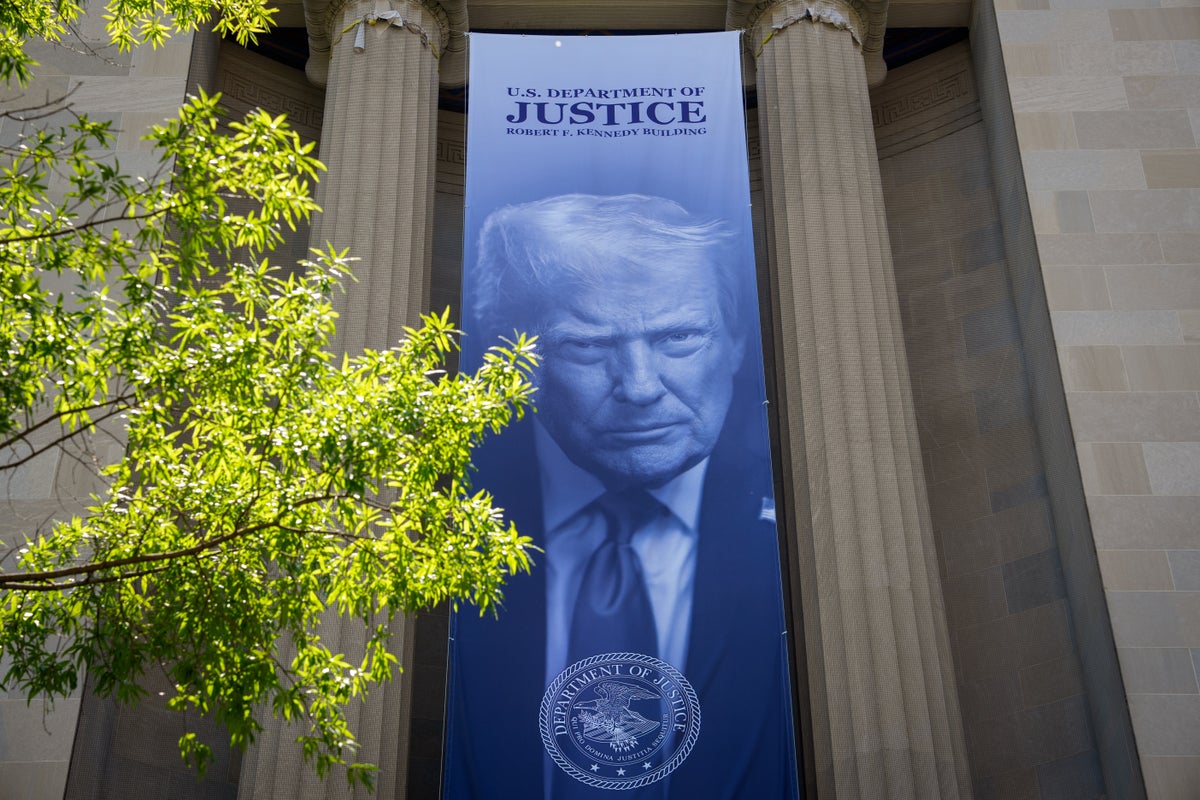
The coffee in the basement of the Department of Justice always tastes like copper and old paper. For twenty-two years, that taste was the baseline of Arthur’s mornings. He was not a political appointee. He was a career civil servant, the kind of lawyer who stays through four different administrations, quietly ensuring that the machinery of American democracy doesn't grind itself to dust. He wore gray suits that never quite fit, carried a scuffed leather briefcase, and believed, with a fervor that bordered on the religious, in the absolute neutrality of the law.
Then came the ledger. For a deeper dive into this area, we recommend: this related article.
It didn't arrive with a dramatic flourish. It appeared as a digital spreadsheet on a secure server, a column of figures totaling 1.7 billion dollars. To the uninitiated, the numbers looked like standard discretionary allocations. But Arthur knew how to read between the lines of a federal budget. He knew that money in Washington is like water; it always flows toward power. And this particular stream was being diverted into a private reservoir designed exclusively for the allies of Donald Trump.
The public calls it a slush fund. In the sterile hallways of the capital, it was referred to as "discretionary realignment." But no matter the vocabulary used to disguise it, the reality remained unchanged. A massive mountain of taxpayer money was being weaponized as a financial reward system for political loyalty. To get more information on this development, extensive coverage is available at TIME.
Arthur resigned on a Tuesday. No press conference. No fiery manifesto posted to social media. Just a single page of bond paper left on a mahogany desk, and a quiet exit through the revolving doors into the rain.
His departure was the first crack in a dam that is now bursting.
The Cost of Saying Yes
To understand why a top government lawyer would walk away from a lifetime pension and a prestigious career, you have to understand the invisible stakes of institutional decay.
Imagine a local bank where the vault is left unlocked, not because the security guards are lazy, but because the bank president has instructed them to look away whenever his friends walk in. The money doesn't belong to the president. It belongs to the depositors who sweat for every dollar. The guards know it is wrong. The tellers know it is wrong. But the president holds their paychecks in his hands.
That is the exact mechanism of the 1.7-billion-dollar fund.
This wasn't a sudden, middle-of-the-night heist. It was a methodical redirection of public funds. Money originally earmarked for infrastructure, civic programs, and non-partisan oversight was quietly re-routed. The beneficiaries were not communities in need, but a hand-picked network of political allies, corporate donors, and loyalists who had demonstrated an unwavering willingness to defend the administration's agenda.
The outrage currently mounting in Washington isn't just about the money. A billion dollars is an abstract concept to most people—a string of zeros on a screen. The real fury stems from the realization that the very nature of public service is being systematically inverted.
When the law becomes a tool to reward friends and punish enemies, it ceases to be law. It becomes a racket.
The Anatomy of an Executive Slush Fund
How does someone hide nearly two billion dollars in plain sight? The answer lies in the complexity of federal procurement and emergency spending powers.
During moments of political crisis or economic shifting, the executive branch possesses broad authority to reallocate certain funds to address immediate needs. It is a necessary flexibility built into the system to ensure the government can react swiftly to unforeseen disasters. However, that flexibility relies entirely on an unwritten rule: the assumption of good faith.
Consider what happens next when that good faith vanishes.
The administration utilized obscure statutory loopholes to shield these allocations from congressional oversight. Contracts were awarded without the traditional competitive bidding process. Grants were approved with unprecedented speed, bypassing the rigorous vetting protocols that career officials like Arthur had spent decades enforcing.
When a small tech firm owned by a prominent campaign donor suddenly receives a multi-million-dollar non-compete contract for "consulting services" that are never clearly defined, the system isn't working. It is being exploited. When real estate developers who hosted high-dollar fundraisers find their projects suddenly infused with federal development grants under the guise of "economic revitalization," the coincidence becomes too heavy to bear.
The career lawyers inside the Department of Justice saw the patterns emerging months ago. They watched as the guardrails were systematically dismantled. First came the subtle pressures—an email suggesting a specific application get "expedited review." Then came the overt demands—direct orders to sign off on allocations that violated the spirit, if not the exact letter, of federal appropriations law.
For a long time, the strategy was survival through compliance. Officials told themselves that if they stayed, they could mitigate the damage. They could be the adults in the room. But compliance has a predatory appetite. It always demands more.
The Invisible Victims of Financial Favoritism
It is easy to view this entire scandal as a spectator sport played out on cable news networks, a tribal conflict between political factions where one side scores a point and the other side cries foul. That perspective is a luxury of the unaffected.
The money poured into this political trough had to come from somewhere.
Think of a rural community in Ohio where the municipal water system is failing, its pipes leaching lead into the school drinking fountains. They applied for a federal mitigation grant, a lifeline that would have replaced the infrastructure and ensured the safety of three thousand children. The application was pristine, the need undeniable.
But their grant was denied. The funds were no longer there.
Instead, those resources were diverted into the 1.7-billion-dollar pool, eventually surfacing as a subsidized loan for a luxury marina project owned by a major political contributor three states away. The children in Ohio still drink bottled water from plastic jugs. The marina now boasts a private helipad.
This is the human cost of the slush fund. It is measured in the projects that were never built, the safety inspections that were never conducted, and the vulnerable populations whose needs were traded for political currency. Every dollar given to a wealthy ally as a reward for loyalty is a dollar stolen from a legitimate public necessity.
The system is designed to be fair precisely because scarcity is real. Resources are finite. When the allocation of those resources is determined by political fealty rather than objective merit, the foundational contract between the citizen and the state is shattered. You pay your taxes under the assumption that the money will be used to maintain the society you live in, not to bankroll the private ambitions of a political faction.
The Breaking Point of the Deep State
There is a popular narrative that portrays government bureaucrats as a cabal of shadowy, all-powerful actors working to subvert the will of elected leaders. The reality is far more mundane, and far more tragic. The people holding these institutions together are largely individuals who value predictability, precedent, and the quiet dignity of doing a job well.
They are people who took an oath to the Constitution, not to a person.
When the top government lawyer handed in his resignation, it wasn't an act of political defiance. It was an admission of defeat. It was the realization that the internal mechanisms of resistance—the formal memos, the legal objections, the appeals to precedent—had been rendered completely useless. The system was no longer listening to its own legal counsel.
His departure has triggered an unprecedented wave of internal panic within the administration. It is one thing to dismiss the criticisms of political opponents or investigative journalists; it is quite another when your own chief legal architects signal that the line of legality has been crossed.
The resignation has given permission to others to speak. In the days following the exit, a steady trickle of internal documents, encrypted messages, and memo drafts has begun flowing toward congressional oversight committees and independent watchdogs. The fortress of secrecy is beginning to show structural fractures.
The administration’s defense has been characteristically aggressive. They have dismissed the mounting outrage as a partisan witch hunt, asserting that the executive branch possesses the absolute right to distribute discretionary funds as it sees fit. They argue that the resignation is simply the departure of a disgruntled employee who refused to align with the mandate given by the voters.
But that argument ignores a fundamental truth about the American experiment. The president is the manager of the nation's wealth, not its owner.
The Sound of an Empty Office
The true tragedy of this crisis is not the sheer volume of the money misused, though 1.7 billion dollars is an enormous sum. The tragedy is the cynicism it leaves in its wake.
When citizens watch an administration openly use the treasury as a private checking account to reward friends and secure power, something vital dies in the public consciousness. Belief in the fairness of the system evaporates. It replaces a culture of civic duty with a culture of transactional survival. It teaches the public that honesty is for the naive, and that prosperity is reserved only for those willing to bend the knee to whoever happens to hold the keys to the vault.
Arthur’s desk is empty now. The family photos have been packed into a cardboard box, the desktop computer wiped clean by IT security, the nameplate removed from the door. The hallway outside his former office is quiet, save for the rhythmic clicking of heels on linoleum as another staffer hurries past, carrying another stack of folders.
The machinery of government continues to turn, indifferent to the souls that are crushed within its cogs. The 1.7 billion dollars is largely gone, distributed into a web of accounts and entities where it will be spent, invested, and converted into influence.
But the vacancy remains. It is a physical reminder that there are still some individuals who believe that a career, a reputation, and a life's work are small things to lose compared to the loss of one's integrity. The question that hangs over the capital now is not how many more dollars will be spent from the fund, but how many more people like Arthur will have to leave before there is nothing left of the temple but the money changers.