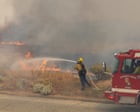
The air didn't just smell like smoke. It tasted like history turning to carbon. When 4,100 acres of California scrub and timber go up, it isn't just a number on a Cal Fire ledger or a smudge on a satellite map. It is the sound of ancient oaks popping like gunfire and the sight of a horizon turned the color of a bruised peach.
Down in the valleys, people look at the containment percentages on their phones. 20 percent. 50 percent. They see progress. But up on the ridge, progress is measured in inches of dirt scraped raw by human hands and the steady, rhythmic pulse of a chainsaw that hasn't stopped for six hours.
The "containment" of a wildfire is a deceptive term. It suggests a cage, a door slammed shut on a beast. In reality, it is a fragile, dusty pact between exhausted crews and a landscape that is increasingly designed to burn.
The Weight of the Red Tool
Imagine a man named Elias. He isn't a hero in a movie; he’s a twenty-four-year-old from a small town in the Central Valley who spent his morning drinking lukewarm coffee in the back of a transport truck. Elias carries a Pulaski—a tool that is half-axe, half-hoe, and entirely heavy after the first four miles of vertical hiking.
His job is the "line."
To understand the fire that claimed those 4,100 acres, you have to understand the line. It is a strip of earth, sometimes only two feet wide, where every leaf, every twig, and every blade of dried grass has been removed. It is a literal void. The logic is simple: if the fire reaches the void and finds nothing to eat, it dies.
But the wind doesn't care about logic.
When the gusts pick up, the fire performs a terrifying magic trick called "spotting." It flings a burning ember—a single, glowing pinecone or a shard of bark—hundreds of feet into the air, over the heads of Elias and his crew, and drops it into a fresh patch of dry brush behind them. Suddenly, the line is useless. The beast is behind the cage.
This is the psychological toll of the 4,100-acre mark. It represents a constant state of retreat and reassessment. For every acre saved, there is the ghost of the acre lost.
The Chemistry of a Drying State
Why does 4,100 acres happen so fast? It isn't just bad luck. It is the result of a thirsty landscape.
Scientists talk about "fuel moisture content," but Elias feels it in the snap of a branch. In a healthy year, a branch bends. In a California summer that has stretched into a permanent state of being, the wood is brittle. It’s essentially standing kindling.
The fire that ripped through this particular stretch of terrain wasn't just burning trees. It was consuming decades of accumulated debris. For nearly a century, we operated under a policy of total fire suppression—putting out every flame the moment it flickered. We thought we were being safe. Instead, we were building a pantry. We filled the forest floor with dead wood and thick underbrush that, in a natural cycle, would have been cleared out by smaller, cooler fires.
Now, when a spark hits, it doesn't just crawl along the ground. It climbs "ladder fuels"—low-hanging branches and tall shrubs—and leaps into the canopy. This is how a small brush fire becomes a crown fire, a wall of flame that moves faster than a person can run.
The Invisible Stakes
While the headlines focus on the acreage, the real story lives in the "contained" sections. To contain a fire, you don't just put water on it. Water is a luxury. Often, there aren't enough hydrants in the wilderness, and helicopters can only drop so much.
The real work is done with fire itself.
Crews perform "burnouts." They stand at their hand-dug line and intentionally set fire to the brush between them and the main blaze. They steal the fire’s food before it can get there. It’s a high-stakes gamble. If the wind shifts, their "controlled" fire becomes part of the problem.
There is a specific kind of silence that happens after a burnout. The crews stand there, soot-streaked and vibrating with adrenaline, watching the two fires meet and cancel each other out. It’s a moment of violent stillness.
But even when the news says "contained," the danger hasn't left. A fire can live underground for weeks. It can smolder in the root systems of trees, traveling like a fever through the earth, only to pop up days later in a spot everyone thought was safe.
This is why the 4,100 acres aren't just a memory. They are a monitored perimeter. Crews stay on-site, patrolling the "black," feeling for heat with the backs of their hands. They call it "cold trailing." It is the most tedious and essential part of the job.
The Human Cost of the Perimeter
Behind the numbers are the evacuations.
Imagine having twenty minutes to decide what your life is worth. You grab the dog, the hard drive with the photos, and perhaps a family heirloom that seems ridiculous once you’re sitting in a high school gym turned into a shelter.
The people living on the edges of those 4,100 acres aren't just worried about their houses. They are worried about the air. The smoke from a fire of this scale contains more than just wood ash. It contains the vaporized remains of everything we build—plastics, paints, insulation, and tires. It hangs in the lungs of the elderly and the very young, a toxic reminder that the wilderness is no longer separate from the suburb.
The protection crews aren't just fighting for trees. They are fighting for the power lines that keep the hospitals running two counties away. They are fighting for the watershed that provides the morning water for millions.
When a hillside burns, the soil changes. It becomes "hydrophobic"—it literally repels water. This means that when the winter rains finally arrive, the water won't soak in. It will slide off the surface, taking the topsoil with it, creating debris flows that can bury entire neighborhoods in seconds. The fire of today is the mudslide of tomorrow.
The Rhythm of the Recovery
As the containment numbers climb—70 percent, 85 percent, 95 percent—the world starts to look away. The news cameras pack up. The smoke clears enough for the sun to look yellow instead of red.
But for the land, the journey is just beginning.
Nature has a brutal, beautiful way of resetting. In the wake of those 4,100 acres, some things will never come back the same. Some species of pine need the heat of a fire to open their cones and release their seeds. In a few months, tiny needles of green will poke through the black ash.
But in other places, the fire was too hot. It cooked the seeds. It sterilized the ground. In those spots, the forest might be replaced by invasive grasses that burn even easier next year.
Elias and his crew will eventually go home. They will scrub the soot from under their fingernails and sleep for eighteen hours straight. They won't talk much about what they saw. How do you describe the sound of a forest dying? How do you explain the feeling of standing three feet away from a heat so intense it melts the soles of your boots?
They leave behind a landscape that is scarred but stable. The 4,100 acres are no longer a threat, but a lesson. They are a reminder that we live on a tilting scale, balanced between the necessity of the flame and the fragility of our grip on the land.
The line is held, for now.
But the wind is always blowing somewhere. The brush is always drying. And the next acre is always waiting for a spark.
The sun sets over the charred ridges, casting long, spindly shadows of trees that no longer have leaves. It is a quiet, haunting beauty. In the distance, a single spotter plane circles one last time, a silver needle stitching together the sky and the blackened earth, ensuring that the pact remains unbroken for one more night.
The fire is contained. The people are safe. But the wilderness remembers every flame.