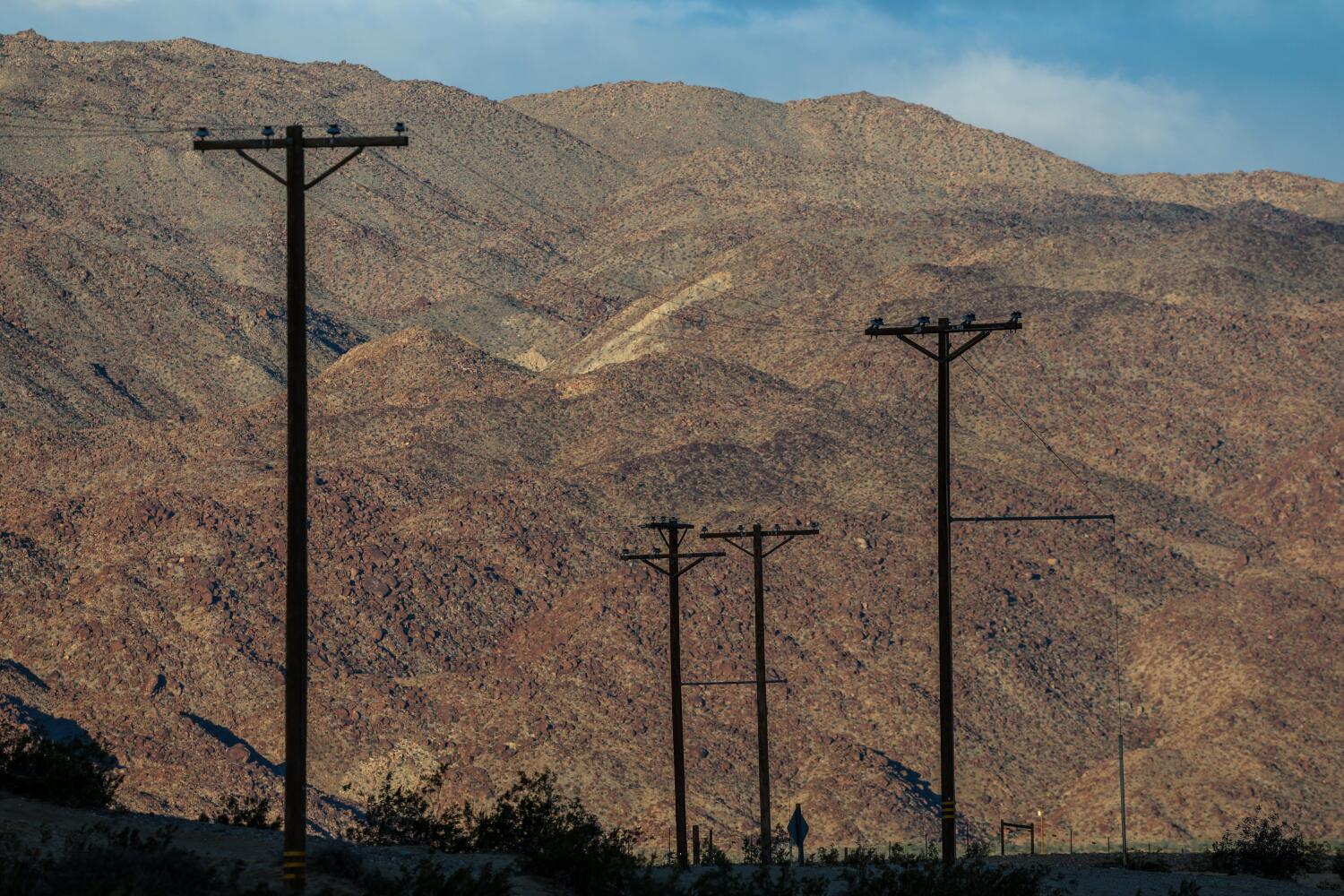
The air in the backcountry always has a specific weight before a storm. It smells of dried sage, parched earth, and a faint, metallic tang that hooks the back of your throat. If you stand under the heavy transmission lines cutting through the valleys of Southern California, that metallic taste never really leaves. It hums. A low, vibrating thrum that lives in your teeth.
For the people who live beneath these steel giants, that sound is not the music of progress. It is a ticking clock.
Fourteen years ago, the Sunrise Powerlink cut a scar across the landscape. It was promised as a gateway to a cleaner future, a 117-mile umbilical cord carrying renewable energy from the Imperial Valley into San Diego. We were told it was necessary. We were told it was unique.
Now, the maps are being unrolled again. Another high-voltage project is on the table, tracing paths that feel sickeningly familiar to anyone who watched the first grid go up. The logos on the paperwork have changed, but the blueprint remains the same. Infrastructure advocates talk about these lines in the language of spreadsheets: megawatts, transmission efficiency, and regulatory compliance. They see a blank canvas.
They do not see the dust. They do not remember the fire.
Consider a hypothetical resident named Frank. He is not a statistic, though he represents thousands of families living in the rural interfaces where these projects actually touch the ground. Frank bought his patch of land thirty years ago for the silence. Today, his morning coffee is accompanied by the rhythmic snap-crackle of 500,000 volts ionizing the air above his property line. When the Santa Ana winds kick up, blowing hot and dry from the desert, Frank does not sleep. He watches the ridgeline. He knows that a single arc, a single failure of steel or ceramic in the backcountry, can turn his life’s work into ash in twenty minutes.
The fear is not irrational. It is historical.
The Weight of Steel
To understand why a new power line project feels like a betrayal, you have to look at what happened when the Sunrise Powerlink was rammed through over a decade ago. It was pitched as a vital artery for green energy. Yet, the physical reality of building a massive transmission corridor involves heavy machinery tearing through fragile ecosystems, the eminent domain battles that strip landowners of their autonomy, and the permanent alteration of the horizon.
Large-scale energy infrastructure follows the path of least resistance. Usually, that path goes right through communities with the least political leverage to fight back.
Energy executives argue that to power our digital lives—our electric vehicles, our climate-controlled homes, our data centers—we must accept these corridors. They present it as a binary choice: either we build massive, centralized lines through the backcountry, or the lights go out.
But this is a false choice. It relies on an outdated twentieth-century model of energy distribution.
Think of our electrical grid like our water system. The old way is to build a massive dam hundreds of miles away and pipe the water through a single, giant aqueduct across the desert. If that aqueduct breaks, or if the source dries up, everyone downstream thirsts. The new way—the smarter way—is decentralized catchment. Rain barrels, localized recycling, and community wells.
In energy terms, this means distributed generation. Rooftop solar, localized microgrids, and neighborhood battery storage. When you generate power precisely where it is consumed, you eliminate the need for the giant, vulnerable arteries that carve up rural communities. You eliminate the line loss—the energy that simply evaporates into the air as heat while traveling hundreds of miles over copper wires.
The new project being proposed is not an innovation. It is an expensive echo.
The Cost of the Corridor
There is a strange blindness that happens in boardroom meetings in downtown high-rises. When looking at a topographic map, a mountain range is just a contour line. A community is just a cluster of yellow dots.
If you talk to the engineers, they will give you the hard data. They will tell you that the new lines are designed with modern materials, that the fire mitigation protocols are stricter now, and that the environmental impact reports are thousands of pages thick. They use these numbers as a shield against human emotion.
But numbers cannot quantify the psychological toll of living in a permanent evacuation zone.
During the construction of the original Powerlink, helicopters buzzed over homes from dawn until dusk. Heavy trucks turned quiet country lanes into choked, dusty thoroughfares. The local economy, built on eco-tourism and peace, choked on the exhaust. The promised economic boom for locals turned out to be a transient workforce that left as soon as the concrete cured.
Worse, the financial burden of these mega-projects almost always trickles down to the ratepayer. The utility companies guarantee their investors a return on capital expenditures. Every mile of steel tower, every foot of cable, and every substation built represents a cost that is quietly tacked onto the monthly utility bills of working-class families miles away from the towers. You pay for the destruction of the backcountry every time you flip a light switch in the city.
It is a closed loop of profit and displacement.
Broken Promises on the Wind
The most bitter pill for residents to swallow is the justification used for these projects. They are almost always wrapped in the green flag of environmental stewardship. We are told these lines are the only way to meet ambitious state carbon-reduction goals.
Look closer at the actual output data of centralized desert energy projects over the last decade. The reality is messy. Centralized solar farms take up massive footprints of desert habitat, destroying the desert tortoise’s home and flattening ancient ecosystems to create a mirror-world of silicon panels. Then, we build hundreds of miles of lines to bring that power to the coast.
It is an incredibly inefficient way to be green.
True sustainability does not require a sacrifice zone. It does not require rural families to live in terror of the next windstorm just so city dwellers can feel good about their carbon footprint. We have millions of square feet of empty, flat warehouse roofs in our industrial zones, sitting right next to the sub-stations that feed our cities. We have parking lots that could be shaded by solar canopies.
Why build a pipeline through a forest when you can harvest the sun right on top of the factory?
The insistence on building new high-voltage lines is not driven by engineering necessity. It is driven by an institutional inertia. Utilities know how to build big things and charge the public for them. It is their business model. Microgrids and decentralized solar threaten that model because they give power—literally and figuratively—back to the individual.
The Horizon Remembered
Go back to the backcountry. Walk away from the highway, up past the chaparral, to where the ridges overlook the valleys. If you look in one direction, you can see the towers of the Sunrise Powerlink marching across the hills like an invading army of giant iron insects. They do not blend in. They never will.
The people who live here remember what the ridgeline looked like before the steel arrived. They remember the unbroken silhouette of the mountains against the twilight sky.
A new project threatens to double that footprint. To add another set of wires to the sky. Another set of hums to the night air. Another variable in the terrifying calculus of wildfire season.
We are told that this is the price of the future. But when you look at the old paths being walked by the energy companies, it becomes clear that this is not the future at all. It is just the past, built bigger, heavier, and closer to home.
The wind is beginning to pick up in the canyon. The dry leaves of the live oaks scratch against one another, a frantic, paper-thin sound. Above them, on the ridge, the wires begin their familiar, high-frequency sing-song. It is a warning. If we do not change how we think about energy, how we value the spaces between our cities, and who we listen to when decisions are made, we will keep building the same mistakes over and over again, casting longer and darker shadows over the earth below.


