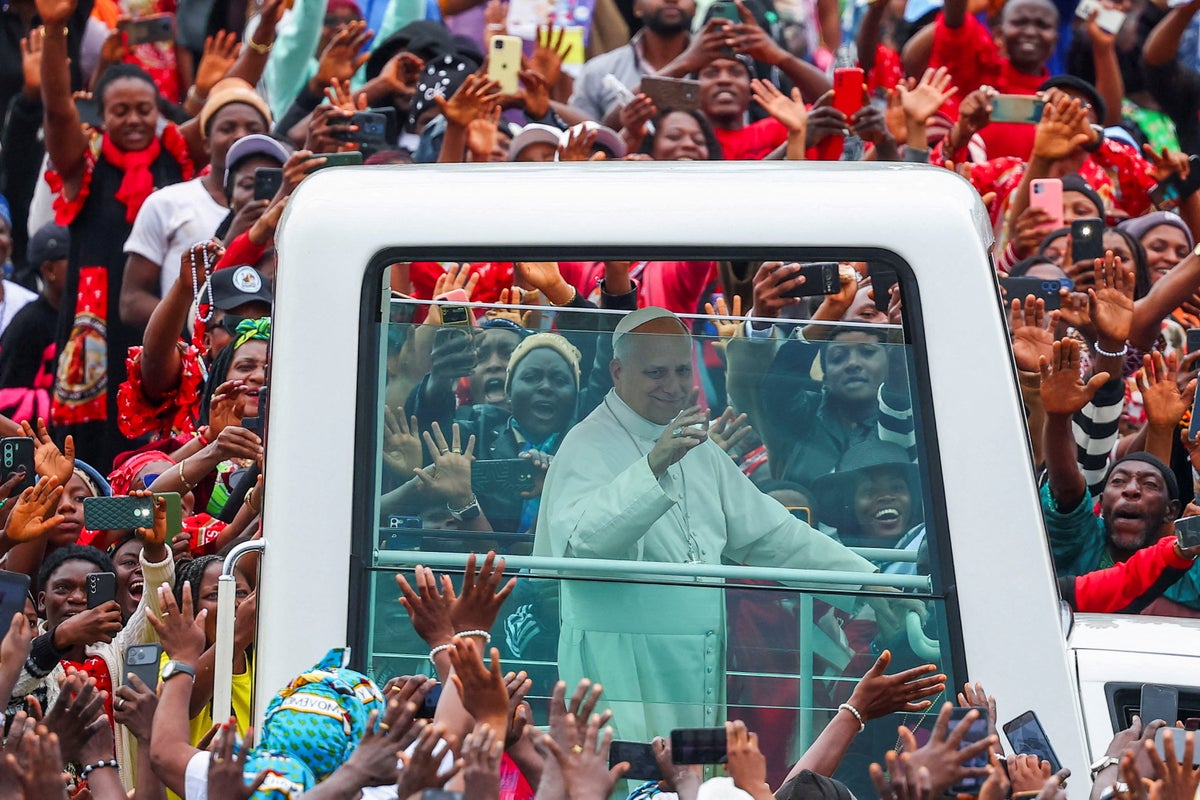
More than a million people are expected to descend upon Ndolo airport for a single morning of prayer, marking the centerpiece of a high-stakes diplomatic and religious journey through the Democratic Republic of Congo. This is not merely a religious service. It is a massive logistical gamble in a city where infrastructure is already stretched to its breaking point. While the official narrative focuses on peace and reconciliation, the reality on the ground involves a grueling mobilization of security forces, health workers, and transit systems struggling to accommodate a crowd larger than the population of many European capitals.
The scale of this gathering exceeds almost any other event on the global calendar. To put it in perspective, the crowd anticipated for this Mass is roughly ten times the capacity of the largest American football stadiums. They are coming from every corner of the DRC and neighboring countries, many traveling for days on foot or in overcrowded barges along the Congo River.
The Mechanics of a Million Person Gathering
Holding a Mass for over a million people at an urban airport creates a unique set of hazards. Ndolo airport, usually reserved for light aircraft and domestic freight, has been transformed into a sprawling open-air cathedral. The sheer physics of moving that many human bodies into a confined space requires more than just faith.
Security cordons must be airtight. In a region where political tensions often simmer just below the surface, the presence of the Pope acts as both a unifying force and a potential lightning rod. The Congolese government has deployed thousands of police and elite guard units to manage the perimeter. However, the real challenge isn't just the threat of outside interference; it is the management of the crowd itself.
Crowd crush is a constant shadow over events of this magnitude. To mitigate this, organizers have divided the airport tarmac into massive "corrals" separated by heavy-duty fencing. This prevents a localized surge of people from turning into a deadly wave. Each section has its own dedicated entry point and emergency exit, though the effectiveness of these measures will be tested the moment the first person tries to move toward the altar for communion.
Beyond the Altar
The Vatican’s interest in the DRC is deeply pragmatic. Africa is the only continent where the Catholic Church is seeing explosive growth, and the DRC is home to the largest Catholic population on the continent. This Mass is a statement of power and presence. It is meant to remind the political elite in Kinshasa that the Church remains the most organized and influential non-state actor in the country.
For the average citizen, the motivations are more personal. The DRC has endured decades of conflict, particularly in the eastern provinces. For many, attending this Mass is an act of desperation as much as devotion. They are looking for a moral authority to acknowledge their suffering in a way their own government often fails to do.
The Health and Sanitation Deficit
Providing basic necessities for a million people in the equatorial heat is a staggering task. The water requirements alone are massive. Thousands of temporary water stations have been installed, yet history suggests these often run dry within hours of a crowd’s arrival.
Medical tents are stationed every few hundred yards, staffed by volunteers from the Red Cross and local hospitals. Their primary concern is not just heatstroke, but the rapid spread of waterborne illnesses if sanitation systems fail. Portable toilets are being deployed in numbers never seen before in Kinshasa, but the ratio of facilities to attendees remains dangerously low.
The Economic Ripples
While the spiritual focus is clear, the economic impact of the Papal visit is felt in every market stall in the city. Prices for basic goods, transport, and lodging have tripled in the lead-up to the event. Street vendors have shifted their entire inventory to Papal memorabilia—printed cloths, candles, and plastic fans bearing the Pope's likeness.
This isn't just opportunistic "side-hustle" culture. It is a vital injection of capital into a struggling local economy. However, the flip side is that the city's poorest residents are being priced out of their own neighborhoods as pilgrims snap up every available square inch of floor space.
A Fragmented Security Apparatus
While the elite units guard the Pope, the rest of the city is left in a state of flux. Small-scale crime often spikes during these massive events as police resources are concentrated at the airport. There is also the matter of the "invisible" security: the Church’s own lay volunteers. Tens of thousands of young Catholics have been trained to act as ushers and first-line security. They are the ones who will actually manage the flow of the crowd, serving as a buffer between the civilian population and the more heavy-handed state military forces.
The Message and the Map
The Pope’s homily is expected to address the "blood diamonds" and mineral wealth that have fueled the DRC’s internal wars. This is a deliberate choice. By speaking these truths on Congolese soil, the Vatican is positioning itself as a critic of the international corporations and local militias that profit from the chaos.
Critics argue that a single Mass cannot change the systemic corruption that plagues the region. They are right. A liturgy is not a policy white paper. Yet, the symbolic weight of a million people standing together in silence cannot be dismissed. It creates a temporary, visible "nation" within the airport walls that demands to be seen by the rest of the world.
The Logistics of Departure
The most dangerous part of any mega-event is not the arrival, but the exit. When the final blessing is given, a million people will attempt to leave the airport simultaneously. This is the moment when the system is most likely to fracture.
Kinshasa’s roads are notoriously narrow and prone to gridlock. If the exit routes are not managed with surgical precision, the resulting bottleneck could leave hundreds of thousands of people stranded in the dark as night falls. Organizers have planned a staggered release, but human nature rarely follows a schedule. People will be tired, dehydrated, and anxious to return to their families.
The success of this day will not be measured by the beauty of the choir or the eloquence of the sermon. It will be measured by the ability of a million people to return home safely.
The Pope’s plane will take off, leaving the scent of incense and the echoes of a massive choir behind. What remains will be a city exhausted by the effort of playing host to the world. The temporary altars will be dismantled, and the airport will return to its mundane routine of freight and regional hops. But for those who stood on the hot tarmac, the memory of being part of that massive, breathing sea of humanity will linger far longer than any official diplomatic communiqué.
Those planning to attend must prioritize self-sufficiency. Carry more water than you think you need. Identify the nearest medical tent the moment you enter your designated zone. Establish a meeting point with your group outside the airport perimeter in case you are separated during the exit surge. Relying on mobile phone networks is a mistake; they will almost certainly crash under the weight of a million simultaneous uploads. Prepare for a long, slow journey back to reality.