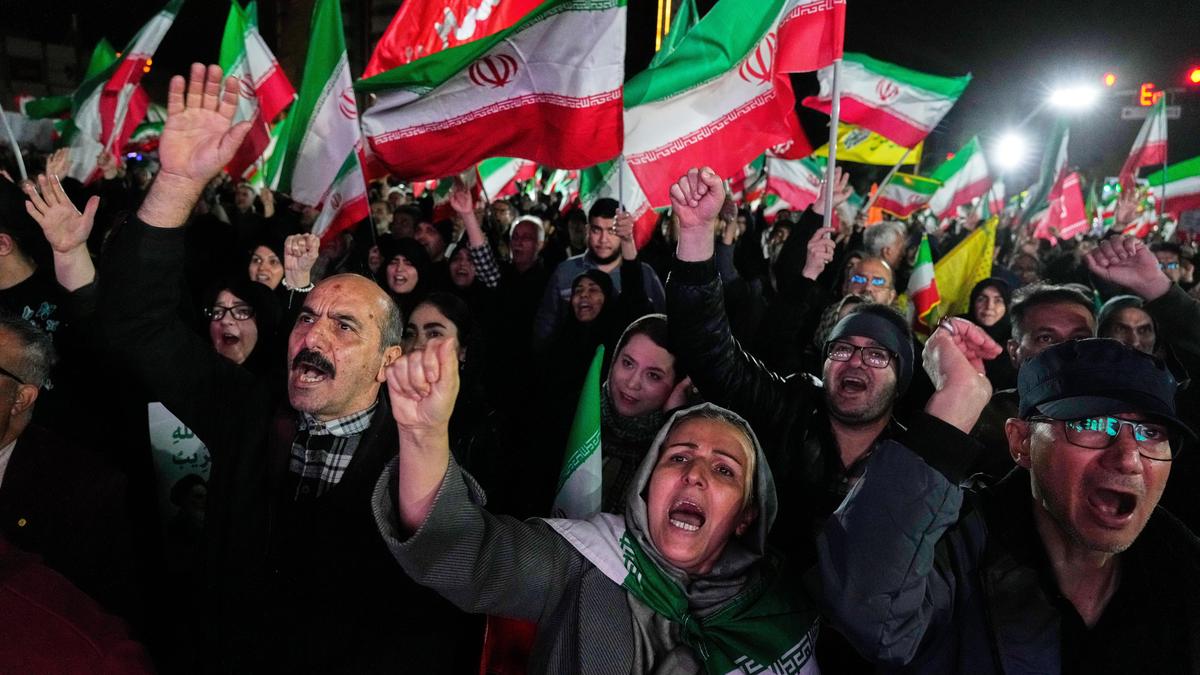
The declaration by Iranian President Masoud Pezeshkian that 14 million citizens have volunteered for existential sacrifice represents more than a rhetorical flourish; it is a formal data point in the doctrine of asymmetric deterrence. When a state leader quantifies "martyrdom" as a strategic asset, the objective is to signal a specific threshold of civil-military integration designed to offset conventional technological deficits. Analyzing this claim requires moving past the surface-level political messaging and deconstructing the institutional framework, the demographic reality, and the logistical friction that governs such a massive hypothetical mobilization.
The Institutional Architecture of Voluntarism
The figure of 14 million finds its origin in the organizational structure of the Basij-e Mostaz'afin (Organization for Mobilization of the Oppressed). This is not a spontaneous gathering of individuals but a state-managed paramilitary entity integrated into the Islamic Revolutionary Guard Corps (IRGC). To understand how a state reaches a "14 million" volunteer metric, one must examine the three tiers of membership that constitute the Basij:
- The Regular (Aadi) Tier: This group comprises the bulk of the reported numbers. These are citizens—students, workers, and government employees—whose "volunteer" status is often tied to social services, educational benefits, or professional advancement. Their readiness for high-intensity conflict is nominal.
- The Active (Fa’al) Tier: This segment undergoes consistent ideological and basic military training. They serve as the functional link between the civilian population and the IRGC, acting as internal security and local administrative support.
- The Special (Specialized) Tier: These individuals are effectively reserve military personnel. They possess technical skills or combat training and are integrated into the IRGC’s operational plans.
The "14 million" figure likely aggregates all three tiers, conflating social affiliation with combat readiness. This creates an Ideological Buffer Zone, where the state uses high membership volume to discourage external intervention by implying that any kinetic conflict would necessitate a ground war against a saturated civilian-military hybrid force.
The Cost Function of Mass Mobilization
Claiming the availability of 14 million volunteers ignores the catastrophic economic and logistical bottlenecks of actual deployment. In a modern theater of war, the transition from "volunteer" to "combatant" is governed by a strict cost function.
Procurement and Equipment Constraints
Providing even the most basic kit—small arms, personal protective equipment, and communication devices—to 14 million individuals exceeds the manufacturing and procurement capacity of any middle-income economy. If the Iranian defense industry attempted to outfit this volume of personnel, the resulting strain on the supply chain would lead to a rapid depletion of strategic reserves. The logistical reality dictates that mass mobilization would likely result in an Under-Equipped Surplus, where the sheer number of personnel becomes a liability, clogging transport arteries and consuming rations without providing a proportional increase in lethality.
The Opportunity Cost of Labor
The withdrawal of 14 million able-bodied citizens from the workforce would trigger an immediate collapse of the domestic economy. Iran’s GDP is heavily reliant on industrial and service sectors that require a stable labor pool.
- Agricultural Disruption: A significant portion of Basij recruits comes from rural and working-class backgrounds. Their removal from the labor cycle would lead to immediate food insecurity.
- Urban Gridlock: The administrative functions of the state are managed by individuals who populate these volunteer lists. Mobilizing them halts the very bureaucracy required to manage a wartime economy.
The state’s claim therefore rests on the Paradox of Non-Utilization. The volunteers are most valuable when they are not mobilized, acting as a psychological deterrent rather than a functional army.
The Mechanism of Deterrence via Human Capital
The strategy employed here is rooted in the concept of Social Saturation. By claiming that roughly 16% of the total population is prepared for self-sacrifice, the Iranian leadership seeks to alter the risk-benefit analysis of its adversaries. This is a shift from conventional deterrence (weapons systems) to normative deterrence (the threat of an "unwinnable" social war).
Asymmetric Attrition
The Iranian military doctrine emphasizes the ability to absorb high levels of damage while inflicting constant, low-level attrition on a technologically superior foe. In this framework, the 14 million volunteers serve as a "Human Depth" strategy. Just as Russia uses geographic depth to exhaust invaders, the Iranian strategy uses demographic depth. The logic assumes that an adversary may have the precision to strike 1,000 targets, but lacks the political or logistical will to engage with a decentralized force of millions scattered across a complex topography.
Domestic Legitimacy and the Cohesion Loop
The public declaration of these numbers also serves an internal function. It reinforces a Cohesion Loop, where the state defines national identity through the lens of readiness and sacrifice. By including himself in the count, the President attempts to bridge the gap between the ruling elite and the populace, signaling that the "cost of war" is shared equally. This is a crucial tactic for maintaining internal stability during periods of intense international sanctions and economic pressure.
Limitations of the Volunteer Model
While the figure serves as a potent psychological tool, three primary friction points undermine its operational validity:
- The Training Gap: There is a significant divergence between "ideological readiness" and "tactical proficiency." Modern warfare is increasingly defined by electronic warfare, drone integration, and precision strikes. A mass of uncoordinated volunteers provides a target-rich environment for advanced kinetic systems.
- Command and Control (C2) Fragility: Managing a force of 14 million requires a decentralized command structure that is prone to fragmentation. In a high-stress environment, the communication links between the IRGC and the local Basij cells are likely to break down, leading to friendly fire incidents or total operational paralysis.
- Diminishing Returns of Zeal: History demonstrates that the initial surge of volunteerism often fades under the reality of prolonged, high-casualty conflict. The Iranian leadership is banking on a sustained level of commitment that may not survive the transition from rhetoric to the battlefield.
Strategic Forecast: The Shift to Hybrid Reserves
The 14 million claim signals that Iran is doubling down on its "Mosaic Defense" strategy. Rather than attempting to match the West or regional rivals in conventional naval or air power, the focus will remain on saturating the internal landscape with loyalist elements.
Military planners should anticipate that Iran will continue to use these figures to justify the expansion of the Basij’s role in cyber-warfare and domestic surveillance. The "volunteer" of the future in the Iranian context is less likely to be a rifleman and more likely to be a digital actor or a local enforcer tasked with maintaining regime continuity under extreme pressure.
For external actors, the strategic counter-play is not to engage with the 14 million figure as a military reality, but to target the logistical and economic pillars that allow the state to maintain this social contract. If the state cannot provide the benefits—subsidies, education, and career paths—that underpin Basij membership, the "volunteer" pool will undergo a rapid, non-linear contraction. The battle for influence in Iran is not against a 14-million-man army, but against the economic framework that makes such an army's existence a useful political fiction.