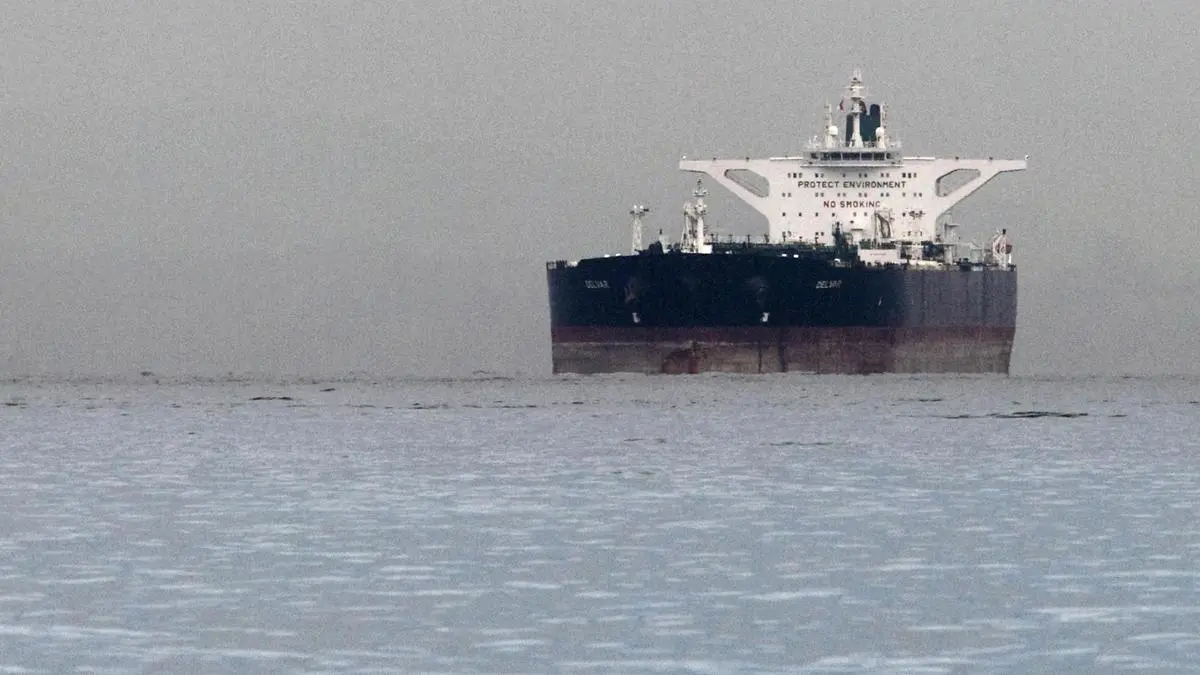
A VLCC—a Very Large Crude Carrier—is a floating cathedral of steel. When it is fully loaded with two million barrels of oil, it doesn’t so much sail as it displaces the world. It sits deep, a massive, sluggish heartbeat of the global economy, moving at the pace of a steady jog. Now, imagine you are the captain of that vessel, standing on the bridge as you approach the Strait of Hormuz.
The water here is a choke point. At its narrowest, the shipping lanes are only two miles wide. To your left and right, the rocky coastlines of Iran and Oman squeeze the horizon. You are carrying a cargo worth roughly $150 million, and you are doing so through a corridor where, in recent months, drones have buzzed like angry hornets and sea mines have been whispered about in every insurance office from London to Tokyo. This is the "Hormuz Dilemma." It is the reason your palms are damp on the console.
For decades, the world has accepted this anxiety as the cost of doing business. If the Strait closes, the lights go out in cities thousands of miles away. But a shift is happening, quiet and tectonic. Saudi Arabia is currently offering the world’s thirsty oil markets a back door. They are inviting the world to look away from the Strait and toward the Red Sea.
The Steel Arteries
Deep beneath the scorched gravel of the Arabian Peninsula lies a different kind of miracle. It isn't liquid. It is a series of pipes, 48 inches in diameter, stretching 745 miles from the massive oil fields in the East to the port of Yanbu in the West. This is the East-West Pipeline.
For years, this pipeline was a secondary thought, a contingency plan gathering dust in the heat. But as geopolitical tensions in the Persian Gulf transitioned from a seasonal simmer to a permanent boil, the Saudi state oil giant, Aramco, began to see the sand differently. They saw a way to bypass the world's most dangerous maritime intersection entirely.
Consider the logistics of a global buyer. If you are a refinery in Rotterdam or a trader in New York, the Strait of Hormuz is a gamble. Every time a tanker passes through, the "war risk premium"—the extra insurance cost tacked onto every barrel—spikes. It is a tax on instability. By moving the point of sale to the Red Sea, Saudi Arabia is essentially offering a "security discount." They are moving the checkout counter of the world's gas station to a safer neighborhood.
The Human Cost of a Choke Point
Statistics are cold. They don't capture the tension in a boardroom when a CEO realizes their entire quarterly projection is tied to a single naval escort. They don't capture the exhaustion of a merchant mariner who hasn't slept properly in three days because the radar is picking up "unidentified fast-moving craft."
The Red Sea option isn't just about moving molecules of hydrocarbons from point A to point B. It is about the psychology of certainty. In the world of high-stakes energy trading, certainty is the only currency that matters more than the oil itself. By beefing up the capacity of the Yanbu terminals and the pipelines that feed them, the Kingdom is attempting to de-risk the very concept of energy.
But this isn't a simple fix. It is a massive engineering feat. Pumping millions of barrels of oil uphill across mountains and across the vast Rub' al Khali desert requires an incredible amount of energy. It is expensive. It is grueling work performed by engineers who live in remote pump stations, surrounded by nothing but wind and sun, ensuring that the pressure remains constant. These are the invisible guardians of your morning commute.
A New Map of the World
Geopolitics is often taught as a series of lines on a map, but it is actually a story of plumbing. When the pipes move, the power moves.
By shifting the focus to the Red Sea, Saudi Arabia is recalibrating its relationship with the West and the East. The Red Sea is the gateway to the Suez Canal and the Mediterranean. It is a straight shot to Europe. Traditionally, the majority of Saudi crude headed east to China, Japan, and India through the Strait of Hormuz. Now, the Kingdom is creating a dual-pronged strategy. They are telling the world: "We are no longer hostages to a single waterway."
There is a vulnerability here, of course. No plan is perfect. The Red Sea has its own ghosts, specifically the Bab el-Mandeb strait to the south, where different conflicts and different drones wait. But for a buyer sitting in a glass tower in London, the Red Sea feels like an open door compared to the claustrophobia of Hormuz.
The "Red Sea Option" is a signal. It tells us that the era of relying on twentieth-century infrastructure to solve twenty-first-century volatility is over. We are watching the literal redirection of the world's lifeblood.
The Quiet Momentum
Walk through the port at Yanbu and you won't see much drama. You see the shimmering heat haze over the storage tanks. You hear the low hum of massive pumps. You see the steady, rhythmic loading of tankers that will never have to see the jagged cliffs of the Oman coastline.
There is a strange peace in this kind of industrial grit. It is the peace of a problem being engineered out of existence. While headlines scream about naval standoffs and regional collapses, the technicians in the desert are simply turning valves. They are lengthening the nerves of the global economy, stretching them thin and far, hoping that distance equals safety.
The oil still flows. It just found a different way to breathe.
Think about that next time you see the price at the pump flicker by a few cents. Somewhere, a thousand miles from the nearest ocean, a sensor is monitoring a pipe in the sand, ensuring that the chaos of a distant strait stays exactly where it belongs: in the rearview mirror.
The sand eventually covers everything, but the oil under the pressure of the desert sun keeps moving, silent and relentless, toward the blue water of a safer shore. It is a long, dark line drawn across the world, a promise kept in steel and sweat.
Would you like me to analyze how this shift in oil transit routes specifically impacts the maritime insurance industry's pricing models for the next fiscal year?