The Knock at the Door
The sun was barely up over the Maryland suburbs when the silence of a mundane Tuesday shattered. For most neighbors, it was the sound of a commute beginning. For the people inside the house, it was the sound of a legacy finally catching up to them. Federal agents don't usually knock with a light touch when the name on the warrant is tied to the most famous general in the Middle East.
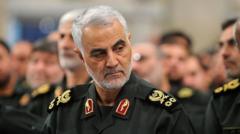
They were looking for the relatives of Qasem Soleimani. Meanwhile, you can explore similar events here: The Terrorist Logic We Refuse to Map.
Six years ago, a drone strike at Baghdad International Airport turned the Iranian commander into a martyr or a monster, depending on which side of the border you stood. The world watched the fireball on the news and assumed the story ended there. We like our geopolitical dramas to have clean credits at the end. We want the villain or the hero gone so we can move on to the next headline.
But history doesn't work in snapshots. It bleeds. It lingers in bank accounts, in hushed phone calls, and in the lives of people who carry a specific DNA. The recent arrests in the United States prove that while the general is buried in the earth of Kerman, the network he built remains a living, breathing thing. To see the full picture, we recommend the detailed report by Associated Press.
A Web of Blood and Ledger Sheets
To understand why the Department of Justice is kicking down doors in quiet American neighborhoods, you have to look past the military medals and the green fatigues. Soleimani wasn't just a soldier. He was an architect of a shadow economy.
Under his leadership, the Quds Force became more than an elite military unit. It became a multi-billion-dollar conglomerate. It dealt in oil, in construction, and in the silent movement of currency through front companies that looked as innocent as a local dry cleaner or a small-scale import-export business.
The strategy was simple: survival. When a country is choked by sanctions, it doesn't just stop breathing. It finds new ways to circulate blood. Soleimani’s relatives weren't arrested for what they believe. They were arrested for what they allegedly moved. Money.
Federal prosecutors aren't chasing ghosts; they are chasing the paper trail left by the living. The charges involve sophisticated schemes to bypass US sanctions—a game of financial cat-and-mouse where the stakes aren't just a fine or a slap on the wrist. The stakes are the continued funding of proxy wars that stretch from the Mediterranean to the Persian Gulf.
The Weight of a Name
Imagine growing up in the shadow of a man who commanded tens of thousands. Imagine the pride, the fear, and the inevitable target painted on your back the moment you stepped onto Western soil.
The relatives arrested in this sweep lived in a strange duality. On one hand, they were part of the American fabric, perhaps driving the same SUVs and drinking the same coffee as the people next door. On the other, they were allegedly nodes in a clandestine network designed to undermine the very system they inhabited.
This is the messy reality of modern conflict. It isn’t always fought in trenches. Sometimes it is fought in the backend of a banking app. It’s fought in the discrepancy between a declared income and a hidden wire transfer.
The FBI doesn't move on family members lightly. To do so is to invite a firestorm of diplomatic tension. But the evidence presented suggests a pattern of behavior that was less about family loyalty and more about institutional continuity. The Quds Force didn't die in that 2020 drone strike. It just learned to whisper.
The Invisible Stakes
Why does this matter to the average person? Because it reveals the porosity of our borders—not just the physical ones, but the financial ones.
When money moves through these shadow channels, it isn't just "Iranian money." It becomes invisible. It mixes with the global flow of capital. It buys influence. It funds operations that the world only learns about when something explodes.
The arrests act as a reminder that the "War on Terror" never really transitioned into a period of peace. It just morphed into a high-stakes game of forensic accounting. Every dollar moved by a relative of a sanctioned individual is a test of the West's resolve. If the rules don't apply to everyone, they eventually apply to no one.
Consider the complexity of the operation. To track these individuals, investigators had to sift through thousands of encrypted messages and years of financial records. They had to wait for the moment when the suspects felt safe enough to make a mistake.
The mistake was thinking that time had blurred the memory of the American intelligence community.
The Cold Reality of Geopolitics
There is a tendency to view these arrests through a lens of cruelty. "Why go after the family?" people ask. It’s a fair question in a vacuum. But in the world of high-level espionage and state-sponsored militancy, family is often the only circle small enough to be trusted.
If you are a regime looking to move millions of dollars past the prying eyes of the Treasury Department, you don't hire a stranger. You hire your blood. You hire the people whose loyalty is guaranteed by something deeper than a paycheck.
This creates a tragic cycle. The sins of the father—or in this case, the general—become the chains of the children. They are born into a game they didn't choose, but many of them choose to play it anyway.
The arrests in Maryland and beyond aren't just about punishing individuals. They are about sending a signal to Tehran: the reach of the law is as long as the reach of the general's influence once was.
The Echo in the Halls of Power
In Washington, these arrests are viewed as a tactical victory. In Tehran, they are seen as a provocation.
The Iranian government has already begun the predictable cycle of condemnation, calling the moves an "act of aggression" against innocent civilians. This rhetoric ignores the technical nature of the charges—conspiracy, money laundering, and violations of the International Emergency Economic Powers Act. These aren't vague accusations of being "bad people." They are specific, documented instances of breaking the law.
Yet, the human element remains. There is a chilling nature to the realization that the geopolitical battles we read about in history books are actually happening in our zip codes. The neighbor who always kept their lawn perfectly manicured might have been the person ensuring that a shipment of drone parts made it through a port in Dubai.
The world is smaller than we think.
The Unfinished Story
We often think of justice as a gavel hitting a block of wood. A definitive end. But this story has no end in sight.
As long as there are sanctions, there will be people trying to break them. As long as there are powerful figures like Soleimani, there will be those who try to carry their torch. The arrests of his relatives represent a single stitch in a massive, frayed tapestry of global security.
The agents who led the suspects away in handcuffs weren't just making an arrest. They were closing a gap. They were attempting to prove that even the most powerful ghosts can eventually be exorcised if you follow the money long enough.
Outside the courthouse, the world keeps moving. People go to work. They buy groceries. They plan for the future. But for a few individuals, the future has been traded for a past they could never quite outrun. The shadow of the general is long, cold, and now, it is finally starting to recede.
The silence that followed the morning arrests wasn't a sign of peace. it was the sound of a very long, very quiet war entering its next chapter.



