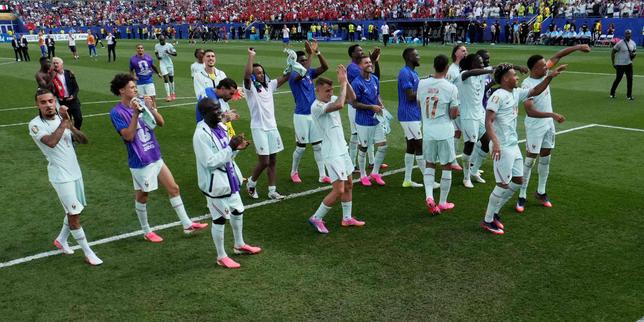
The camera does not care about friendship. It does not care about the years spent sharing a locker room in Paris, the inside jokes, or the shared holidays. Under the blinding lights of the stadium, the lens zooms in until the frame holds nothing but the sweat bead tracing a path down Achraf Hakimi’s temple.
To the millions watching the broadcast, it is just a high-definition close-up before a semifinal kickoff. But if you look closer, tracking the micro-movements of his posture through the exclusive tactical feed, you see something entirely different. You see the immense, crushing isolation of a man caught between his past and his purpose.
Football at this level is stripped of its romance. It is reduced to cold physics and brutal mechanics. Yet, when Morocco faces France, the tactical diagrams on the whiteboard melt away. The game transforms into an intimate psychodrama played out across seventy yards of perfectly manicured grass.
Every player has a shadow. For Hakimi, that shadow happens to be the fastest, most lethal forward on the planet.
The Geometry of Isolation
Positioning yourself as a modern right-back is an exercise in managed paranoia. You are asked to be an attacker, an architect, and a frontline defender all at once. When the whistle blows, Hakimi is completely alone in his zone.
The exclusive tactical camera tracks him from an elevated angle, stripping away the crowd's noise to reveal the sheer spatial reality of the match. You can see his head constantly on a swivel. Three degrees to the left. Two steps back. He is calculating distances in milliseconds. He knows that a single step too far forward leaves an ocean of space behind him—an ocean that France is engineered to exploit.
Consider the physical reality of tracking a world-class winger. It is not just about running fast; it is about the violence of deceleration. Hakimi sprints at top speed, only to force his heels into the turf, absorbing hundreds of pounds of force through his knees, turning his hips in a desperate bid to match a change of direction. The specialized camera capture shows the precise moment his muscles lock, the sudden tension in his jaw as he denies the inside lane.
It is exhausting to watch. It is torturous to endure.
The narrative of the modern fullback is often written in statistics—crosses completed, interceptions made, kilometers covered. But statistics are a terrible way to measure fear. They fail to capture the suffocating anxiety of knowing that a solitary mistake will be replayed in slow motion on every television screen across the globe for the next decade.
The Dialogue of the Eyes
Sports television usually focuses on the ball. We follow the white sphere as it zips across the grass, tracking the action like cats watching a laser pointer. But the real game occurs away from the ball, in the silent, tense negotiations between opponents.
During a break in play while an injured player receives treatment, the isolated camera lingers on Hakimi. He does not look at his coach. He does not look at the referee. His eyes find a familiar figure in a blue shirt.
There is a brief, almost imperceptible nod. No smiles. This is the tragic beauty of elite sport: the people who understand your journey best are often the ones tasked with destroying it. They grew up in similar European academies, navigated the intense pressures of early stardom, and pushed each other to the absolute limit in training sessions behind closed doors. Now, they are separated by the color of a jersey and the weight of national expectation.
The camera catches the shift in Hakimi's expression as play resumes. The warmth vanishes. The eyes narrow. The friend is gone, replaced by an obstacle that must be neutralized at all costs.
This is where the psychological burden becomes physical. When you know an opponent's tendencies intimately, you risk overthinking. You expect the cut inside because you have seen it a thousand times in practice. But the opponent knows you expect it. The game becomes a hall of mirrors, a series of bluffs and double-bluffs executed at twenty-two miles per hour.
The Weight of a Continent
To play for France is to carry the expectations of a footballing superpower, a machine built to collect trophies. To play for Morocco is to carry something entirely different. It is the weight of a culture, the dreams of an entire diaspora, and the roaring pride of a continent that has historically been told to wait its turn.
Every time Hakimi touches the ball, the stadium erupts into a wall of sound that seems to vibrate the camera lens itself. You can see the energy transfer into his stride. He plays with a distinct, furious urgency. It is the style of someone who knows he is playing for more than just a medal. He is playing for the kids in Casablanca, the suburbs of Madrid, the cafes in Brussels, and every place where a red flag with a green star is currently being waved with trembling hands.
The exclusive broadcast feed captures a moment late in the first half. Morocco has sustained a wave of French pressure. The defenders are gasping for air, hands on knees. Hakimi walks through the penalty box, clapping his hands forcefully, screaming instructions, pulling his teammates up by their shirts.
He is not just a defender; he is the emotional anchor of a nation.
The contrast between the two sides is stark. France moves with the chilly, robotic precision of a corporate entity executing a quarterly plan. Morocco plays with the desperate, beautiful friction of an existential battle. Every tackle is celebrated like a goal; every cleared corner is an eviction of doubt.
The Cruel Verdict of the Clock
Time behaves differently under this kind of pressure. In the first fifteen minutes, it flies by in a blur of adrenaline and tactical sorting. In the final fifteen minutes, each second stretches out, heavy and agonizing.
The tracking camera shows the physical toll of this temporal distortion. Hakimi’s jersey is soaked through. His stride, usually so fluid and effortless, begins to look heavy. The explosive bursts of speed that define his game require an immense expenditure of willpower.
Then comes the moment the entire stadium has been waiting for. A loose ball in midfield. A quick transition. France moves the ball wide.
It is a footrace. The camera pans rapidly, struggling to keep both players in the frame as they accelerate down the touchline. The distance between them shrinks. Hakimi commits to the slide, his body launching across the grass in a desperate, perfectly timed intervention. His boots hook the ball away a split-second before the attacker can unlock the defense.
The stadium roars. Hakimi rises from the turf, pumping his fist, a primal scream caught perfectly by the microphone behind the goal.
It is a momentary victory. There is no time to celebrate. The ball is already being thrown back into play. The wheel turns again.
The Silent Arena
When the final whistle eventually blows, the noise of the crowd fades into a strange, distant hum for the players on the pitch. The camera cuts away from the celebrating side to focus entirely on Hakimi.
He stands motionless in the center circle. The contrast between his frantic movement during the match and this sudden, absolute stillness is jarring. The tactical feed shows him looking up at the sky, his face a mask of pure exhaustion and raw emotion.
The cameras will move on. The analysts will gather around their digital screens to dissect the pass completion percentages, the defensive errors, and the tactical adjustments that decided the match. They will reduce ninety minutes of human drama to a series of colored arrows and heat maps.
But those who watched the exclusive, unblinking lens tracking the Moroccan captain know the truth. They saw a performance that cannot be quantified by data. They witnessed the quiet heroism of a man who gave every ounce of his soul to an impossible task, fighting through the loneliness of the pitch, the ghosts of friendship, and the heavy, beautiful burden of his people.
The camera finally cuts to black, leaving behind the memory of a defender standing alone on the grass, surrounded by the debris of a battle that will be remembered for generations.