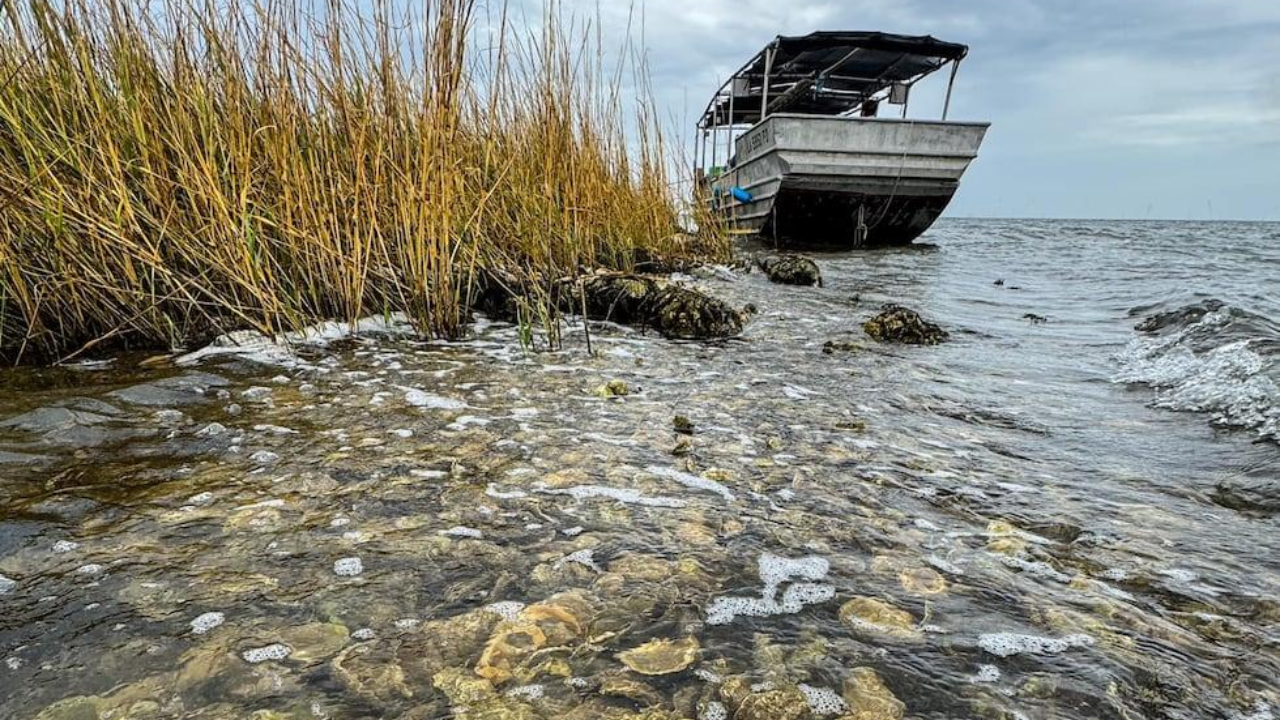
Louisiana volunteers recently collected 200 tons of discarded oyster shells from local restaurants and returned them to coastal waters, resulting in more than double the local oyster population on those restored reefs. By diverting calcium-rich shells from municipal landfills and placing them back into strategic estuaries, conservation groups created the exact hard substrate baby oysters need to attach, grow, and form protective coastal barriers.
Most people see an empty half-shell on a restaurant table in New Orleans or Baton Rouge and think of it as garbage. For decades, that is exactly how the hospitality industry treated it. Millions of pounds of shells were hauled off to landfills every year, buried under household waste where they did nothing but take up space. Meanwhile, just a few miles south, Louisiana’s coastline was dissolving into the Gulf of Mexico at an alarming rate, starved of the very material sitting in those dumpsters.
The math behind this ecological disconnect is brutal. Louisiana loses roughly a football field of wetlands every hundred minutes. Hurricanes, subsidence, and sea-level rise get the headlines, yet the quiet disappearance of natural oyster reefs plays an equally destructive role. Without those jagged, underwater walls breaking up wave energy, storm surges slam directly into fragile marsh grasses, ripping them out by the roots.
The Biology of a Housing Crisis
To understand why dumping 200 tons of shells back into the water works so well, you have to understand how an oyster lives. An oyster does not just appear out of nowhere on a muddy bottom. During the warm months, adult oysters release millions of microscopic larvae into the water column. These free-swimming babies, known as spat, drift with the tides for about two to three weeks.
Eventually, they get heavy and sink. This is the make-or-break moment of their lives. If a larva lands in soft Gulf mud, it suffocates and dies within hours. To survive, it must cement itself to a hard, clean surface. While they will occasionally attach to rocks, concrete, or wooden pilings, nothing triggers their biological settlement response quite like the calcium carbonate of another oyster shell.
When commercial harvesting removes millions of bushels of oysters from public reefs without returning the shells, the reef literally shrinks. Over generations, the hard foundation disappears, leaving behind flat, lifeless mud. You can have the cleanest water and the healthiest spawning population in the world, but without that hard cultch—the industry term for the shell base—the next generation has nowhere to live.
From Bourbon Street Dumpsters to Coastal Reefs
Turning restaurant waste into a living breakwater sounds simple on paper. In practice, it is a logistical grind that smells terrible in the July heat.
Programs like the Coalition to Restore Coastal Louisiana’s Oyster Shell Recycling Program have spent years building a supply chain out of thin air. Trucks make regular routes to dozens of participating restaurants across New Orleans, Baton Rouge, and Lafayette. Instead of tossing shucked shells into the regular trash, kitchen staff dump them into dedicated bins.
The work does not stop at collection. You cannot take a shell straight from an air-conditioned raw bar and toss it into the Gulf. Fresh shells carry bits of leftover meat, bacteria, and potentially invasive pathogens from other waters. If introduced directly into a sensitive estuary, that organic matter can spark localized algae blooms or introduce diseases like Dermo and MSX, which wipe out native oyster stocks.
To prevent this, the 200 tons of collected shells must be quarantined and cured. They are piled into massive mounds at staging sites—often in remote parishes—and left to bake under the Louisiana sun for at least six months. Rain washes away the salt and grime. Wind dries out the tissue. Ultraviolet rays sterilize the surface. Only when the shells are bleached white and completely odorless are they cleared for deployment.
The Grunt Work of Building a Reef
Once cured, the shells are loaded onto barges or heavy-duty boats and hauled out to designated restoration sites, such as Barataria Bay or the waters near Pointe-aux-Chenes. This is where the volunteers come in.
Deploying 200 tons of shell is not a delicate scientific procedure. It is backbreaking manual labor. Volunteers, commercial fishermen, and conservation staff spend hours shoveling shells off barges, filling mesh bags, and hauling them into waist-deep brackish water. In some projects, heavy machinery pushes the loose shell off deck barges onto pre-mapped reef footprints, creating long, low ridges parallel to the shoreline.
Within weeks of hitting the water, the transformation begins. The first warm tide brings waves of microscopic spat drifting over the newly laid shell. Sensing the calcium carbonate below, they drop down and glue themselves to the crevices.
By the following season, those invisible specks have grown into fingernail-sized juveniles. Two years later, they are three-inch adults, filtering up to 50 gallons of water a day each and spawning their own millions of larvae. Monitoring data from these restored sites consistently shows that oyster density more than doubles compared to adjacent, unrestored mudflats.
What the Feel-Good Headlines Leave Out
It is easy to celebrate a doubling of oyster numbers on a restored reef. The numbers are real, and the visual difference between a barren mudflat and a thriving, jagged reef is undeniable. Yet anyone who has covered Gulf Coast restoration for more than a decade knows that 200 tons of shell is a drop in a very large, very leaky bucket.
Louisiana’s coastal crisis is massive, and shell recycling faces severe limitations that rarely make it into press releases.
First, there is the sheer scale of the deficit. Two hundred tons sounds like a lot of weight until you spread it across an estuary. A single mile of shoreline protection can require thousands of tons of material. While New Orleans restaurants serve millions of oysters a year, a huge percentage of Louisiana’s harvest is shipped out of state in the shell, meaning those calcium resources leave the ecosystem forever. Even if every single restaurant in Louisiana recycled every single shell, it would not come close to replacing what has been lost over the last century of industrial harvesting and coastal erosion.
Second, oysters are entirely at the mercy of freshwater diversions. Louisiana’s master plan for coastal restoration relies heavily on cutting gaps into the Mississippi River levees to let sediment-rich river water flow back into dying marshes. That sediment builds land, which is vital. However, sudden floods of fresh river water drastically drop the salinity of the estuaries.
Oysters need a specific balance of salt and fresh water to survive. If salinity drops too low for too long during a hot summer, the oysters cannot pump water, they cannot feed, and they die off in massive numbers. Conservation groups have spent millions building reefs in areas like Breton Sound, only to watch high river years wipe out nearly the entire population in a matter of weeks.
The Hidden Economics of Waste
Despite these ecological headwinds, the financial logic of shell recycling remains rock solid. Municipalities spend taxpayer money to haul heavy wet waste to landfills, where tipping fees are calculated by weight. Oyster shells are remarkably heavy. Removing 200 tons of shell from the waste stream saves restaurants and cities thousands of dollars in disposal costs before a single shell even touches the water.
On the flip side, state agencies and non-profits routinely pay high prices to buy quarried limestone or crushed concrete from out-of-state mines to build artificial reefs. Shipping rock down the river from Kentucky or Missouri burns diesel and drains restoration budgets. Using local oyster shells keeps that money in the state, cuts transportation emissions, and provides a superior biological surface that rock simply cannot match.
Beyond the oysters themselves, these restored reefs quickly become economic engines for recreational and commercial fishing. A bare mudflat holds very little life. Drop 200 tons of shell onto that mud, and within months, the crevices fill with mud crabs, grass shrimp, and amphipods. Those small creatures draw in speckled trout, redfish, black drum, and sheepshead. Charter captains and weekend anglers actively target restored shell reefs because they act as underwater oases in otherwise featureless bays.
The Structural Reality of Living Shorelines
Engineers have spent decades trying to armor the Louisiana coast with concrete seawalls, riprap, and steel bulkheads. The problem with hard gray infrastructure in southern Louisiana is that the ground itself is sinking. A concrete wall does not grow. As the mud beneath it compresses and sea levels creep upward, the wall slowly sinks until waves simply wash right over the top of it.
A living oyster reef operates under a completely different set of rules. Because new generations of oysters continuously cement themselves on top of older generations, a healthy reef grows vertically. Under the right water conditions, an oyster reef can accrete upward faster than the local rate of sea-level rise and land subsidence. It is self-repairing infrastructure. When a hurricane rips chunks off the reef, the remaining shell provides the exact foundation needed for the next summer's spawn to rebuild it.
This biological resilience is why coastal planners no longer view shell recycling as a quirky environmental hobby. It has become a core component of modern shoreline engineering, often paired with marsh grass plantings to create layered defense systems. The reef knocks down the heavy wave energy offshore, allowing the fragile spartina grass behind it to take root and trap mud.
Where the Supply Chain Breaks Down
If the science is proven and the economics make sense, why are millions of pounds of shells still ending up in landfills?
The bottleneck is rarely a lack of volunteers. People show up in droves to bag shells and load barges. The real friction happens in the back alleys of the hospitality industry.
Running a high-volume seafood restaurant in the French Quarter is chaotic. Kitchen space is tight, and staff turnover is high. Asking a dishwasher during a Friday night rush to separate oyster shells from lemon wedges, cocktail sauce cups, and broken glass is a big ask. If a single bag of regular trash gets dumped into a shell recycling bin, the entire batch can be contaminated, forcing collection crews to spend hours hand-sorting garbage in the heat.
Furthermore, the program relies heavily on grant funding, corporate sponsorships, and philanthropic donations to pay for the trucks, fuel, staging land, and heavy equipment needed to move hundreds of tons of dead weight. Until shell recycling is integrated into municipal waste management contracts—or incentivized through state tax credits for participating restaurants—the industry will continue throwing away the exact raw material it needs to survive.
Every half-shell tossed into a standard dumpster is a permanent loss to the Gulf Coast ecosystem, representing a missed opportunity to build a storm barrier that could protect the very cities serving the seafood.