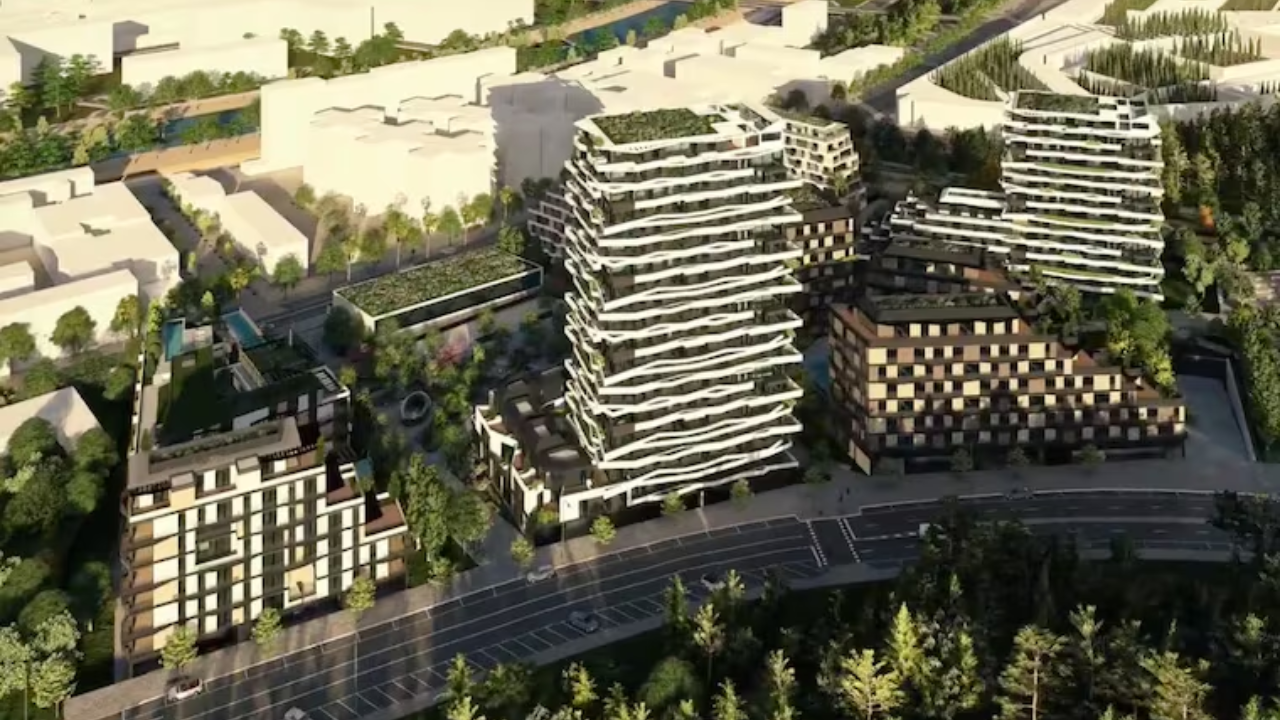
Madrid’s iconic La Ermita shopping center is gone, flattened to make way for 529 apartments in a €77 million urban redevelopment that has exposed the sharpest fault lines in Spanish real estate. For decades, the sprawling complex along the Manzanares River was a rite of passage for locals—a place where David Bowie played a legendary 1990s concert, where a young Carlos Sainz Jr. cut his teeth on indoor go-karts, and where generations of working-class families spent their weekends. Now, excavators have cleared the rubble for a high-density residential and commercial project spearheaded by Socimi Desarrollos Ermita del Santo, pitting municipal housing ambitions against fierce neighborhood resistance over gentrification and lost public memory.
The demolition did not happen overnight. It represents the culmination of a decade-long battle over what constitutes urban progress in one of Europe’s fastest-heating property markets.
The Anatomy of a Dying Mall
To understand why La Ermita fell, you first have to look at the brutal economics of late-20th-century retail. Built in the late 1980s near the Puente de Segovia in the Latina district, the Centro Comercial La Ermita was a product of Spain’s post-transition consumer boom. It was never a sleek, climate-controlled glass palace. It was an open-air, slightly chaotic labyrinth of entertainment venues, bowling alleys, cinemas, and discount outlets.
That quirkiness was its greatest asset and its eventual death sentence.
By the mid-2010s, the rise of e-commerce and the arrival of massive suburban megamalls—like Intu Xanadú and Plaza Río 2 just across the water—bled La Ermita dry. Foot traffic evaporated. Storefronts shuttered one by one, leaving behind empty corridors, peeling paint, and a maintenance bill that no longer made mathematical sense for its owners. When a commercial asset stops generating yield in a prime central location, institutional capital does not get sentimental. It looks at the underlying dirt.
And the dirt beneath La Ermita is gold. Situated right next to Madrid Río—the massive linear park created when the city buried the M-30 ring road underground—the plot transformed from a gritty riverside backwater into prime real estate overnight. Suddenly, a decaying 43,000-square-meter retail complex was sitting on land worth far more as residential square footage than as a nostalgia trip for rock fans and karting enthusiasts.
Inside the €77 Million Math
Real estate developers rarely speak in terms of cultural heritage. They speak in terms of buildable floor area, municipal zoning modifications, and internal rates of return.
The consortium behind the project, backed by Venezuelan and Spanish investment capital through Desarrollos Ermita del Santo, spent years negotiating a modification to Madrid’s General Urban Development Plan (PGOU). Changing land use from commercial to residential is the holy grail of urban property speculation. It unlocks massive value out of thin air, provided City Hall signs off on the paperwork.
Under the approved master plan, the €77 million investment will fund the construction of 529 residential units alongside roughly 15,000 square meters of public green space, local retail, and municipal facilities. On paper, City Hall framed the deal as a textbook win-win. Madrid is suffocating under a severe housing shortage, with rents and purchase prices hitting historic highs across nearly every district. Injecting over five hundred new homes into a consolidated urban neighborhood—without paving over untouched countryside—aligns neatly with modern urban planning orthodoxy.
The Affordable Housing Illusion
Look closer at the numbers, however, and the municipal victory lap starts to look complicated.
Under Spanish urban planning laws, private developers benefiting from a lucrative zoning change must cede a portion of the buildable area to the public administration for protected or affordable housing (VPO). In the case of La Ermita, roughly 28% of the residential space is designated for public housing regimes.
That leaves the remaining 72%—nearly 380 apartments—for the open market.
In a neighborhood like Los Cármenes and Puerta del Ángel, where average household incomes sit noticeably below the Madrid median, introducing hundreds of market-rate units overlooking Madrid Río carries an obvious consequence. Developers do not spend €77 million on land acquisition, demolition, and vertical construction to sell apartments at a discount. High-rise towers—some reaching up to 23 stories in earlier drafts before neighborhood pushback forced height reductions—naturally command premium prices.
Local housing advocates argue that the project acts as a Trojan horse for gentrification. When market-rate units sell at €4,500 to €6,000 per square meter, every landlord within a ten-block radius notices. Property taxes climb, neighborhood cafés turn into artisanal bakeries, and the very families who spent thirty years bowling at La Ermita find themselves priced out of their own postal code.
More Than Concrete and Steel
If this were merely a zoning dispute over density and square meters, it would have stayed buried in the municipal gazette. What turned La Ermita into a flashpoint was what the concrete actually held.
In the 1990s, before Madrid became a polished stop on every global stadium tour, Sala Aqualung—the legendary concert venue tucked inside the La Ermita complex—was the beating heart of the city’s live music scene. On July 14, 1997, David Bowie took the stage there during his Earthling Tour, playing an intimate, sweat-drenched club show to a crowd that could hardly believe the Thin White Duke was standing fifty feet away in a suburban-style shopping center. Nirvana, Radiohead, Pearl Jam, and Oasis all passed through or around that ecosystem during Madrid’s golden era of alternative rock.
Just down the concourse, the Carlos Sainz Karting center offered a different kind of adrenaline. Founded by the two-time World Rally Champion, the indoor track became a training ground for Spanish motorsport talent. A young Carlos Sainz Jr. spent countless hours learning racecraft on that asphalt long before he ever sat in a Ferrari or Williams Formula 1 cockpit.
Urban planners rarely assign a monetary value to collective memory. You cannot put "David Bowie played here" on a discounted cash flow spreadsheet. Yet when a city systematically erases the physical spaces where subcultures, sports, and community life actually happened, it hollows out its own identity. Madrid has spent the last decade tearing down or gutting historic cinemas, theaters, and music halls—turning them into flagship clothing stores, tourist apartments, or luxury condos. La Ermita is simply the largest domino to fall.
The Neighborhood Pushback and Legal Friction
The demolition crews did not roll in unopposed. For over three years, a coalition of neighborhood associations, including No al Pelotazo de la Ermita, waged an aggressive civic and legal campaign to halt the project.
Their objections centered on three primary failure points in the city’s approval process:
- Infrastructure Strain: Critics pointed out that adding over 1,200 new residents to a pocket bordered by the Manzanares River and major arterial roads would overwhelm local schools, primary care health centers, and public transit links that are already operating near capacity.
- Environmental and Wind Tunnel Effects: Towering residential blocks rising abruptly along the river corridor risk altering local microclimates, casting long shadows over the Madrid Río parklands and disrupting airflow across the valley.
- Loss of Sports and Leisure Facilities: Beyond the music venue and karting track, the complex housed the Paidesport Center, a massive gym and swimming pool facility used daily by thousands of local residents who suddenly lost their neighborhood athletic club with few affordable alternatives nearby.
The opposition filed administrative appeals and took the zoning modification to the High Court of Justice of Madrid (TSJM), alleging that the city had bypassed proper environmental assessments and tailored the urban plan to suit private financial interests—a practice Spaniards colloquially call a pelotazo (a speculative windfall).
City Hall, controlled by Mayor José Luis Martínez-Almeida’s administration, held firm. Municipal officials argued that keeping a half-abandoned, asbestos-ridden, energy-inefficient 1980s mall standing was an ecological and urbanistic absurdity. They insisted the developer had agreed to reduce building heights, expand public plazas, and fund new municipal sports facilities as part of the final agreement. In the end, administrative momentum and private capital proved heavier than neighborhood banners.
The Bigger Picture for European Cities
What happened at La Ermita is not unique to Madrid. Across London, Paris, Berlin, and Milan, cities are wrestling with the exact same structural dilemma.
The 20th-century retail model is dead. Dead malls, underutilized office parks, and obsolete industrial zones represent the last remaining land banks inside dense European capitals. At the exact same moment, those cities are facing a generational housing crisis driven by demographic growth, tourism pressures, and decades of underbuilding.
Converting dead commercial space into housing is, in theory, the smartest urban planning move available. It prevents suburban sprawl, utilizes existing metro lines, and revitalizes decaying blocks.
The problem lies entirely in execution and governance. When municipalities rely almost exclusively on private speculative capital to execute these transformations, the financial math dictates the outcome. Developers must maximize high-margin luxury or upper-middle-class units to absorb skyrocketing construction costs and financing rates. Public housing quotas become bargaining chips rather than the core mission, and cultural or recreational spaces are treated as expendable luxuries.
What Comes Out of the Dust
The heavy machinery has finished the loudest part of its work along the Paseo de la Ermita del Santo. The go-kart track is gravel. The stage where Bowie stood is open sky.
Over the next thirty-six months, cranes will dominate the skyline above the Manzanares River as the 529 apartments take shape. Developers promise landscaped walkways, modern energy-efficient homes, and a seamless connection between the Latina district and the riverfront park. For the buyers who can afford the down payments, it will be an enviable address—ten minutes from the Royal Palace, steps from jogging trails, with brand-new insulation and underground parking.
For everyone else in the neighborhood, the trade-off remains starkly unresolved. Madrid traded a messy, loud, imperfect piece of its living cultural history for clean lines, higher property valuations, and a fraction of the affordable housing it desperately needs. The concrete dust has barely settled, and the city is already moving on to the next plot of land.