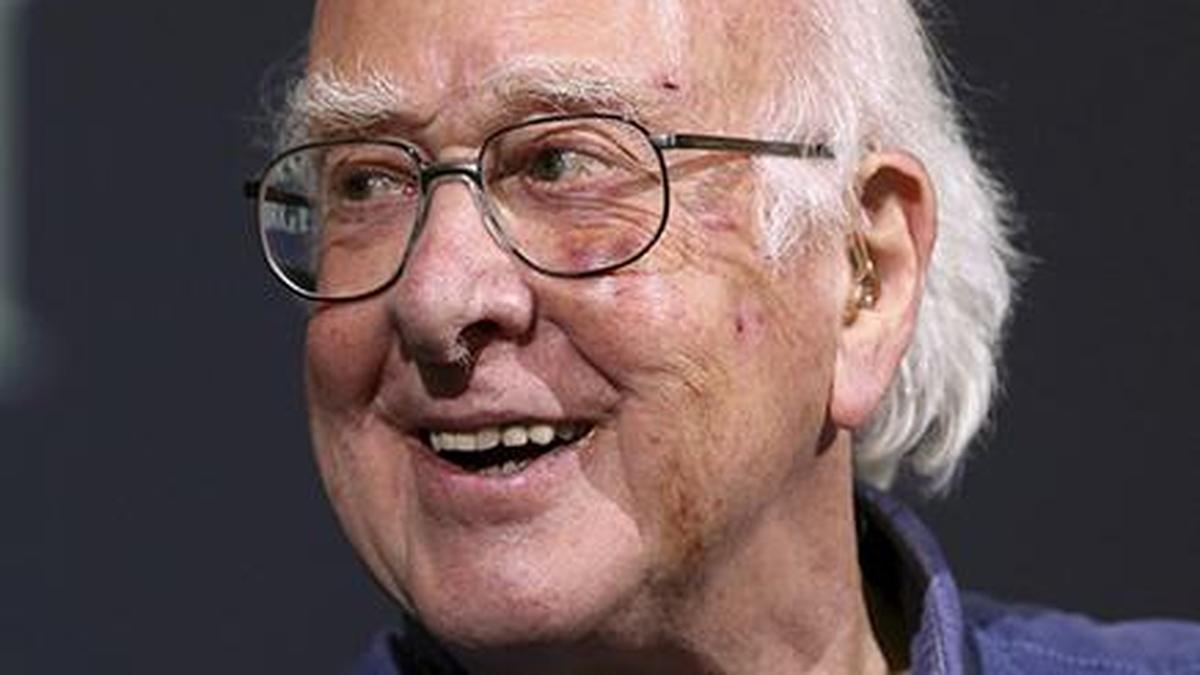
In the early summer of 2012, an elderly man with thin white hair and a gentle, slightly hunched posture sat in a crowded lecture hall in Geneva, Switzerland. He wore a modest suit. He looked like a retired schoolteacher who had wandered into the wrong room. Around him, the air vibrated with a frantic, electric energy. Hundreds of brilliant young minds were jammed into the seats, sitting on the steps, and leaning against the walls, checking screens with breathless anticipation.
When the presentation began, the data flashed onto the screens. It was a series of complex graphs, jagged lines plotting the outcomes of trillions of subatomic collisions. To a passerby, it looked like static. But to the people in that room, it was a map of Genesis.
The speaker announced a discovery with a statistical certainty that left no room for doubt. The crowd erupted. People cheered, stomped their feet, and wept open-mouthed tears of pure exhaustion and triumph.
The elderly man reached into his pocket, pulled out a handkerchief, and wiped his eyes. He smiled a small, private smile.
His name was Peter Higgs. He had just spent forty-eight years waiting to find out if he was right about how the universe holds itself together. He had spent nearly half a century wondering if a mathematical guess he made as a young man in Edinburgh was a profound truth or a beautiful fiction.
In the spring of 2024, at the age of ninety-four, Peter Higgs passed away quietly at his home. The University of Edinburgh announced his departure with the standard reverence reserved for academic giants. The news tickers ran the cold facts: British physicist, Nobel laureate, finder of the "God Particle."
But the tickers missed the point. Peter Higgs did not just discover a particle. He solved the mystery of why anything exists at all.
The Weight of Nothing
To understand what Higgs did, we have to look at the universe the way he did back in 1964. It was a terrifyingly broken picture.
At the time, physicists were building a magnificent framework called the Standard Model. It was an ambitious blueprint designed to explain every force and particle in existence. It was beautiful. It was elegant. There was only one catastrophic flaw.
According to the math, every fundamental particle in the cosmos should be entirely weightless.
Imagine a universe where everything moves at the exact speed of light. Electrons, quarks, the building blocks of every atom—all of them skimming through space like ghosts. They could never slow down. They could never bind together. Without weight, there are no atoms. Without atoms, there are no chemicals. No stars can ignite. No planets can form in the dark. No oceans can pool, no trees can grow, and no conscious being can ever stand on a hillside and look up at the night sky.
The universe should have been a blinding, empty flash of perpetual light.
Yet, we are here. You are holding a device. Your feet are pressed against the floor. You have weight. The universe is heavy.
Physicists were stuck in a brilliant, suffocating trap. The equations worked perfectly, but they described a reality that clearly did not exist. Something was missing from the vacuum of space. Something invisible was catching the particles, slowing them down, and gifting them with substance.
Higgs was a quiet, unassuming lecturer at the University of Edinburgh. He was not a loud man. He did not seek the spotlight. But he had an imagination that could peer into the absolute emptiness of space and see a hidden architecture.
He sat at his desk with a fountain pen and a stack of paper. He began to calculate what would happen if the vacuum of space was not actually empty.
The Submerged World
Let us use a metaphor to see what Higgs saw.
Imagine a vast, perfectly still ocean. This ocean is completely invisible. It fills every cubic millimeter of the universe, stretching across the billions of light-years between galaxies, but also filling the tiny spaces between the atoms in your own hand. It is everywhere, all the time.
Now, imagine different creatures moving through this invisible water.
A photon—a particle of light—is like a sleek, perfectly hydrodynamic needle. It slices through the water without feeling a single molecule of resistance. Because it experiences no drag, it flies at the maximum possible speed. It remains weightless.
An electron is like a small fish. It feels a slight drag. The water catches it, tugging at its sides, forcing it to slow down. That resistance, that drag, is what we call mass.
A top quark is like a massive, clumsy whale. It slams into the water, experiencing an enormous amount of resistance. It requires a massive amount of energy to move. We perceive this heavy drag as a massive particle.
This invisible ocean is what physicists call the Higgs field.
Higgs realized that mass is not an inherent property born inside an object. A rock is not heavy because it contains "heaviness." A rock is heavy because it is constantly fighting its way through an invisible cosmic molasses that fills the room.
It was a staggering idea. It meant that empty space was not a void. It was a dynamic, living stage that actively shaped the behavior of everything within it.
But there was a catch. You cannot see the ocean if you are trapped underwater and have never known anything else. How do you prove an invisible field exists when it permeates everything?
Higgs found the answer in his equations. If you strike the invisible water hard enough—if you create a shockwave violent enough—you might just cause a single droplet to fly out of the sea for a fraction of a second.
That droplet is the Higgs boson.
If the droplet existed, the ocean existed. If the ocean existed, the math was saved.
Higgs wrote a short, two-page paper outlining his theory and sent it to a prestigious physics journal.
They rejected it.
They told him his ideas had no obvious relevance to physics.
The Long Wait
Many people would have abandoned the idea. Higgs did not. He added a few paragraphs, sent it to another journal, and this time, it was published.
Then, the silence set in.
For decades, the Higgs boson remained a ghost on paper. The technology required to strike the cosmic ocean hard enough to shake loose a droplet did not exist. It required energies that human beings could barely comprehend, let alone engineer.
While the scientific community debated his theory, Higgs lived his life. He taught students. He walked the cobblestone streets of Edinburgh. He watched the world change. He did not own a mobile phone. He did not use email. He preferred the deliberate pace of books, letters, and quiet contemplation.
Imagine carrying a secret like that for forty years. Imagine knowing that the explanation for the physical existence of the entire universe rests on your shoulders, but you might die before anyone can prove you were not just daydreaming.
The search became an obsession for the global scientific community. It required the construction of the largest, most complex machine ever built by human hands: the Large Hadron Collider at CERN.
The machine is a twenty-seven-kilometer ring of superconducting magnets buried deep beneath the border of France and Switzerland. Its sole purpose was to recreate the conditions of the universe a fraction of a second after the Big Bang. It was built to smash protons together at 99.999999% the speed of light.
It was built to make the invisible ocean bleed a single drop.
The cost ran into billions of dollars. Thousands of scientists from hundreds of countries spent decades designing detectors the size of cathedrals. The stakes were immense. If the collider found the particle, Higgs would be vindicated, and human knowledge would achieve a monumental victory. If it found nothing, the entire foundation of modern physics would crumble into dust.
Through it all, Higgs remained detached. He did not visit the collider often. He did not hover over the shoulder of the experimentalists. He waited.
The Flight to Edinburgh
When the call finally came in July 2012, inviting him to Geneva for a major announcement, Higgs knew what it meant.
Yet, when the presentations were over and the world media descended upon him, he looked almost overwhelmed by the noise. He had spent his life in the quiet sanctuaries of mathematics. Now, he was being treated like a rock star. The media dubbed it the "God Particle"—a term Higgs, an atheist, thoroughly disliked because he felt it missed the elegant simplicity of nature.
The next year, he was awarded the Nobel Prize in Physics.
True to form, on the day the prize was announced, Higgs did not wait by the phone. He left his house, walked down to the Edinburgh waterfront, and went to a seafood restaurant for a quiet lunch of soup and beer. He had no interest in the media circus. He simply wanted to be an ordinary man who had asked a good question.
There is an profound honesty in that kind of humility. It reminds us that the pursuit of science is not about personal glory, nor is it about corporate metrics or branding. It is an act of pure curiosity. It is about a solitary mind trying to decipher the handwriting of the universe.
The Space Left Behind
Peter Higgs lived to see his life's work validated. Few visionaries get that privilege. Galileo died under house arrest; Darwin died before genetics proved his theories right. Higgs got to sit in that lecture hall and watch the data confirm his imagination.
His death marks the end of an era. It closes the chapter on the giants who sketched out the modern map of reality using nothing but paper, ink, and raw intellect.
Consider what happens next: the world he left behind is still wrestling with the implications of his ocean. We know the Higgs field gives things weight, but we still do not know why it has the exact strength that it does. If it were even slightly different, the universe would still be a barren waste.
We are left with a cosmos that is slightly less mysterious, but infinitely more beautiful because of him.
The next time you hold a stone in your hand, feel its weight. Notice the heft of it pressing against your palm. That pressure is not a passive fact. It is a continuous, dynamic conversation between the atoms of the stone and the invisible ocean that Peter Higgs saw through a window of mathematics sixty years ago.
The man is gone. But the field remains, holding us all down, keeping us real, and making the universe heavy enough to love.