Salt water has a way of exposing every lie a boatbuilder tells.
Out past the harbor buoys, where the swells stop behaving like polite ripples and start moving with the heavy, indifferent muscle of the open ocean, fiberglass creaks. Aluminum groans. Wood swells, drinks, and occasionally splits along a grain you swore was flawless back in the dry warmth of a garage. Every seam is a gamble against pressure and time.
Now picture taking that gamble in a boat grown out of dirt, sawdust, and mushroom roots.
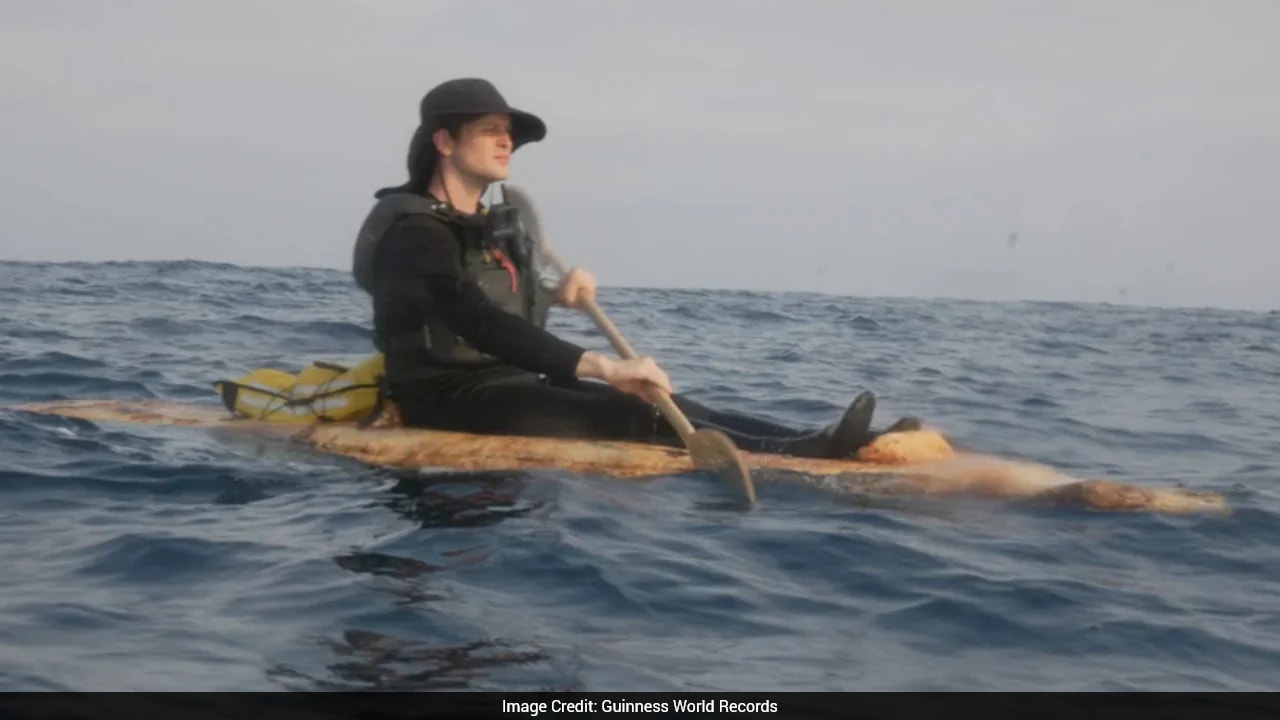
No resin. No petroleum-derived foam. No carbon fiber baked in an industrial autoclave. Just a twelve-foot hull composed of mycelium—the dense, thread-like root network of fungi—shaped in a plywood mold, dried in the sun, sealed with beeswax, and launched into the Atlantic.
When Sam Shoemaker, an artist and sculptor from California, pushed his twelve-foot mushroom kayak off the coast of Maine and paddled forty-two kilometers across open sea, the headlines reduced his feat to an oddity. A quirky bullet point for the morning scroll. US Man Builds 12-Foot Kayak From Giant Mushroom, Completes 42-Km Sea Journey. Read it, smirk at the mental image of a floating portobello, and move on to the weather report.
That reaction misses the entire point.
Because forty-two kilometers—roughly twenty-six miles of cold, shifting Atlantic current—is not a novelty stunt. It is a marathon on water. It is six to eight hours of continuous upper-body labor where a structural failure does not mean getting your shoes wet; it means hypothermia in water cold enough to steal the breath from your lungs in seconds. Shoemaker did not build a conversation piece. He built a seaworthy vessel out of an organism that usually spends its life quietly digesting dead trees on a forest floor.
And if a mushroom can survive the Atlantic, we have to ask an uncomfortable question about the mountains of indestructible plastic we still insist on building everything else out of.
The Architecture of Rot
To understand why a fungal kayak sounds absurd to modern ears, you have to look at how thoroughly we have trained ourselves to fear decay.
For the last century, human engineering has operated on a single, obsessive premise—permanence. We wanted materials that would never rot, never rust, never yield to weather or microbes. We cracked crude oil, rearranged its carbon chains, and invented polymers so stubbornly immortal that a disposable coffee lid tossed into a ditch today will outlast the civilization that manufactured it.
Walk down any marina dock and you are looking at a monument to that obsession. Modern kayaks and hulls are marvels of synthetic chemistry, spun from fiberglass, polyethylene, and epoxy resins. They are light, fast, and nearly indestructible. They are also toxicological nightmares to produce and virtually impossible to dispose of cleanly. When an old fiberglass boat reaches the end of its life, it cannot be melted down or composted. Most end up crushed in landfills, shedding microscopic glass shards into the soil for centuries.
I learned this lesson the hard way years ago while helping a friend strip down a derelict coastal skiff behind a boatyard in Rhode Island. Even through a respirator and Tyvek suit, the fine white dust from sanding oxidized resin found its way onto my forearms, itching like ground fire for three days. Standing ankle-deep in toxic synthetic snow just to patch a hull made me wonder why going out to enjoy nature required poisoning a small patch of it first.
Mycelium operates on the exact opposite philosophy.
If you have ever kicked over a rotting log in the woods and seen a web of white, cottony threads binding the damp wood chips together, you have seen mycelium in action. In nature, it is the great recycler—the digestive tract of the forest. While the mushroom cap you slice onto a pizza is merely the temporary fruit, the mycelium beneath the surface is a vast, intelligent architectural network. As those microscopic filaments, called hyphae, grow through agricultural waste like hemp hurds or sawdust, they secrete enzymes that break down cellulose and bind the loose fibers into a dense, unified mat.
Think of it less like stacking bricks and more like pouring concrete where the cement grows itself.
When you pack damp substrate inoculated with fungal spores into a mold, the organism goes to work in the dark. Over days and weeks, billions of microscopic threads weave through every millimeter of empty space, locking the loose agricultural scraps into a rigid, lightweight solid. Then, just before the fungus decides to sprout mushrooms, you bake it or dry it in the sun. The heat puts the organism into permanent dormancy. What remains is a structural material lighter than cork, surprisingly resistant to compression, naturally fire-retardant, and—when its job is finally done—completely edible to the soil.
The Invisible Stakes of Twenty-Six Miles
Still, there is a vast gulf between a mushroom packing peanut and a vessel capable of carrying a grown man across twenty-six miles of ocean.
Water is the ultimate enemy of raw mycelium. Left untreated, the same porous network that makes the material so light and buoyant will greedily drink in moisture, softening the structural bonds until the hull turns back into soggy mulch. A kayak doesn't just sit on top of the water; it slices through it, flexing with every stroke of the paddle, absorbing the lateral slap of cross-waves and the grinding abrasion of rocky landings.
Consider what happens when a hull meets a three-foot beam sea—a wave hitting the boat squarely from the side. The center of the kayak bridges the crest while the bow and stern hang momentarily unsupported, putting immense bending stress right under the paddler's seat. Seconds later, the trough arrives, reversing the load entirely. Repeat that cycle ten thousand times over a single afternoon.
To survive that punishment without synthetic resins, Shoemaker had to solve the oldest problem in boatbuilding using the oldest biological tools available.
For his primary fungal strain, he worked with Ganoderma polychromum—a tough, woody bracket fungus closely related to the medicinal reishi mushroom. Unlike soft culinary mushrooms that dissolve in a skillet, bracket fungi grow in shelf-like plates on the sides of dead hardwoods, engineered by millions of years of evolution to withstand wind, rain, and frost without losing their rigid form.
Even so, growing a twelve-foot hull is an exercise in controlled anxiety. Unlike mixing a batch of epoxy, where chemical ratios guarantee a predictable cure time, working with a living organism means negotiating with biology. Too much moisture in the mold invites competing molds—green Trichoderma spores that can ruin weeks of growth overnight. Too little airflow suffocates the mycelium, stalling the weave before the walls gain enough density to hold a human being's weight.
When the mold finally came apart, the raw hull looked less like a sleek sporting craft and more like an enormous, pale loaf of sourdough bread—textured, organic, and faintly earthy. To keep the Atlantic from dissolving his vessel mid-crossing, Shoemaker turned to another ancient biological sealant, coating the porous fungal skin in melted beeswax.
Water beaded on the surface. It held.
What It Feels Like to Float on Biology
Imagine, for a moment, sitting inside that cockpit three miles offshore.
Let us step into a hypothetical reconstruction of that crossing, grounded in the physics of coastal kayaking and the documented mechanics of Shoemaker's voyage. The shore has flattened into a thin gray ribbon behind you. Beneath your thighs, separated from fifty-five-degree ocean water by less than two inches of compressed sawdust and dormant fungus, there is none of the hollow, drum-like slap you hear inside a plastic hull. Mycelium is a natural acoustic dampener; the tiny trapped air pockets inside the fungal matrix swallow vibration. The boat moves through the chop with a quiet, muffled thud, almost like carved cedar.
Every paddle stroke requires trust. You are acutely aware that your vessel was never extruded from a factory die or tested in a naval engineering tank. Its strength comes from billions of microscopic threads that grew together in the dark because they were hungry.
This is where the psychological weight of the journey sets in. Modern outdoor gear is designed to insulate us from vulnerability—Gore-Tex membranes, carbon-fiber shafts, GPS beacons, rotomolded hulls rated for impacts against granite boulders. We buy equipment specifically so we do not have to think about the boundary between ourselves and the elements.
Paddling a mushroom across forty-two kilometers strips that illusion away entirely. You feel the flex of the hull beneath your heels. You smell warm beeswax and damp earth every time the sun breaks through the coastal haze. And slowly, mile after agonizing mile, doubt gives way to astonishment. The bow cuts cleanly through the swells. The tracking holds true against the tidal pull. The material does not buckle, does not delaminate, and does not surrender to the sea.
By the time the landing beach comes into focus and the bow grates softly onto wet gravel forty-two kilometers later, the experiment has already answered the skeptics. The boat did not merely survive the ocean. It performed like a real craft.
Why Builders Are Suddenly Obsessed With Fungi
Shoemaker's voyage sits at the leading edge of a quiet industrial rebellion.
For the past decade, architects, aerospace engineers, and packaging designers have been wrestling with a brutal truth—our most versatile materials are poisoning our supply chains. Expanded polystyrene foam, the ubiquitous white Styrofoam that cushions everything from flat-screen televisions to fragile lab equipment, takes centuries to break down and leaches styrene into groundwater. Concrete production alone accounts for roughly eight percent of global carbon dioxide emissions.
Enter myco-materials.
Companies like Ecovative in New York and architectural research labs across Europe have spent years proving that mycelium is far more than an art-school curiosity. Major furniture retailers and electronics brands have already begun replacing molded plastic foam with custom-grown mushroom packaging. After you unbox your new appliance, you can break the protective corner blocks apart with your bare hands and toss them into your garden beds, where they decompose within forty-five days and enrich the soil.
Architects have pushed the scale even further. In 2014, the architectural studio The Living erected Hy-Fi in the courtyard of MoMA PS1 in Queens—a forty-foot-tall tower built entirely from ten thousand compostable bricks grown from corn stalks and mycelium. Critics expected the structure to sag under summer humidity or crumble in rainstorms. Instead, it stood tall through an entire New York summer, bearing its own structural load without a single steel rebar reinforcement, before being dismantled and composted into local community gardens.
Even NASA has funded research into myco-architecture, exploring whether astronauts could one day land on Mars with compact bags of dormant fungal spores and dried substrate, add water, and grow radiation-shielding habitats directly on the Martian surface rather than paying astronomical fuel costs to haul heavy building blocks out of Earth's gravity well.
Yet despite all the lab tests, compressive-strength charts, and architectural installations, nothing convinces the human gut quite like watching someone stake their physical safety on a material.
A lab report tells you that mycelium has a compressive strength comparable to expanded polystyrene. A forty-two-kilometer ocean crossing tells you that a human being trusted it with his life in deep water—and won.
The Hard Truths Nobody Mentions
Before we start imagining marinas filled with mushroom yachts and suburbs built entirely from bracket fungi, honesty demands we look at the limits.
Mycelium is not a miracle substitute for every material on Earth, and pretending otherwise does real science a disservice. Growing a structural object takes time—often weeks of controlled temperature and humidity—whereas an injection-molding machine can spit out a polyethylene kayak in less than twenty minutes. In manufacturing, time is money, and biology refuses to be rushed on a quarterly earnings schedule.
There is also the problem of tensile strength—resistance to being pulled apart rather than squeezed. While fungal composites handle compression remarkably well, they are relatively brittle under sharp impact or extreme twisting forces unless reinforced with natural fibers like woven hemp, flax, or burlap. Drop a raw mycelium brick onto concrete from waist height, and it can snap cleanly in half.
And waterproofing remains an ongoing puzzle. Beeswax works beautifully for an artisan craft maintained by hand, yet commercial marine applications demand coatings that can survive years of UV exposure, barnacle scraping, and prolonged immersion without flaking off or requiring constant reapplication. Researchers are actively testing bio-resins derived from pine rosin, linseed oil, and cashew nutshell liquid to bridge that durability gap, though scaling those finishes affordably remains a stubborn engineering hurdle.
Perhaps the biggest obstacle, however, is cultural.
We have become deeply conditioned to equate value with permanence. When we spend a thousand dollars on a kayak, a piece of furniture, or a cooler, we expect it to sit unchanged in our garage for thirty years, looking identical to the day we bought it. Accepting biological materials requires a profound shift in mindset—learning to appreciate objects that age, weather, and eventually return to the earth when their usefulness ends.
A Different Kind of Footprint
Long before plastics existed, coastal peoples across the world built extraordinary ocean-going vessels from materials that grew right outside their doors.
In the Pacific Northwest, Indigenous master carvers hollowed massive, rot-resistant red cedars into forty-foot canoes capable of hunting whales in open ocean swells. Across the Arctic, Inuit builders lashed driftwood frames together with sinew and stretched oiled sealskins tight over the ribs, creating the original kayaks—vessels so light, flexible, and responsive that modern naval architects still study their hydrodynamics in awe.
Those boats did not last forever. They required care, seasonal re-oiling, and intimate knowledge of the living materials from which they were shaped. When a cedar canoe finally split beyond repair or a skin frame rotted away, the ocean simply reclaimed its own chemistry, leaving behind no microplastics, no toxic leachates, and no permanent scar.
Somewhere along the way, we traded that partnership with living systems for the convenience of dead, synthetic permanence. We gained cheaper goods and effortless maintenance, and in exchange we buried our coastlines under indestructible debris.
Sam Shoemaker's twelve-foot mushroom kayak will never replace the global fiberglass boat industry. It was never meant to. Its real cargo across those forty-two kilometers of Atlantic swell was proof of possibility—a tangible, floating rebuttal to the lazy assumption that strength must always come from petrochemicals and permanence must always come at the planet's expense.
Picture that hull pulled up above the high-tide line at the end of the journey. Water drips from its beeswaxed flank onto the wet sand, leaving behind a faint scent of forest floor and warm honey. In a hundred years, every plastic kayak built this summer will still be sitting in a dump or fracturing into invisible dust in the surf. Shoemaker's boat, when its days on the water are finally over, will simply crumble back into dirt—feeding the next generation of trees, and the next quiet web of roots waiting underneath.