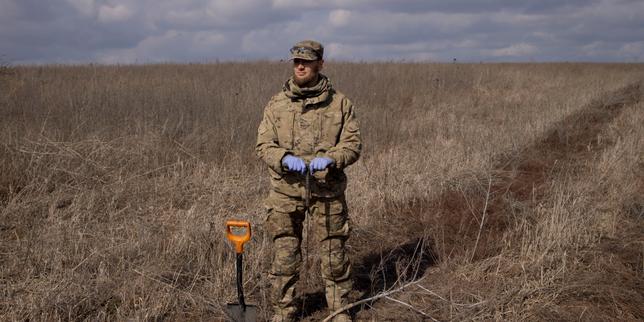
The war leaves behind an arithmetic of missing names. Long after artillery fire stops echoing across the agricultural belts of eastern Ukraine, a different kind of labor begins in the quiet wreckage. Oleksi Ioukov understood this better than anyone. Known across the frontlines as the soul collector, he spent years crawling through abandoned trenches and burnt-out armor to retrieve fallen soldiers from both sides of the conflict. When his truck finally stopped rolling following a fatal blast, it marked the loss of an irreplaceable archivist of humanity in a theater defined by mass erasure.
Media coverage often fixates on the geography of territorial loss or the abstract statistics of ammunition expenditure. Yet the actual physical cost of the invasion is measured in teeth, dog tags, and unrecovered remains scattered across minefields. Ioukov operated in that grim space between life and formal burial. His work exposed the agonizing operational reality of modern attrition warfare, where soldiers vanish into pulverized dirt, and grieving families spend years searching for basic closure.
The Grim Mechanics Of The Search
Finding a body in a war zone requires an eccentric mix of forensic science, local intuition, and morbid patience. Ioukov did not wear a uniform belonging to any combat brigade. He led the Black Tulip humanitarian mission, a team dedicated to exhuming human remains from active or recently contested zones. Armed with metal detectors, long probes, and an encyclopedic knowledge of soil behavior, his crew treated every patch of disturbed earth as a potential grave.
Modern artillery turns human anatomy into fragments that defy standard identification. Shrapnel strips uniforms of serial numbers, and high explosives scatter bones across wide perimeters. Ioukov tracked these traces using methods honed over years of digging up relics from the Second World War. A patch of scorched grass, an unusual indentation in a trench wall, or a swarm of carrion insects often served as the only markers pointing toward a fallen combatant.
- Soil analysis: Freshly turned earth collapses differently than compacted trench floors, revealing buried weight long after grass begins to grow back over the site.
- Personal effects: Wallets, religious medallions, and handwritten notes offer the fastest route to an identity when military command structures fail to keep accurate logs.
- Explosive hazards: Every recovery operation doubles as a demining exercise, requiring teams to clear unexploded ordnance before touching the soil around a body.
Beyond The Politics Of Attrition
The public narrative surrounding fallen soldiers usually adheres to patriotic frameworks or political messaging. Ioukov rejected those boundaries with a stark philosophy. To him, a corpse rotting in a sunflower field was not an enemy combatant or a political symbol; it was a human being denied the dignity of a grave. His teams regularly recovered Russian soldiers abandoned by retreating units, treating their remains with the exact same professional reverence afforded to Ukrainian defenders.
This neutrality earned him deep respect among front-line troops who watched their comrades disappear into the gray zone between opposing lines. It also drew criticism from hyper-nationalist factions who viewed the recovery of enemy dead as a distraction from the war effort. Ioukov ignored the noise. He recognized that leaving bodies to rot poisoned the psychological well of the nation and degraded the moral standing of anyone participating in the conflict.
"When you pull a boy from the mud, you are not fighting the war anymore. You are cleaning up the mess the politicians made."
That sentiment captures the weary realism defining veteran humanitarian workers in Ukraine. The longer a war drags on, the more institutional fatigue sets in regarding missing personnel. Governments focus heavily on active force generation and logistics, leaving the grim task of recovery to independent volunteers operating on donations and sheer willpower.
The Bureaucracy Of Missing Persons
Recovering a body is only the first step in a bureaucratic gauntlet. Once remains are pulled from the ground, they enter a complex chain of custody managed by forensic institutes, military prosecutors, and DNA laboratories. The backlog is staggering. Thousands of families live in a state of suspended grief, unable to hold funerals because genetic matching takes months or because bodies lack sufficient tissue for immediate testing.
Ioukov bridged the gap between the chaotic front lines and the sterile laboratories in Kyiv and Dnipro. He maintained meticulous logs, matching field coordinates with photographic evidence before handing remains over to state authorities. Without this documentation, many fallen soldiers would end up in unmarked mass graves labeled merely as unknown combatants, denying families the closure of a proper mourning process.
Obstacles In The Field
- Active shelling: Recovery missions frequently operate within range of mortar fire and drone surveillance, turning simple exhumations into high-risk tactical maneuvers.
- Contaminated sites: Chemical residues from munitions and decomposing organic matter create severe health hazards for workers lacking advanced protective gear.
- Administrative friction: Disorganized military record-keeping often makes it difficult to match recovered DNA profiles with families searching across different regions.
The Legacy Left In The Mud
The loss of Oleksi Ioukov leaves a profound void in the infrastructure of Ukrainian humanitarian recovery. While state-backed agencies and international forensic teams continue the work, the intimate, fearless grit of independent operators cannot easily be replaced. They possessed local knowledge that institutional bureaucracies rarely replicate, knowing which farmers saw an armored vehicle burn down in March or which forest line swallowed an entire platoon during a counter-offensive.
As the war grinds forward through changing seasons and shifting frontlines, the number of missing soldiers continues to climb. The physical landscape of eastern Ukraine remains scarred by thousands of unmapped makeshift graves and shallow trenches. Ioukov proved that recovering the dead is not merely a logistical afterthought. It is a vital act of reclamation, asserting human value in a landscape designed to destroy it. The work continues, but the soul collectors are fewer now, working quietly beneath gray skies to give names back to the silence.