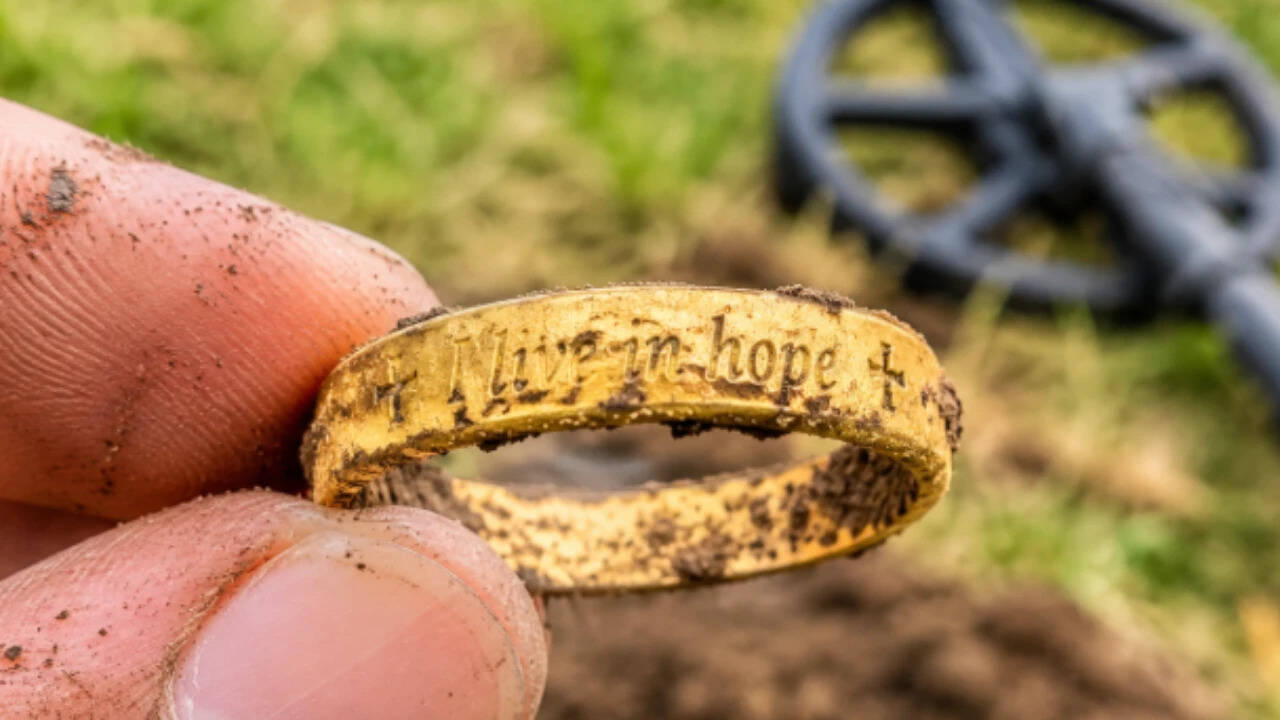
Keys.
Think about the tiny, jagged pieces of brass sitting in your pocket or on your kitchen counter right now. You don't give them a second thought when you twist them in the ignition to grab a gallon of milk, or when you slide them into your front deadbolt after a long Tuesday. You take the frictionless autonomy of your own life for granted because, right now, nobody is asking you to surrender the metal.
Now imagine being one hundred and two years old. Imagine the world—well-meaning, anxious, obsessed with liability and bubble-wrap safety—gently suggesting that it is time to sit down, stay inside, and let someone else drive.
Most people comply. Most people are gone long before they even reach the conversation. According to U.S. Department of Veterans Affairs projections, fewer than one percent of the 16.4 million Americans who served in World War II are still breathing today. We are losing them at a rate of well over a hundred a day. The generation that pulled the world out of the fire is disappearing, shrinking into faded photographs and high school textbook footnotes.
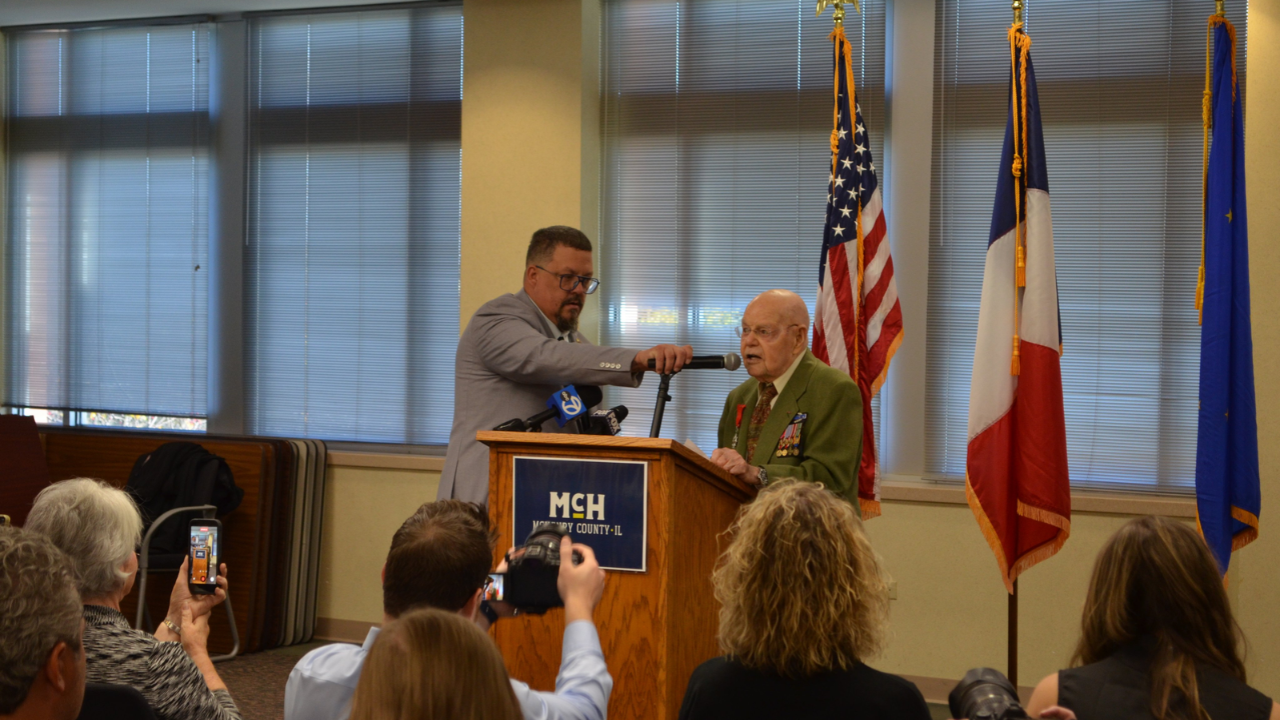
Yet in a quiet suburban driveway, a 102-year-old veteran of the U.S. Army's 42nd Infantry Division—the storied Rainbow Division—still walks out to his car, opens the door, checks his mirrors, and drives himself where he needs to go. He cooks his own meals. He manages his own house. And recently, eighty-one years after he walked through the gates of hell in southern Germany, the French government pinned the Legion of Honor—France’s highest order of merit, established by Napoleon Bonaparte himself in 1802—onto his chest.
The standard news cycle treats a story like this as a charming human-interest blip. A feel-good palette cleanser between stories about inflation and political gridlock. Look at the cute centenarian who can still parallel park.
That framing misses the point entirely. It is a comforting lie we tell ourselves so we don't have to confront what this man actually represents. His independence isn't a cute quirk of good genetics. It is an act of quiet, stubborn defiance against a culture that treats aging as a disease and history as something that happened to other people.
The Weight of April 1945
To understand why a 102-year-old man insisting on driving himself to the grocery store matters, you have to understand what his eyes saw when he was barely twenty.
Spring in Bavaria, 1945. On April 29, elements of the 42nd Infantry Division, alongside the 45th Infantry Division and the 20th Armored Division, approached a sprawling complex near the town of Dachau, roughly ten miles northwest of Munich. Dachau was the prototype. Established in March 1933, just weeks after Adolf Hitler became Chancellor, it was the first regular concentration camp created by the Nazi regime—the blueprint for the industrial slaughter that followed across Europe.
Picture a hypothetical twenty-year-old rifleman from the American Midwest—let’s call him Arthur, though his reality belonged to thousands of real young men whose names are etched into unit rosters. Arthur has spent months slogging through the Vosges Mountains, freezing in foxholes during the German winter counteroffensive, surviving on cold C-rations and unfiltered cigarettes. He thinks he knows what war looks like. War is mud, artillery concussions, and the sudden, violent absence of the guy standing ten feet to your left.
Then the wind shifts near Dachau.
Before Arthur even sees the guard towers, he smells it. A thick, greasy stench of burning flesh, human waste, and unwashed, starving bodies that clings to the wool of his uniform and coats the back of his throat. Outside the camp perimeter, the soldiers find thirty-nine railway boxcars sitting on a siding. Inside are over two thousand corpses, skeletal figures tangled together like kindling, dead from starvation, typhus, and suffocation during a forced transport from Buchenwald.
When the soldiers breach the compound, they find more than thirty thousand survivors—hollow-eyed ghosts in striped rags who can barely lift their heads, alongside mounds of unburied dead stacked like cordwood outside the crematorium. Battle-hardened infantrymen, kids who had fought their way across France and the Rhine without flinching, drop their rifles and vomit in the dirt. Others weep uncontrollably.
I have spent years interviewing elderly veterans and sitting with families navigating the twilight of life, and there is one universal truth about men who walked into camps like Dachau: they do not talk about it for forty, sometimes fifty years. They come home, take off the uniform, get a job at the post office or the hardware store, raise kids, and lock that April afternoon in an iron box at the bottom of their minds. They carry an invisible ballast that nobody around them can see.
What the Legion of Honor Actually Means
When France awards the Ordre national de la Légion d'honneur to an American veteran today, it isn't a participation trophy for surviving a long time. It is a specific, formal recognition of a debt that can never be fully repaid.
Under French law, foreign nationals cannot technically become formal members of the Order, so they are named Chevaliers—Knights—of the Legion of Honor. Since 2004, coinciding with the 60th anniversary of the D-Day landings, the French government has actively sought out surviving American veterans who fought on French soil, enduring the hedgerows of Normandy, the liberation of Paris, or the brutal winter campaign through Alsace-Lorraine on the road into Germany.
Think about the mechanics of that ceremony. A French consul or diplomatic representative travels to the veteran’s hometown, stands before a small gathering of family and local officials, and speaks the ritual words: "Au nom du Président de la République et en vertu des pouvoirs qui nous sont conférés, nous vous faisons Chevalier de la Légion d'honneur."
Then comes the red ribbon.
When you watch a 102-year-old man stand up—slowly, deliberately, refusing the steadying arm of a grandson—to receive that medal, you are watching two completely different eras collide in a living room. You are watching the twenty-year-old kid who marched across occupied France in the mud shake hands with the old man who outlived almost everyone he ever knew.
The ceremony is brief. The applause is polite. And then the dignitaries pack up their flags, get into their black sedans, and drive away.
What happens the next morning? That is the real story.
The Invisible War Against Irrelevance
The next morning, the alarm goes off at 6:30 AM. The house is quiet. There are no cameras, no French diplomats, no local news anchors asking what it felt like to liberate Europe. There is just a stove, a sink, a set of car keys on the counter, and the slow, relentless gravity of a body that has been operating for over a century.
Modern society doesn't know what to do with a 102-year-old who doesn't need help.
We love the elderly when they are symbolic. We love putting them on parade floats on Veterans Day, waving small flags while they sit in folding chairs wrapped in blankets. We love framing their old black-and-white portraits on the mantle. Symbols are easy. Symbols don't argue with you about renewing their driver's license. Symbols don't insist on mowing their own lawn or balancing their own checkbook.
Living, breathing human beings are much more inconvenient.
Consider what happens to the human brain and body the moment we strip away agency in the name of safety. Gerontologists and behavioral psychologists have documented this pattern for decades: when an older adult is moved out of their home, stripped of daily responsibilities, and placed in an environment where every decision is made for them, cognitive and physical decline accelerates dramatically. It is not just a correlation; it is a collapse of purpose. If nobody needs you to wake up, if you have nowhere to drive, if your hands never have to measure coffee grounds or turn a wrench or unlock a door, the body receives a clear, unmistakable signal: Your shift is over.
Independence at 102 is not an accident. It is a daily, grueling discipline.
Imagine the sensory reality of maintaining a household at that age. Every staircase requires calculation. Every trip to the supermarket is a tactical operation requiring focus, reaction time, and spatial awareness. Passing a state driving renewal at 102 isn't a favor granted out of pity; motor vehicle departments are notoriously unsentimental bureaucracies. You pass the vision test, you pass the road test, or you walk.
To keep those keys, you have to stay sharp. You have to read the newspaper every morning. You have to keep your muscles moving even when your joints ache like rusted hinges. You have to care enough about tomorrow to prepare for it today.
The Bridge We Are About to Lose
Let’s be honest about something uncomfortable: most of us are terrified of getting old.
We spend billions of dollars on anti-aging serums, boutique fitness classes, and supplements designed to erase the evidence of time from our faces. We treat aging as a slow-motion tragedy, a gradual surrender of everything that makes us us. At the same time, we treat history like a streaming service—something we can pause, skip, or ignore until we feel like watching a two-hour documentary on a rainy Sunday.
A 102-year-old Dachau liberator living independently blows both of those illusions to pieces.
First, he proves that the end of life does not have to be a passive waiting room. Yes, luck and biology play massive roles—nobody reaches triple digits without winning a genetic lottery and dodging a hundred stray bullets, both literal and medical. You cannot willpower your way out of every illness. Pretending otherwise would be dishonest and cruel to the millions of families dealing with dementia or frailty. Yet within the margins that life gives us, attitude and autonomy are ferocious forces. This man didn't survive the Siegfried Line and the horrors of Bavaria just to sit in a recliner staring at daytime television. He survived to live.
Second, his physical presence forces us to reckon with the reality of the past.
It is easy to minimize history when nobody is left to contradict you. When the last eyewitness dies, atrocities become debates. Tyranny becomes an abstract political theory. The sacrifice of young men who left farms and factories to stop a genocidal machine in Europe becomes a sepia-toned cliché.
As long as this man is still driving himself down Main Street, history is not dead. It is sitting at the red light next to you. The hands resting at ten-and-two on that steering wheel are the exact same hands that held an M1 Garand rifle in 1945. The eyes checking the rearview mirror are the exact same eyes that looked through the barbed wire at Dachau and saw what happens when human beings abandon their conscience.
The Last Ride
Eventually, the keys will be hung up for the final time. Time is undefeated; even the strongest fortress eventually yields to the tide. One day, the driveway will be empty, the house will go up for sale, and the Legion of Honor medal will sit inside a velvet-lined box on a shelf in a grandchild’s study.
We cannot stop that clock from running out.
What we can do—right now, while these men and women are still among us—is stop treating them like fragile museum pieces and start paying attention to how they carry themselves. We can ask the questions before the rooms go silent. We can listen without checking our phones. We can recognize that the stubbornness we sometimes find frustrating in our elders is often the very engine keeping them alive.
Picture him one last time. It is late afternoon. The sun is dropping low, throwing long amber shadows across the asphalt. An old man walks down his front steps, steady and unhurried, the small red ribbon of the French Republic pinned neatly to his lapel. He unlocks the car door, slides behind the wheel, turns the key, and pulls smoothly out into the traffic, heading down the road on his own terms.