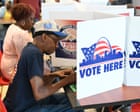
The United States Supreme Court slammed the door on a Republican-drawn congressional map in Missouri, blocking a Trump-backed attempt to reconfigure the state's political boundaries just as absentee voting for the midterms got underway. This decision ended a protracted legal war that pitted state courts against federal judges, exposed deep fractures within election administration, and revealed the limits of late-stage electoral engineering. At the center of the dispute was a legislative push to carve up a Kansas City-based district, shifting voters and altering political equations to favor conservative candidates. Instead of securing an extra seat, the state found itself trapped in a constitutional maze of competing court orders, eleventh-hour executive actions, and citizen-led resistance.
The Collision Course in Jefferson City
Political maps are rarely redrawn without friction, but the effort inside the Missouri General Assembly crossed into unprecedented territory. Following strong encouragement from Donald Trump and Governor Mike Kehoe, Republican lawmakers pursued a mid-decade redistricting plan. The primary target was the historic district represented by longtime Democratic Representative Emanuel Cleaver. By splitting the Kansas City area across multiple boundaries, the legislature intended to dilute Democratic influence and manufacture an additional safe Republican seat. In related updates, we also covered: Stop Calling Germany's Political Gridlock an Identity Crisis (It Is a Structural Realignment).
This maneuver was not born in a vacuum. Across the country, political operatives eyed every available tool to influence the balance of power in the House of Representatives. Yet Missouri presented a unique administrative headache. Redrawing district lines after a primary election had already been conducted under older boundaries created logistical nightmares for local election authorities. Voters suddenly found themselves assigned to entirely new districts midway through an election cycle, scrambling the calculus for candidates and election workers alike.
Public backlash materialized swiftly. Grassroots organizers launched a massive petition drive, gathering more than 300,000 signatures from citizens demanding a statewide vote on the map. This petition was designed to suspend the new districts until the public could weigh in directly. Under normal circumstances, such petitions trigger automatic stays on legislation. What followed, however, was a high-stakes standoff between executive power and constitutional procedure. NBC News has analyzed this critical subject in extensive detail.
Anatomy of a Legislative Overreach
Secretary of State Denny Hoskins took a hardline stance against the referendum effort. Operating near the statutory deadline on August 4, Hoskins rejected the petition signatures, asserting that state law did not permit citizen referendums on congressional redistricting. That refusal sparked an immediate legal counter-offensive. Voting rights organizations, individual citizens, and Democratic defenders rushed to state court to block Hoskins from enforcing the map.
The Missouri Supreme Court moved with rare urgency. Justices reviewed the statute and concluded on September 3 that the referendum petition was entirely valid. They ordered Hoskins to halt the implementation of the new map and revert to the districts established in 2022 following the previous census. For a brief moment, it appeared the judicial branch had settled the question.
That appearance dissolved almost immediately. Parallel federal litigation introduced a second, entirely contradictory reality into the state's election apparatus.
The Competing Judicial Orders
While the state supreme court defended the referendum rights of Missourians, Republican plaintiffs turned to the federal bench for relief. U.S. District Judge Stephen Clark issued a ruling that flatly contradicted the state supreme court, favoring the implementation of the Trump-backed map. The friction between state and federal forums intensified when the U.S. Supreme Court initially declined to disturb the state court's freeze on the map, only for the Eighth Circuit Court of Appeals to step in days later and issue a ruling backing the federal district court's preference.
Chaos followed. Local election officials received conflicting directives from state officials and federal judges. Some counties began preparing ballots under the old map, while others were pressured to adopt the new boundaries. The state supreme court took the extraordinary step of holding Secretary Hoskins temporarily in contempt for instructing local authorities to proceed with the disputed map despite clear judicial instructions to the contrary.
Voters were left completely in the dark. In districts where boundaries shifted back and forth, individuals discovered they had voted in primary elections under rules that might no longer apply to the general election. Candidates who won multi-way primaries under revised lines suddenly faced uncertainty regarding which geographic constituency they were actually running to represent.
When Election Administration Collides With Chaos
The mechanics of running an election require stability. Ballots must be printed, testing equipment must be calibrated, and poll workers must be trained weeks before polls open. Injecting legal ambiguity into this delicate machinery damages public trust.
When the U.S. Supreme Court finally intervened to resolve the standoff on September 25, the justices did not rule on the underlying merits of partisan gerrymandering or the technicalities of the referendum law. Instead, they acted out of sheer necessity to prevent catastrophic administrative failure. The court noted that altering district boundaries in the middle of active voting would usher in electoral chaos.
Denny Hoskins expressed frustration with the outcome, labeling the high court's decision a disappointing blow to representative democracy while acknowledging that it provided final clarity. On the other side of the ledger, voting rights advocates celebrated the decision as a vindication of the thousands of citizens who petitioned against the map. Governor Kehoe acknowledged the ruling, signaling that the state would comply and revert to the 2022 districts for the general election.
The Wider Fallout of Midterm Map Manipulation
The Missouri episode serves as a case study in the risks of aggressive electoral tinkering. Across the nation, attempts by various political factions to rewrite district lines ahead of the midterms yielded mixed results, frequently backfiring when mobilized voters turned out in large numbers to protest perceived overreach. The belief that maps can be arbitrarily shifted at the eleventh hour without triggering severe institutional friction ignores the resilience of state-level checks and balances.
When courts are forced to untangle competing orders issued by state and federal judges within days of an election, the system is failing its primary mandate of providing a clear, dependable mechanism for the public to choose its leaders. Missouri voters ultimately retained their prior districts, but the road to that outcome exposed deep vulnerabilities in how laws governing election administration are enforced and contested. The legal dust may have settled, but the institutional scars left by the battle over the congressional map will influence legislative strategy for years to come.