The coffee in the glass cup was already cold, a dark ring clinging to the rim, but Ambassador Roy did not notice. He was staring at a blue plastic model of the Arabian Sea sitting on the walnut corner of his desk. To anyone else, it was a toy from a geography classroom. To Roy, who had spent thirty-eight years carrying diplomatic cables through the security checkpoints of three continents, it was a pressure gauge.
Every line drawn across that blue plastic was shifting.
Down the hall, across twelve time zones, a twenty-six-year-old software engineer named Aarav was slamming his laptop lid shut in a rented apartment in South Delhi. He had just finished compiling a patch for an open-source semiconductor supply chain tool. He didn’t think of himself as a geopolitical actor. He thought of himself as tired. Yet, the code he pushed tonight would be vetted by a server farm in Northern Virginia before sunrise, and by tomorrow afternoon, it would govern the thermal sensors of an automated shipping container clearing customs in Mumbai.
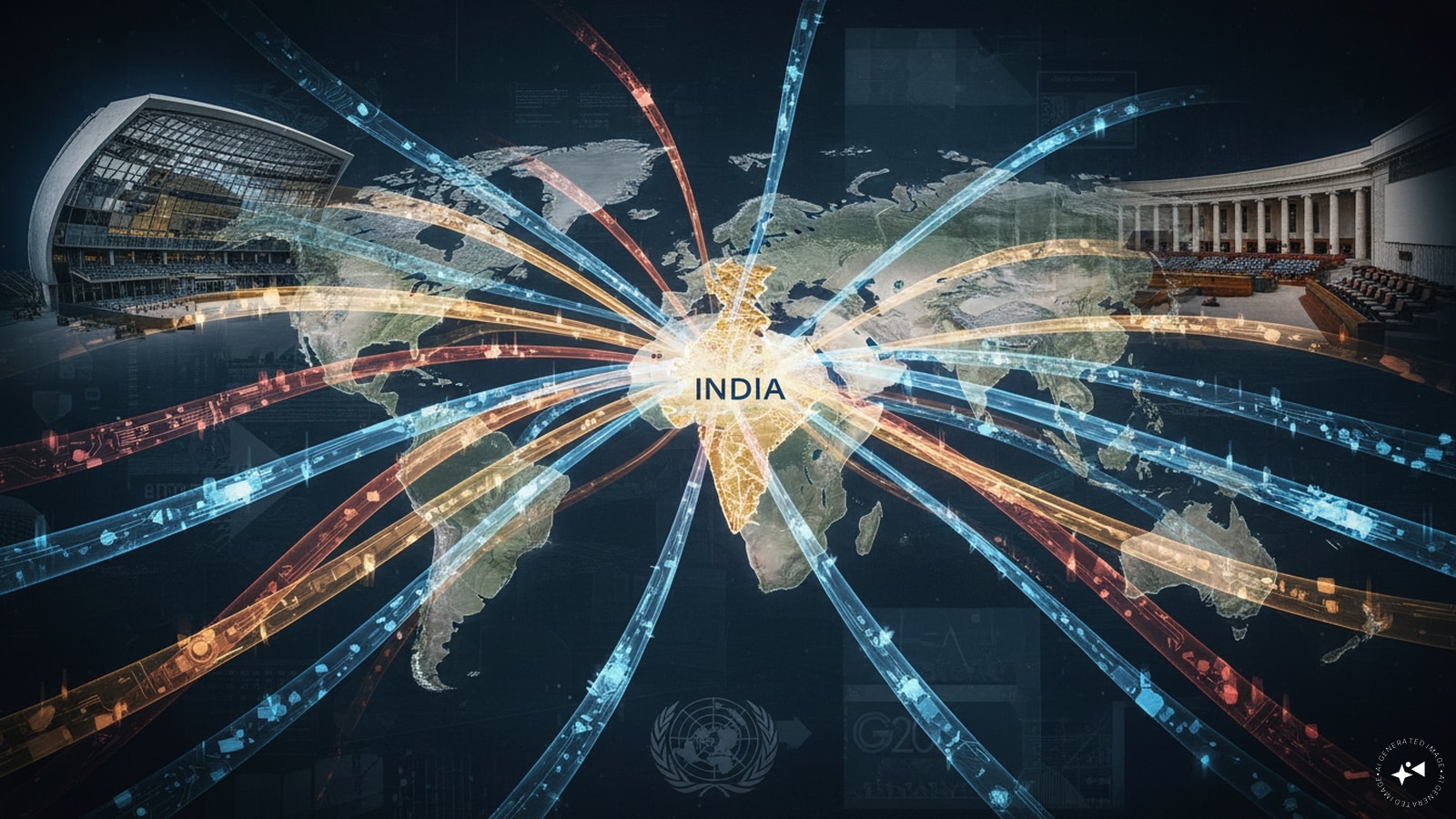
This is how empires converse now. Not through treaty halls draped in velvet, but through the quiet hum of fiber-optic cables running along the cold, dark floor of the Atlantic Ocean, and through the frantic keystrokes of engineers who have never worn a suit in their lives.
For decades, we were fed a neat, tidy story about the world. There was a center, and there were peripheries. Washington held the pen; the rest of the planet signed at the bottom of the page. It was a comfortable arrangement, built on post-war rubble and enforced by the unmatched gravity of the American dollar and the American aircraft carrier. But gravity, it turns out, is not a permanent law of international relations. It is merely a balance of masses. And the mass of the world has moved.
Consider what happens when you watch the map today.
Look past the grandstanding on cable news, past the polished communiqués issued after ministerial summits, and look at the physical architecture of survival. Supply chains are no longer rivers flowing outward from a single industrial factory floor; they are spiderwebs spun from necessity. When New Delhi and Washington began talking—really talking—over the last decade, it wasn’t born of a sudden burst of romantic affection. It was born of a shared, cold terror.
The terror of dependency.
Imagine standing on a dock in Gujarat in 2020. Cargo ships sat motionless under a zinc-colored sky, their hulls riding high in the water because the containers inside were empty. The factories that made the microchips powering everything from hospital ventilators to sedan braking systems had gone silent. Not because of war, but because of a fragile, hyper-concentrated geography that assumed peace was the default setting of human history.
That silence was the alarm clock.
When nations realize they have outsourced their heartbeat to a single vulnerable strait or a single rival capital, they do desperate, creative things. They reach across oceans. They pick up the phone.
This is where the new geometry begins. It is not an alliance in the old, NATO-style sense. There are no secret clauses promising mutual blood in the trenches. It is something much more modern, and perhaps much more durable: an alignment of parallel anxieties.
Washington realized it could no longer police the world’s supply lines alone while manufacturing the future entirely within its own borders. New Delhi realized that its explosive, hungry demographic engine—millions of young people stepping out of rural universities every single year—needed more than domestic momentum; it needed a seat at the high table of global technology and maritime security.
So the diplomats started talking about rare earth minerals. They talked about secure quantum communications. They built frameworks for critical and emerging technologies—words so dry they could turn dust to powder, yet carrying implications that will shape whether your grandchildren live in an open society or a monitored cage.
Let us be honest about the friction here. This is not a marriage of soulmates. It is an arranged marriage brokered by reality.
There are days when the old suspicions flare up like dry timber in a drought. Indian bureaucrats remember decades of economic sanctions, lectures on sovereignty, and the casual condescension of Western capitals. American strategists occasionally wring their hands over India’s stubborn refusal to abandon its traditional posture of strategic autonomy, its historical ties to Moscow, or its fiercely independent trade postures.
To ignore these tensions is to write fairy tales. But to let them obscure the tectonic shift beneath is to be willfully blind.
Walk through the tech parks of Bengaluru on a Tuesday afternoon. The air smells of espresso and ozone from cooling servers. You will hear Hindi, Kannada, Tamil, and Silicon Valley-inflected English tumbling over one another in glass-walled conference rooms. A team of twenty-somethings is training an artificial intelligence model to parse agricultural soil data for farmers in the Midwest while simultaneously auditing the cryptographic security of a satellite constellation orbiting six hundred miles above the earth.
These young engineers do not care about the Non-Aligned Movement of the 1960s. They do not carry the emotional baggage of the Cold War. They live in a hyper-compressed present where distance has been murdered by bandwidth. When an American venture capitalist wires seed money to a startup in Hyderabad, or when an Indian aerospace firm wins a contract to manufacture components for commercial launchers alongside American primes, they are drawing the new borders of the twenty-first century.
These borders are not marked by barbed wire or trenches. They are marked by standards. By who writes the protocols for artificial intelligence. By whose encryption keys protect the financial transactions of half the globe.
Power used to belong to the nation that could build the biggest wall or fire the heaviest shell. Today, power belongs to the nation that can knit together the most resilient network.
And that brings us back to Ambassador Roy, still sitting in his quiet office as the dusk turns the glass of his window into a dark mirror.
He knows that history is rarely a neat upward staircase. It is a pendulum swung by human ambition, fear, and error. The partnership binding the world's oldest democracy and the world's most populous one will stumble. There will be diplomatic insults swallowed in silence, trade disputes fought over steel tariffs, and political leaders in both capitals who will occasionally try to score cheap domestic points by picking at old scabs.
Yet, the gravitational pull is too strong to reverse.
The map has been redrawn, not by generals signing armistices on the decks of battleships, but by millions of small, urgent choices made by engineers, supply chain managers, venture capitalists, and sailors navigating contested waters.
The old world is gone. The new one is being welded together right now, in the dark, out of code, copper, and compromise. And the most remarkable thing about it is not that it is happening smoothly.
It is that it is happening at all.


