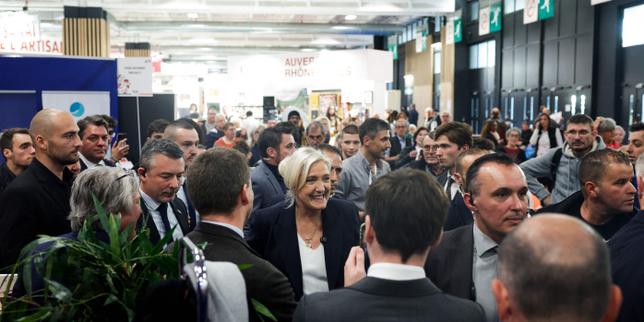
The Parisian commentary class is hyperventilating again. Whenever Marine Le Pen or the Rassemblement National (RN) signals an end to unconditional French military aid to Kyiv ahead of the 2027 presidential election, the mainstream press reaches for the exact same moralizing script. They frame it as capitulation. They call it treason against European values. They treat French foreign policy like a charity gala where refusing to sign a blank check gets you kicked off the VIP list.
That framing is lazy, intellectually dishonest, and strategically blind.
If you look past the predictable outrage over the headline Présidentielle 2027 : Marine Le Pen assume sa volonté d’abandonner l’Ukraine en mettant fin aux aides françaises, you find a much uglier truth that the Élysée Palace refuses to admit. France isn't being "abandoned" by its far-right opposition; French foreign policy has been running on empty rhetoric and hollowed-out arsenals for years. The real story isn't that Le Pen wants to pull the plug. The real story is that the current French establishment has been writing checks its defense industrial base cannot cash, all while pretending that unilateral generosity equals geopolitical strength.
The Arithmetic of Empty Warehouses
I have spent enough time watching European defense procurement cycles to recognize a classic institutional bluff. Politicians love announcing multi-billion-euro security agreements because press releases don't require factory floor space. Artillery shells do.
When pundits attack Le Pen for wanting to halt French arms shipments, they conveniently ignore the physical reality of the French military. France operates a boutique expeditionary force, not a continental attrition machine. Over the last few years, sending CAESAR self-propelled howitzers, Scalp cruise missiles, and Crotale air-defense batteries to Eastern Europe didn't just drain surplus stock. It carved straight into the operational readiness of the French Armed Forces.
You cannot run a high-intensity war economy on vibes and summit declarations. Under the current Loi de programmation militaire (LPM), France is scrambling just to rebuild basic stockpiles that would last weeks, not years, in a peer-to-peer conflict. Every battery shipped out of Toulon or Bourges without an immediate, one-to-one replacement on the assembly line leaves France naked in its own theater of operations—from the Mediterranean to the Indo-Pacific.
Mainstream analysts treat "aid to Ukraine" as an infinite moral good with zero opportunity cost. In the real world of defense economics, opportunity cost is the only metric that matters. When Le Pen questions the wisdom of bleeding French regiments dry for a stalemate on the Dnieper, she isn't reciting Kremlin talking points. She is stating the exact same inventory problem that French generals whisper about behind closed doors at the École Militaire.
Why Everyone Is Asking the Wrong Question
Search engines are flooded with the same tired variations of one query: Will Marine Le Pen hand Ukraine to Putin in 2027?
That question rests on a completely broken premise. It assumes that France is currently the load-bearing wall holding up Kyiv's defense, and that a shift in Paris would single-handedly collapse the front lines.
Look at the actual numbers tracked by the Kiel Institute for the World Economy. In terms of bilateral military commitments, France has consistently lagged behind the United States, Germany, the United Kingdom, and even smaller Nordic economies relative to GDP. Paris mastered the art of high-profile announcements—like floating the idea of sending ground trainers or Mirage 2000-5 jets—while dragging its feet on the unglamorous, industrial-scale grunt work of 155mm ammunition production.
So when commentators panic that a Le Pen presidency would "abandon" Ukraine, they are mourning a level of French dominance that never existed in the first place. Paris has been punching far below its diplomatic weight class while acting as if it were the sole architect of European security.
What Critics Get Wrong About RN's Foreign Policy
To beat an opponent's argument, you actually have to understand it. The media's caricature of the Rassemblement National as simple-minded Moscow stooges misses the cold, transactional Gaullism driving their electoral math.
- The Sovereignty Reflex: Le Pen’s voters do not view the world through the lens of Brussels technocrats or Atlanticist think tanks. To them, sending billions abroad while French hospitals rot, rural transit disappears, and inflation eats household budgets is a direct betrayal of the social contract.
- The NATO Skepticism: Long before February 2022, the RN platform called for leaving NATO's integrated military command—mirroring Charles de Gaulle's 1966 decision. Their opposition to deeper entanglement in Eastern Europe isn't a sudden whim; it is a consistent refusal to let Washington or Brussels dictate where French soldiers and taxpayers get deployed.
- The Escalation Trap: While Emmanuel Macron spent his second term oscillating between calling for diplomacy and refusing to rule out Western boots on the ground, Le Pen staked out the territory of predictable restraint. In a nuclear-armed standoff, voters tend to prefer the candidate who isn't improvising escalation ladders during live TV interviews.
The Strategic Blind Spot in Le Pen's Doctrine
Of course, pointing out the establishment's hypocrisy doesn't make Le Pen's alternative bulletproof. There is a massive, glaring flaw in the RN's approach to European security, and pretending otherwise would be pure propaganda.
If France abruptly halts bilateral military aid and vetoes European Union defense funding in 2027, Paris doesn't magically regain its sovereign glory. It becomes a diplomatic pariah on its own continent.
Imagine a scenario where a President Le Pen freezes French transfers to Kyiv on day one while demanding immediate peace negotiations on Russia's terms. Warsaw, Stockholm, and the Baltic states wouldn't thank France for its "realism." They would write Paris off permanently as an unreliable security partner, cementing total American and German hegemony over Central and Eastern Europe. France's cherished dream of "European strategic autonomy"—the very idea that Europe should defend itself without relying on Washington—would die on the spot. You cannot lead a continent while walking out of the room when the shooting starts.
Furthermore, cutting off aid doesn't stop the war; it merely shifts the terms of surrender. A frozen conflict that rewards territorial conquest by force sets a precedent that directly threatens French interests elsewhere, from overseas territories to maritime trade routes.
The Real Choice Facing French Voters in 2027
The debate over Ukraine in France has been poisoned by two competing fantasies.
On one side sits the Macronist establishment, peddling the illusion that France can act as a global superpower on a shoestring budget, lecturing allies while struggling to hit basic ammunition quotas. They demand unconditional solidarity without ever explaining what victory actually looks like, how long it will take, or who is going to pay for the reconstruction of a shattered state.
On the other side sits Marine Le Pen, offering the comforting fiction that France can simply pull up the drawbridge, shut off the funding tap, and insulate itself from a major land war happening a two-hour flight from Strasbourg.
Real statecraft lives in the uncomfortable space neither camp wants to touch. It requires admitting that European security cannot be outsourced to American taxpayers forever, nor can it be sustained by empty Parisian grandstanding. If France wants to matter in 2027, it doesn't need more moralizing editorials about abandoning allies, and it doesn't need isolationist slogans. It needs factories running three shifts, honest accounting of its own military limits, and the courage to define realistic diplomatic off-ramps before the entire continent runs out of hardware.
Stop listening to politicians who treat war like a campaign slogan—whether they wrap themselves in the blue-and-yellow flag or the tricolor, neither of them is paying the bill when the ammunition runs out.