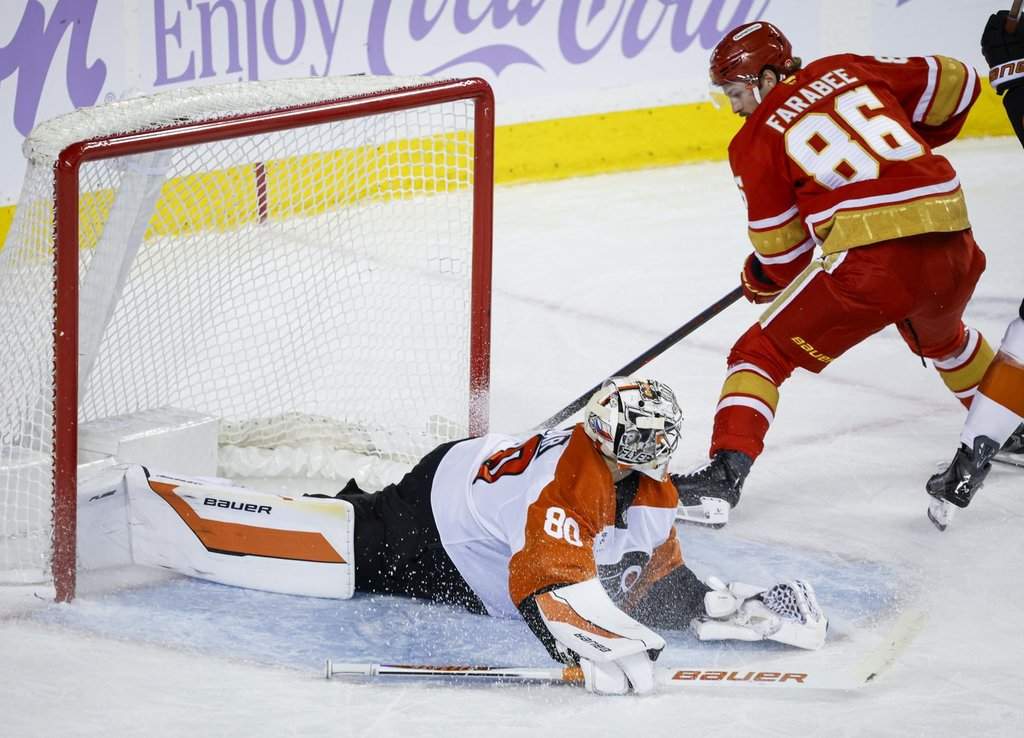
Breakaway conversion in the National Hockey League is rarely a product of sudden luck; it is the downstream result of spatial separation, puck-handling economy, and goaltender manipulation. When Calgary Flames winger Joel Farabee converts on high-danger transition rushes, standard sports commentary reduces the event to "finding his touch." That framing obscures the underlying operational reality. Breakaway scoring is a deterministic sequence of micro-advantages won in the neutral zone and executed within a three-second compression window in the offensive slot.
To understand why Farabee’s breakaway efficiency has stabilized, we must dismantle the vague notion of "offensive confidence" and examine the three mechanical pillars governing one-on-one rush optimization: spatial manipulation prior to the blue line, velocity preservation during puck reception, and the exploitation of goaltender depth-control algorithms. Recently making waves in this space: Myles Garrett's Three-Sack Night Exposes the Fatal Flaw in the Rams' All-In Gamble.
The Structural Economics of the NHL Breakaway
In modern NHL defensive systems—dominated by 1-1-3 neutral zone traps and aggressive weak-side pinching—true uncontested breakaways are scarce commodities. Every breakaway represents a catastrophic structural failure by the defending five-man unit, typically triggered by a turnover at the offensive blue line or a miscalculated pinch by a strong-side defenseman.
Because these events occur at low frequencies, variance heavily distorts short-term shooting percentages. A player can execute the exact same mechanical sequence ten times and score once due to post variance or a desperation paddle save, leading analysts to falsely diagnose a slump. Conversely, two consecutive conversions create the illusion of a sudden breakthrough. Further insights on this are covered by Yahoo Sports.
Separating signal from noise requires evaluating process metrics rather than raw goal totals:
- Separation Velocity: The differential in skating speed between the attacking forward and the nearest back-checking defenseman at the moment the puck crosses the defensive blue line.
- Entry Angle: The geometric trajectory of the carrier relative to the center dot, which dictates how much horizontal ice the goaltender must cover.
- Release Latency: The elapsed time between the final stick-handle adjustment and the puck leaving the blade.
Farabee’s historical profile as a middle-six two-way forward has always featured strong defensive anticipation. However, transitioning from a defensive disruptor to a clinical finisher in Calgary required altering how he manages the puck during the final forty feet of the rush.
Pillar One Pre-Reception Positioning and the Neutral Zone Trap
A breakaway begins before the player touches the puck. The most common failure mode for NHL wingers in transition is "flat-footed stretching"—circling too early in the neutral zone, bleeding forward momentum, and allowing the opposing defenseman to maintain gap control.
Farabee’s adjustment lies in delayed route acceleration. Rather than parking on the far blue line waiting for a stretch pass, he utilizes shallow curling routes through the middle-lane corridor. By timing his crossover acceleration to coincide precisely with the Calgary defenseman’s rim or bank pass, Farabee enters the neutral zone at peak linear velocity while the opposing defenders are still transitioning from backward to forward skating.
This creates a kinematic mismatch. Because human backward-to-forward pivoting incurs a mandatory deceleration penalty of roughly 0.4 to 0.6 seconds, a winger hitting the pass in full stride gains an immediate five-to-eight-foot buffer. Once that buffer is established, the back-checker cannot legally impede the carrier without taking a hooking or slashing penalty, effectively granting the shooter a clean runway from the red line inward.
The Geometry of the Catch
Receiving a fifty-foot stretch pass at twenty-two miles per hour introduces significant kinetic energy that must be absorbed without breaking stride. Poor puck reception forces the shooter to look down at the blade, costing roughly half a second of visual processing time—more than enough for an NHL goaltender to square their shoulders and set their depth at the top of the crease.
Farabee’s efficiency stems from soft-hand absorption on the forehand hip. By cushioning the pass slightly behind his front skate rather than stopping it dead in front of his body, he maintains an uninterrupted triple-threat posture: the ability to shoot immediately, forehand-to-backhand deke, or pull the puck into a toe-drag without an intermediate gathering motion.
Pillar Two Goaltender Depth-Control and the Illusion of Speed
Modern NHL goaltending is governed by strict geometric rules. A goaltender’s primary objective on a breakaway is to match the shooter’s speed backward while maintaining their skate blades on the direct line between the puck and the center of the net. If the goaltender matches speed accurately, the shooter sees zero open net.
To beat an elite goaltender, the shooter must break this synchronization. There are only two ways to disrupt a goaltender’s backward tracking rhythm:
- Vertical Velocity Modulation: Accelerating aggressively through the neutral zone, then subtly decelerating at the hash marks. If the goaltender retreats too quickly, they retreat deep into the blue paint, exposing the top corners. If they brake too hard to hold the top of the crease, the shooter’s residual speed carries them past the goaltender’s lateral reach.
- Lateral Plane Shifting: Moving the puck across the body’s centerline—typically from the wide forehand hip to the backhand—at the exact moment the goaltender plants their skates to prepare for a shot.
Farabee’s recent conversions demonstrate a deliberate shift toward late-stage lateral plane shifting. Earlier in his tenure, his breakaway attempts were characterized by early shot selection—releasing low-to-mid-height wrist shots from the hash marks while moving in a straight line. Against NHL goaltenders who are six-foot-three and wider in the butterfly, straight-line shots from twenty feet out carry an expected goals (xG) value rarely exceeding 0.22.
By holding the puck an extra fraction of a second and dragging it across the royal road (the imaginary line dividing the ice vertically from net to net), Farabee forces the goaltender to abandon their set stance and initiate a lateral push. Once an NHL goaltender commits to a butterfly slide, their upper-body posture drops by twelve to sixteen inches, opening the upper third of the net—specifically the glove-side shoulder and the short-side shelf.
Pillar Three Shot Release Mechanics and Deception
The final bottleneck in breakaway conversion is telegraphing. Goaltenders read hip orientation, shoulder tilt, and blade angle—not the puck itself—to predict shot trajectory. If a shooter opens their hips early to load a wrist shot, the goaltender reads the release point before the puck leaves the ice.
Farabee eliminates this tell through in-stride snapshot mechanics. Instead of sweeping the puck backward to generate torque, he utilizes the flex profile of his stick shaft directly underneath his hands. By pushing the top hand forward while snapping the bottom hand down simultaneously, he generates maximum velocity with minimal wind-up.
This creates two distinct operational advantages:
- Zero Hip Rotation: His torso remains oriented toward the middle of the ice, disguising whether he intends to shoot high-blocker, slide the puck five-hole, or pull it to his backhand.
- Altered Release Angle: Pulling the puck slightly inward toward his skates just prior to release changes the angle of attack by roughly eight to ten degrees. Because goaltenders align their bodies to the puck rather than the shooter’s torso, an eight-degree shift forces the goaltender to adjust their glove or blocker position mid-flight, drastically reducing clean save percentages.
The Backhand Counter-Threat
A forehand snapshot is only lethal if the goaltender respects the backhand alternative. If a goaltender knows a shooter refuses to go to their backhand, they can cheat toward the forehand side, taking away the primary shooting lane.
Farabee’s execution relies on establishing a credible forehand-to-backhand elevator. By driving hard toward the right post (as a left-handed shot) before cutting sharply across the crease, he forces the goaltender to respect the wrap-around and far-post tap-in. When the goaltender over-commits to sealing the ice with their pad during the lateral slide, Farabee elevates the puck over the outstretched leg pad. Even when this move does not result in a goal, the visual memory of the play forces future opponents to hold their edges longer, which subsequently re-opens the five-hole and low-blocker lanes for his snapshot.
System Integration How Calgary’s Tactical Structure Feeds Transition
Individual skill cannot exist in a tactical vacuum. A winger’s breakaway frequency is heavily dictated by the system architecture of their team. Under Calgary’s current structural framework, the Flames emphasize aggressive puck pressure in the defensive zone—specifically utilizing a box-plus-one or hybrid man-to-man coverage scheme below the dots.
The primary byproduct of this defensive aggression is forced turnovers in the lower slot and corners. Unlike passive zone defenses that absorb pressure and rely on chipped clears off the glass, Calgary’s structure tasks the weak-side winger with "cheating" slightly toward the high slot as soon as the puck is contested in the defensive corner.
This creates a direct causal chain:
- Defensive Extraction: A Calgary defenseman or center wins a 50/50 board battle below the goal line.
- Immediate Outlet: Rather than holding the puck behind the net to execute a structured five-man breakout, the defender snaps a hard indirect pass off the boards into the neutral zone space vacated by the pinching opposing defenseman.
- Exploiting the Vacuum: Because Farabee has already positioned himself above the hash marks on the weak side, he intercepts this outlet pass in open ice while the opposing team’s forwards are still trapped deep in the offensive zone.
This tactical design artificially inflates Farabee’s breakaway opportunities compared to systems that prioritize controlled, short-pass possession exits. He is not creating breakaways out of thin air; he is executing the designated release-valve role built into Calgary’s defensive counter-attack.
Limitations and Regression Risks
Treating a hot streak of breakaway conversions as a permanent baseline shift is a classic analytical trap. Several structural constraints and regression variables threaten the sustainability of this output:
- Pre-Scouting Adaptation: NHL video coaches compile exhaustive tendency profiles on every forward. Once Farabee establishes a pattern of late forehand-to-backhand drags or high-blocker snapshots, opposing goaltending coaches will instruct their netminders to hold their depth at the top of the crease and refuse to bite on the first shoulder fake. When the goaltender stays patient, the shooter runs out of real estate and is forced into low-percentage sharp-angle attempts.
- Defensive Gap Adjustments: Opposing coaching staffs will adjust their neutral zone forecheck against Farabee’s line by instructing their weak-side defenseman to bail out early rather than holding the offensive blue line. Eliminating the pinch eliminates the breakaway runway, forcing Farabee to generate offense through structured cycle play—an area where his smaller frame faces higher physical attrition.
- Shooting Percentage Gravity: Across large multi-season samples, even the most elite breakaway specialists in the NHL convert at roughly 35% to 42%. Any short-term stretch exceeding 50% is mathematically guaranteed to regress toward the mean as puck luck, crossbar hits, and desperation saves normalize over an eighty-two-game schedule.
The Strategic Mandate for Calgary’s Coaching Staff
To maximize the return on Farabee’s transition efficiency before opposing video scouts neutralize his primary moves, Calgary’s coaching staff must implement two immediate tactical adjustments.
First, pair Farabee exclusively with defensemen who possess elite first-pass velocity and vision. Putting a high-motor transition winger on the ice with stay-at-home defenders who default to high-glass clears wastes his primary offensive weapon. His deployment must be hard-matched with puck-moving defensemen capable of executing sixty-foot tape-to-tape area passes under heavy forechecking pressure.
Second, introduce a deliberate drop-pass variation on two-on-one and semi-breakaway rushes. As opposing back-checkers begin selling out to catch Farabee from behind, his teammates must trail the play into the high slot. By utilizing the threat of his breakaway speed to drive the opposing defensemen deep into their own crease, Farabee can execute a sudden drop-pass to the trailing center, converting high-pressure breakaway looks into uncontested high-slot one-timers.