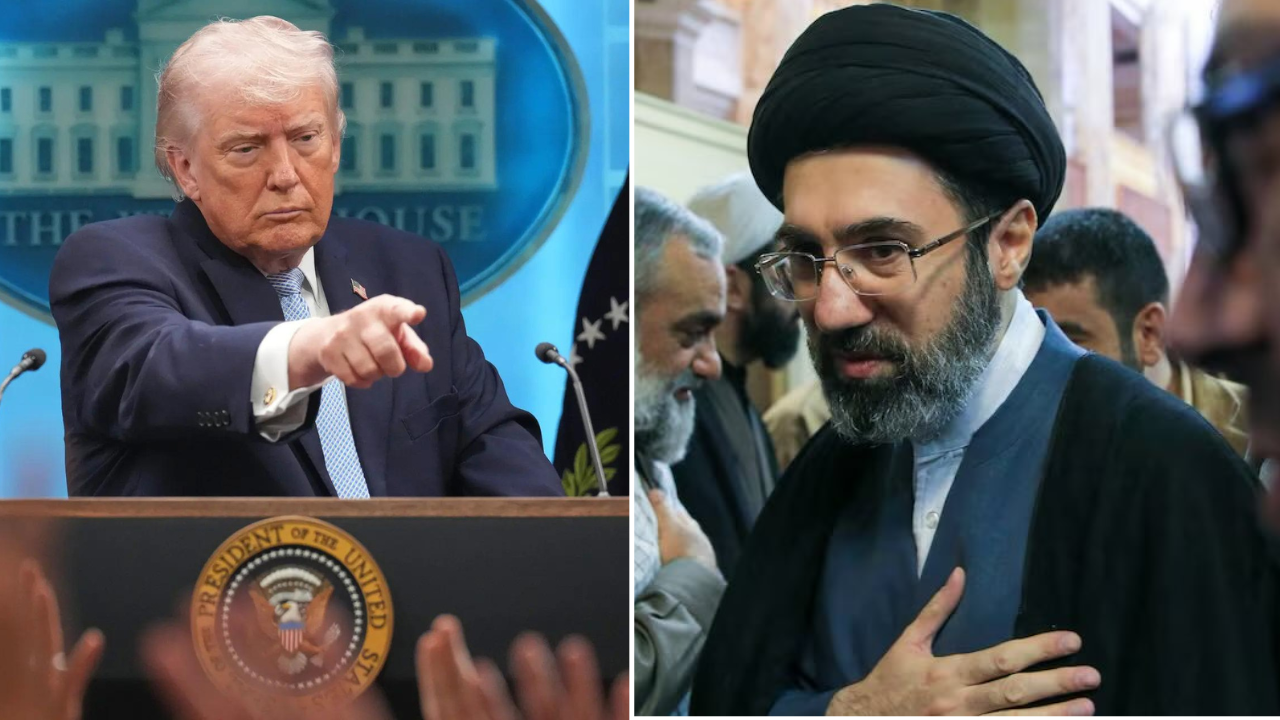
The recent cessation of direct hostilities between Washington and Tehran represents a calculated equilibrium shift rather than a diplomatic breakthrough. This truce is defined by a specific convergence of existential risks and internal political transitions within the Islamic Republic, primarily the emergence of Mojtaba Khamenei as a decisive operational actor. By analyzing the structural incentives of both the Trump administration and the Iranian leadership, we can map the transition from a "total destruction" posture to a stabilized geopolitical freeze.
The stability of this truce rests on three analytical pillars: the credibility of the American kinetic threat, the internal succession dynamics within the Iranian Office of the Supreme Leader, and the technical constraints of Iran's current nuclear breakout capacity.
The Cost Function of Kinetic Ultimatums
The Trump administration’s "wipe out civilization" rhetoric operated as a high-stakes psychological operation designed to reset the risk assessment of the Iranian Revolutionary Guard Corps (IRGC). For an ultimatum to achieve strategic results without physical execution, the target must perceive the cost of defiance as higher than the cost of capitulation.
In this instance, the American side signaled a departure from traditional "proportional response" doctrine. By framing the potential conflict as an existential threat to the Iranian state’s infrastructure and cultural continuity, the administration forced a binary choice upon Tehran. The Iranian response was dictated by a survival-based utility function:
- Regime Preservation Priority: The primary objective of the Iranian leadership is the continuity of the Islamic Republic’s power structure.
- Infrastructure Vulnerability: Iran’s energy export nodes and centralized command-and-control facilities are highly susceptible to high-yield conventional strikes.
- Economic Thresholds: With inflation rates and currency devaluation hitting critical levels, the state lacks the fiscal reserves to sustain a high-intensity defense or a post-conflict reconstruction.
The intersection of these variables created a "dead-end" scenario where the traditional Iranian strategy of "strategic patience" or "asymmetric escalation" became mathematically non-viable.
The Mojtaba Variable: Centralized Decision-Making
The shift in Iranian policy coincides with the consolidation of power by Mojtaba Khamenei. Historically, Iranian foreign policy has been a fragmented process involving the Ministry of Foreign Affairs, the IRGC, and the Supreme Leader's office. This fragmentation often led to contradictory signals.
Mojtaba Khamenei’s intervention represents a vertical integration of Iranian decision-making. By "greenlighting" the de-escalation, he effectively silenced the hardline factions within the IRGC who viewed any retreat as a betrayal of revolutionary principles. This internal alignment was necessary because:
- Succession Readiness: For Mojtaba to secure a stable transition of power from his father, Ali Khamenei, he requires a period of external stability. A full-scale war during a leadership transition would likely lead to systemic collapse.
- Operational Control: His ability to enforce the truce demonstrates a level of control over the security apparatus that previous civilian leaders, such as former presidents Rouhani or Pezeshkian, lacked.
- Pragmatic Realism: Unlike the ideological rigidity of the older revolutionary generation, the younger power bloc appears to view the nuclear program and regional proxies as chips to be traded for regime longevity rather than ends in themselves.
The Nuclear Breakout Logic and the Technical Buffer
The truce is not an agreement to dismantle the nuclear program; it is a management of the "breakout time." Currently, Iran possesses the technical capability to enrich uranium to weapons-grade levels (90% U-235) within a matter of days. However, the weaponization process—miniaturizing a warhead and integrating it into a delivery vehicle—remains a longer-term hurdle.
The truce functions as a "technical pause." Iran agrees to cap its stockpile of 60% enriched uranium and limit the installation of advanced centrifuges (IR-6 and IR-9 models) in exchange for a relaxation of the most stringent kinetic threats. This creates a buffer zone that serves both parties:
- For the US: It prevents a nuclear fait accompli that would force a mandatory military intervention.
- For Iran: It preserves the "latent" nuclear capability—the threat of being a turn-key nuclear state—without incurring the costs of becoming an actual one.
This "threshold status" is more valuable to the current Iranian leadership than a functional bomb. A bomb invites immediate annihilation; the ability to build a bomb invites negotiation and sanctions relief.
The Proxy Feedback Loop: Hezbollah and the Houthis
A critical component of this truce is the management of the "Axis of Resistance." In previous years, Tehran used its proxies to exert pressure on the US and its allies. However, the degradation of Hezbollah’s leadership structure and the persistent maritime strikes by the Houthis have reached a point of diminishing returns.
The strategic logic has shifted from Proxy Expansion to Proxy Conservation.
If Tehran allows its proxies to trigger a regional war, it loses its primary layer of forward defense. By instructing these groups to calibrate their attacks to "harassment" levels rather than "escalation" levels, Mojtaba Khamenei maintains a bargaining chip while avoiding the "wipe out civilization" trigger. This calibration is delicate. If a proxy miscalculates and causes significant American or Israeli casualties, the logic of the truce collapses instantly.
Structural Risks and Bottlenecks
Despite the current stabilization, several variables could disrupt the equilibrium.
First is the Information Gap. If US intelligence detects a covert move toward weaponization that occurs outside the monitored facilities, the "no-strike" commitment is voided. Second is the Economic Pressure Point. If the US does not provide sufficient "shadow" sanctions relief—allowing Iran to export enough oil to maintain basic social order—the Iranian leadership may conclude that the truce offers no survival benefit, leading back to a "breakout" strategy.
Third is the Internal Opposition. While Mojtaba Khamenei has consolidated power, there are elements within the IRGC intelligence services and the Basij who view de-escalation as a sign of weakness. A rogue operation by a hardline faction remains a non-zero risk.
Strategic Forecast: The Management of Latency
The current US-Iran relationship has transitioned from a conflict of ideologies to a management of technical and political limits. We are entering a period of "Competitive Containment."
The United States will continue to utilize its financial hegemony to restrict Iran's growth, while maintaining a credible military presence in the Persian Gulf. Iran will maintain its nuclear latency and proxy network as a defensive shield. The success of this truce depends entirely on the continued perception that the status quo is more survivable than the alternative.
The strategic play for Western observers is to monitor the Iranian domestic economy and the specific movements of IRGC leadership transitions. If Mojtaba Khamenei successfully navigates the succession, the truce likely hardens into a long-term geopolitical freeze. If the succession is contested, the risk of an external "diversionary war" increases exponentially. The current calm is a product of internal Iranian consolidation, not a change in fundamental regional objectives. The goal remains survival; the truce is simply the most efficient tool for achieving it in the current technical environment.