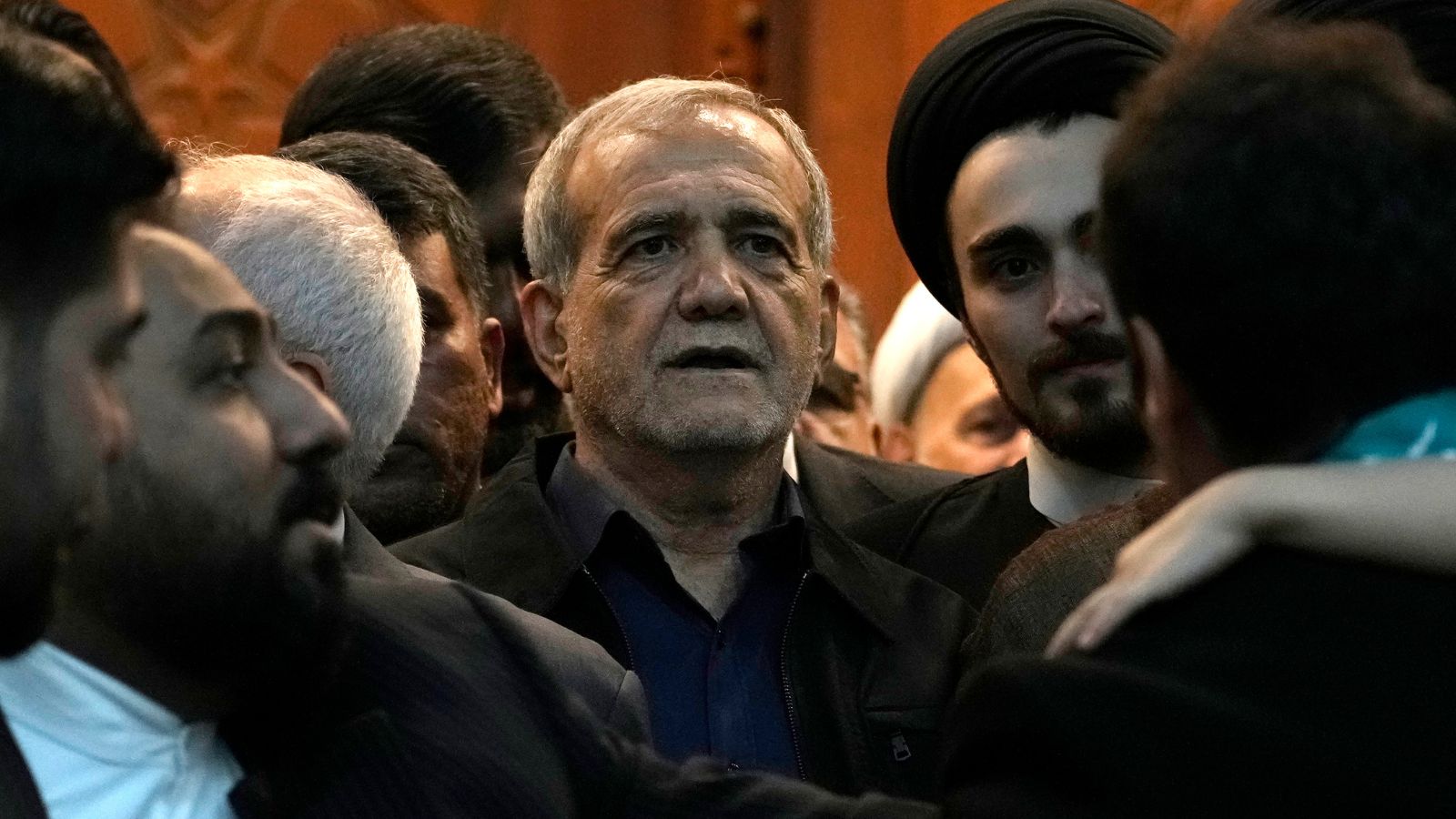
The recent open letter from Iranian President Masoud Pezeshkian addressed to the American public represents a shift in diplomatic communication from ideological confrontation to a calculated strategic appeal. This maneuver is not a gesture of sentiment but a structural attempt to bypass traditional diplomatic bottlenecks and speak directly to a domestic American electorate currently characterized by extreme polarization. By analyzing the letter’s architecture, we can identify three distinct functional objectives: the mitigation of sanction-induced economic attrition, the decoupling of the Iranian state from "maximum pressure" narratives, and the exploitation of perceived shifts in American isolationist sentiment.
The Economic Drivers of Diplomatic Signaling
The fundamental catalyst for Pezeshkian’s outreach is the continued degradation of the Iranian fiscal environment under the U.S. sanctions regime. To understand the letter, one must first understand the cost-of-carry for the Iranian state. The Iranian economy operates under a "Resistance Economy" framework, which prioritizes self-sufficiency and regional trade to blunt the impact of global financial isolation. However, this model faces a critical threshold of diminishing returns. Meanwhile, you can read other stories here: Why the James Comey seashell case is a legal mess for the DOJ.
The primary bottleneck is the lack of capital infusion required to modernize aging energy infrastructure. Iran possesses some of the world's largest proven gas and oil reserves, yet its extraction efficiency is hampered by a lack of Western technology and investment. Pezeshkian’s "We are not your enemy" messaging serves as a preliminary signal to global markets that the Iranian executive branch is seeking a pathway toward reintegration, or at least a softening of the primary and secondary sanctions that prevent foreign direct investment.
A Tripartite Logical Framework of the Pezeshkian Doctrine
The letter’s content can be deconstructed into three logical pillars designed to resonate with specific segments of the American political spectrum. To explore the complete picture, check out the recent report by USA Today.
1. The Sovereignty Equilibrium
Pezeshkian emphasizes the principle of non-interference. This is a tactical alignment with the growing "restraint" school of thought in U.S. foreign policy. By framing Iran’s actions as defensive and reactive, he attempts to neutralize the "aggressor" variable in the American security calculus. The logic suggests that if the U.S. reduces its footprint in West Asia, the friction between the two nations naturally dissipates.
2. The Differentiation Strategy
A significant portion of the messaging is dedicated to separating the Iranian people and their civilizational history from the specific policy disputes of the Islamic Republic’s government. This creates a psychological "out-group" vs "in-group" dynamic where the American public is invited to see the Iranian state not as a monolith, but as a complex actor capable of reform.
3. The Rational Actor Hypothesis
By using the medium of an open letter, Pezeshkian is signaling that Iran is willing to engage in transactional diplomacy rather than purely ideological warfare. This moves the needle from "clash of civilizations" to "negotiated settlement," a shift that appeals to the pragmatic wing of the American business and political elite who view the current stalemate as a lost opportunity for market expansion and regional stability.
The Mechanism of Direct Public Engagement
The decision to address the public directly, rather than through official state channels, is a response to the perceived gridlock in Washington. In the current American political climate, traditional diplomacy often becomes a casualty of domestic partisan signaling. Pezeshkian’s team likely identified that a direct appeal can bypass the legislative and bureaucratic filters that typically harden a state's stance.
This "Public Diplomacy 2.0" operates on the assumption that if the American public becomes less supportive of a hawkish stance, the political cost for U.S. leaders to maintain "maximum pressure" increases. This is particularly relevant during an election cycle where foreign entanglements are under high scrutiny. The letter functions as a wedge, attempting to widen the gap between the U.S. electorate’s appetite for conflict and the established foreign policy consensus.
Structural Obstacles and Strategic Limitations
Despite the calculated nature of the letter, several structural variables ensure that its impact remains limited. These are the hard-coded realities that a rhetorical shift cannot easily override.
- The Regional Proxy Network: Iran’s influence is projected through the "Axis of Resistance." For the U.S. security establishment, Pezeshkian’s words are weighed against the kinetic actions of non-state actors in Lebanon, Yemen, and Iraq. The mismatch between the President’s conciliatory tone and the activities of the Islamic Revolutionary Guard Corps (IRGC) creates a credibility gap.
- The Nuclear Breakout Timeline: The technical progress of Iran’s nuclear program remains the primary metric for U.S. policy. No amount of public outreach can substitute for the verified monitoring and limitation of enrichment levels.
- Legislative Inertia: Many of the sanctions against Iran are codified into U.S. law, such as the Iran Sanctions Act. Removing these requires a level of bipartisan consensus in Congress that is currently non-existent.
The cause-and-effect relationship missed by standard commentary is the internal power dynamic within Iran itself. Pezeshkian represents the reformist-leaning faction, but his ability to deliver on diplomatic promises is contingent upon the approval of the Supreme Leader and the alignment of the security apparatus. The letter is, therefore, as much an internal signal of his administration’s intent as it is a message to Americans.
The Geopolitical Arbitrage of Polarization
Pezeshkian is attempting to leverage the internal discord within the United States. By referencing a "common humanity" and mutual respect, he is positioning Iran as a neutral party that has been unfairly victimized by specific U.S. administrations. This is an exercise in geopolitical arbitrage—buying back "reputational capital" in the West at a time when the West’s own internal consensus is undervalued.
The strategy assumes that the American audience is no longer a monolithic entity. There is a "Restraint" cohort, an "Isolationist" cohort, and a "Globalist" cohort. Pezeshkian’s letter is calibrated to offer something to each:
- To the Restrainers, he offers a vision of a stable region without U.S. troop presence.
- To the Isolationists, he offers the prospect of reduced foreign spending.
- To the Globalists, he offers the potential for a restored JCPOA-style framework and predictable oil markets.
The Tactical Utility of the "Enemy" Narrative
The phrase "We are not your enemy" is a deliberate attempt to reset the baseline of the relationship. In cognitive psychology, "reframing" is the process of changing the conceptual and/or emotional viewpoint in relation to which a situation is experienced. By explicitly stating that Iran is not an enemy, Pezeshkian forces the reader to justify why they would consider Iran an enemy, moving the burden of proof from the Iranian state to the American observer.
However, the efficacy of this reframing is hampered by historical precedent. Decades of "Death to America" rhetoric cannot be neutralized by a single letter. The "hostility function" in this relationship is not a simple binary (Enemy/Friend) but a complex spectrum of competition, proxy conflict, and occasional tactical cooperation.
Determining the Success Metric
How do we measure the success of this outreach? The metrics are not found in public opinion polls but in the subtle shifts of diplomatic theater.
- Rhetorical Reciprocity: Do U.S. officials acknowledge the tone of the letter? Even a dismissal that acknowledges the "different tone" is a win for the Pezeshkian administration.
- Backchannel Activity: An increase in quiet intelligence or diplomatic exchanges following such a public gesture indicates that the letter served its purpose as a "permission slip" for more serious discussions.
- Sanctions Enforcement Elasticity: If the U.S. Treasury Department becomes less aggressive in pursuing small-scale sanctions violations in the wake of improved optics, the letter has achieved a tangible economic result.
The core tension remains: Pezeshkian is attempting to sell a "Normal State" narrative for a nation that continues to operate as a "Revolutionary State." These two identities are functionally incompatible in the long term. A normal state prioritizes economic integration and international law; a revolutionary state prioritizes ideological expansion and asymmetrical power projection.
The Strategic Recommendation for Observers
The primary takeaway for analysts and policymakers is to view the Pezeshkian outreach as a survival mechanism rather than a transformation. It is a tactical pivot necessitated by fiscal reality. To engage effectively, one must look past the sentiment of the "open letter" and focus on the underlying variables that could lead to a stable equilibrium.
- Monitor the IRGC Response: The true measure of Pezeshkian’s authority is whether the security apparatus allows this diplomatic opening to persist or if they initiate a regional provocation to re-establish the "confrontation" status quo.
- Track Enrichment Levels: Watch for a slowdown in 60% enrichment as a signaling mechanism. Words in a letter are "cheap talk" in game theory; material changes in nuclear capability are "costly signals."
- Assess the "Third Country" Facilitation: Look for increased diplomatic activity in Oman or Qatar, which often act as the physical conduits for the ideas floated in these public letters.
The Pezeshkian letter is a sophisticated piece of political theater designed to lower the temperature of a boiling relationship just enough to prevent a structural break. It does not solve the fundamental contradictions of the U.S.-Iran rivalry, but it does introduce a new variable into the equation: the possibility of a transactional, rather than existential, conflict.