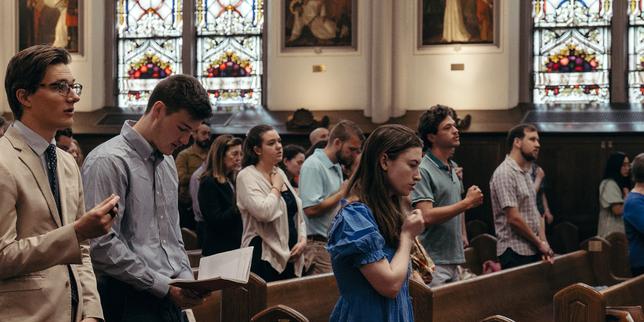
The traditional narrative of secularization in Western democracies fails to account for a counter-cyclical anomaly: the highly localized but statistically significant growth of young recruits within the American Catholic Church. While aggregate mainline religious participation continues its downward trajectory, specific institutional nodes—primarily traditional religious orders, specialized seminaries, and campus ministries—are experiencing a concentrated influx of Generation Z and millennial adherents. This phenomenon is not an accident of cultural nostalgia; it is the predictable output of a structured alignment between rigorous institutional demands and the psychological scarcity of stable community structures in a hyper-mediated society.
Understanding this shift requires moving past sentimental observations about youth piety. Instead, the demographic shift must be analyzed through a strategic framework that evaluates the institutional value proposition, the cost of entry, and the supply-and-demand dynamics of contemporary belief systems.
The Demand Function of Hyper-Individualism
The growth in young Catholic vocations—both to the priesthood and to religious life as sisters or brothers—can be modeled as a flight to high-commitment structures. In economic and sociological terms, when the cost of navigating a highly fragmented, atomized social landscape increases, the relative value of a highly structured, counter-cultural identity rises proportionally.
The target demographic (individuals aged 18 to 30) operates in an environment characterized by acute social isolation, choice paralysis, and institutional distrust. The modern secular landscape imposes a high cognitive load regarding identity formation: individuals must invent, market, and maintain their own personas and moral frameworks continuously.
The Catholic institutional framework reverses this burden through three distinct mechanisms:
- Identity Standardisation: By offering an ancient, non-negotiable set of dogmas and liturgical practices, the institution eliminates choice fatigue. The individual does not need to construct a self; they inherit a highly developed, historically validated archetype.
- Radical Cost Signaling: High-commitment groups thrive precisely because they demand high entry barriers. Vows of poverty, chastity, and obedience serve as extreme forms of cost signaling. In a marketplace of low-stakes digital affiliations, a high tangible cost signals authentic value and screens out low-affinity participants, creating a high-trust internal peer group.
- Total Community Integration: Unlike secular civic organizations or low-maintenance religious groups that require only weekly or periodic attendance, traditional religious orders offer a totalizing communal architecture. Living, working, and praying within a closed, highly cooperative network directly mitigates the contemporary isolation deficit.
The Tri-Pillar Model of Institutional Capture
The pockets of growth within the American Church are not distributed evenly. They are concentrated in specific geographic regions (primarily the American South and Midwest) and specific ideological ecosystems. This growth relies on a tri-pillar operational model.
                  [ Intellectual Rigor ]
                           /  \
                          /    \
                         /      \
  [ Aesthetic Continuity ] ------ [ Uncompromising Orthodoxy ]
1. Uncompromising Orthodoxy as a Market Differentiator
Mainline Protestant denominations and progressive Catholic sectors have spent decades lowering barriers to entry, adapting to contemporary social norms to minimize friction with secular culture. Paradoxically, this strategy has accelerated their decline. When a religious institution mirrors the prevailing cultural consensus, its marginal utility drops to zero; consumers seeking those values can find them more efficiently in secular civic spaces without the accompanying metaphysical baggage.
The seminary systems and religious orders seeing the highest growth rates (such as the Dominican Province of St. Joseph or the Sisters of Life) explicitly reject this accommodation. They emphasize a demanding, clear, and uncompromising orthodoxy. By positioning themselves as a distinct alternative to secularity rather than a modification of it, they capture the segment of the population seeking a totalizing alternative framework.
2. Intellectual Rigor and Thomistic Frameworks
A critical error in standard reporting on this trend is attributing the youth surge entirely to anti-intellectual fundamentalism. The data indicates the opposite: the growth nodes are heavily populated by university graduates, young professionals, and individuals with backgrounds in STEM fields.
The attraction is rooted in the systematic, intellectual tradition of Catholic scholasticism, particularly the philosophy of Thomas Aquinas. In a cultural moment dominated by shifting subjectivism, a highly structured, objective philosophical system provides an attractive intellectual anchor. It offers a comprehensive taxonomy of human action, ethics, and metaphysics that allows analytical minds to categorize their reality with logical precision. The intellectual formation required in these growing seminaries functions as an elite graduate program, appealing to high-achieving individuals who demand intellectual coherence alongside spiritual practice.
3. Aesthetic Continuity and Liturgical Density
The visual and auditory landscape of modern life is highly disposable and rapidly changing. In response, the growing subcultures within the American Church have re-prioritized aesthetic continuity. This includes a revival of traditional liturgies, Gregorian chant, sacred architecture, and the wearing of distinct habits or clerical attire.
Aesthetics serve an operational function. The "liturgical density"—the complexity, solemnity, and historical weight of the ritual—acts as a sensory boundary marker. It demarcates the sacred space from the profane space. For a generation raised in flat, digital environments, the tangible, historic, and unchanging aesthetic of traditional Catholicism provides a visceral sense of historical permanence. The habit or cassock is not merely clothing; it is a visible manifestation of an institutional brand that signals permanence and total personal divestment.
The Geography of Growth and the Campus Bottleneck
The distribution of these new recruits follows a highly specific pipeline that reveals the structural dependency of this movement. The primary engine of this recruitment is the modern American university campus, specifically through organizations like FOCUS (Fellowship of Catholic University Students) and well-funded Newman Centers at major state universities.
The strategy deployed on these campuses bypasses traditional parish structures entirely. It operates via a peer-to-peer mobilization model that mimics corporate sales funnels:
- Mass Outreach: Casual social events and large-scale national conferences (e.g., the annual SEEK conference, which draws tens of thousands of college students) establish a wide top-of-funnel presence.
- Small-Group Discipleship: High-affinity students are filtered into small, intense Bible study groups led by trained missionaries who are close in age to the participants. This creates immediate, localized peer pressure and deep emotional bonds.
- Vocational Discernment Pipelines: Students showing leadership potential or deep religious affinity are routed into targeted spiritual direction, retreats, and direct exposure to growing religious orders.
This campus-centric strategy creates a bottleneck. The growth is highly dependent on the university ecosystem. When these individuals graduate, they frequently experience a "parish shock" when entering standard American parishes, which are often structured around an older demographic and lack the intensity, intellectual rigor, and aesthetic density of the campus ministry. The long-term sustainability of this growth depends on whether these young recruits can reform or colonize traditional parish structures, or if they will remain concentrated within elite religious orders and specialized chaplaincies.
Structural Vulnerabilities and Strategic Risk Profiles
An objective analysis must delineate the systemic risks inherent to this institutional model. While the high-commitment, orthodox model successfully solves the recruitment problem in the short term, it introduces severe long-term operational vulnerabilities.
Ideological Polarization and Institutional Schism
The intense orthodoxy that attracts young recruits frequently borders on ideological rigidity. This creates a widening cultural and operational chasm between the young clergy/religious and the older generation of Church leadership, as well as the broader, less observant Catholic population. This misalignment creates internal friction, leadership bottlenecks, and potential administrative stalemates. The young recruits risk becoming an insular subculture within the larger church bureaucracy, limiting their ability to influence the broader institutional trajectory.
The Fragility of the Totalizing Community Model
When an individual's entire social network, intellectual framework, and physical survival are embedded within a single institution, the psychological cost of failure is catastrophic. The model relies on absolute trust in authority structures. If a growing religious order suffers a leadership scandal, a systemic abuse crisis, or an ideological fracture, the disillusionment rate among members is disproportionately high. Because they have made a totalizing commitment, they lack external support systems to buffer the shock, leading to rapid attrition and severe reputational damage to the recruitment pipeline.
Demographic Imbalance and Scale Limitations
The high barriers to entry mean that this model is structurally incapable of achieving mass scale. It is an elite recruitment strategy. If the institution attempts to scale this model globally or nationally to replace the massive losses in general parish attendance, it faces an iron law of diminishing returns. Lowering the standards to attract more numbers destroys the very distinctiveness that makes the group attractive to the high-performing core. Therefore, the American Church is transitioning toward a smaller, highly concentrated, hyper-orthodox elite structure rather than maintaining its historic position as a broad, majoritarian cultural institution.
The Structural Realignment Matrix
To evaluate where growth is sustainable versus where it is experiencing terminal decline, the institutional activities can be categorized by their operational approach:
| Institutional Vector | Target Demographic | Operational Mechanism | Growth Velocity |
|---|---|---|---|
| Progressive/Accommodating Parishes | Broad cultural Catholics | Low entry barriers, cultural alignment, minimal dogma | Negative (Rapid Decline) |
| Traditional Religious Orders | Gen Z/Millennial high-achievers | High cost signaling, Thomistic philosophy, strict habits | Positive (High Growth) |
| Campus Ministry Pipelines | University students | Peer-to-peer discipleship, structured funnels | Positive (High Growth) |
| Standard Diocesan Parishes | Multi-generational families | Localized sacramental supply, administrative focus | Neutral to Negative |
The data indicates that the only vectors experiencing positive velocity are those that have completely abandoned the accommodating model in favor of the high-commitment, high-density framework.
Strategic Recommendation
The American Catholic Church cannot rely on aggregate cultural momentum to sustain its infrastructure. The administrative leadership must acknowledge that the majoritarian, cultural Catholicism of the 20th century is obsolete. To survive the current demographic transition, the strategic play is not the dilution of identity to broaden appeal, but the deliberate capitalization on these high-commitment nodes.
Resources must be systematically reassigned away from underperforming, low-affinity territorial parishes and concentrated directly into the university chaplaincy funnels and orthodox religious orders that have demonstrated positive recruitment velocity. The institution must accept a smaller overall footprint in exchange for a highly disciplined, ideologically cohesive, and financially self-sustaining core capable of weathering protracted cultural secularization.