Donald Trump’s recent dissemination of a chronological video archive spanning 1980 to the present functions as a calculated exercise in brand stasis. While external market conditions—ranging from geopolitical instability to inflationary pressures—fluctuate with high volatility, the Trump media apparatus utilizes a strategy of historical consistency to counteract the perception of chaos. This is not merely a nostalgic retrospective; it is a technical deployment of The Continuity Principle, designed to signal that the core product (the Trump persona) remains unchanged regardless of the macroeconomic or legal environment.
The Architecture of Temporal Branding
The video serves as a longitudinal data set for the voter-consumer. By presenting a visual record of 45 years, the campaign creates a perception of Brand Durability. In a standard product lifecycle, brands undergo "refreshes" to stay relevant. Trump’s strategy invert this logic: the brand's value is derived from its refusal to evolve.
The logic follows three distinct operational pillars:
- Vocal Frequency and Cadence Stability: The auditory track of the video highlights a static rhetorical style. By maintaining the same tone, volume, and linguistic simplicity from 1980 through 2026, the brand reduces "cognitive load" for its audience. The message is not meant to be new; it is meant to be recognized.
- Visual Anchoring: The use of consistent aesthetics—the hair, the suit, the golden interiors—acts as a sensory anchor. In behavioral economics, this is known as the Availability Heuristic. When voters face the complexity of surging prices and global conflict, they default to the most easily recalled and consistent visual symbol available.
- The Erasure of Context: By stripping away the specific policy failures or successes of individual decades and compressing them into a montage, the campaign converts historical time into Cyclical Time. The viewer is conditioned to see the world as a series of crises that only the static figure can navigate.
Economic Divergence and the Attention Arbitrage
The timing of this release during a period of price surges is a textbook case of Attention Arbitrage. In a high-inflation environment, the "purchasing power" of political promises diminishes. When a burger or a gallon of gas costs significantly more than it did four years ago, the incumbent faces a mathematical disadvantage.
Trump’s media team offsets this by shifting the metric of value from Purchasing Power to Identitarian Equity.
The campaign operates on a specific cost function:
- Variable C (Cost of Living): High and trending upward.
- Variable V (Voter Anxiety): High.
- Variable R (Reliability Signal): The 1980–2026 video.
When C and V increase, the campaign must increase R to maintain equilibrium. The video is a low-cost, high-yield asset that attempts to convince the viewer that while the price of goods is volatile, the "protector" is a fixed constant. This creates a psychological hedge against economic instability.
Logical Framework: The Static Identity vs. The Fluid Crisis
To understand why this content outclasses standard political messaging, we must analyze the Causality Gap. Standard politicians change their messaging to fit the crisis (Fluid Identity). Trump maintains the identity and frames the crisis as a recurring bug in a system he alone understands (Static Identity).
The Static Identity Framework
- 1980s: The Outsider identifies systemic rot.
- 1990s: The Outsider survives the system.
- 2000s: The Outsider masters the system.
- 2010s-2020s: The Outsider attempts to dismantle the system.
This narrative arc relies on the viewer accepting that the world is inherently broken and that progress is an illusion. If progress is an illusion, then "change" is a risk. By showing himself in 1980 saying effectively the same things he says in 2026, Trump validates the suspicion that the world hasn’t improved, thereby positioning himself as the only honest observer of a decades-long decline.
The Technical Limitation of Optical Continuity
While effective for retention, this strategy contains a structural bottleneck: Market Saturation. The 1980–2026 montage appeals primarily to those already invested in the "Equity of the Persona." It does little to convert data-driven swing voters who prioritize the Actualized Utility of policy over the Perceived Consistency of the leader.
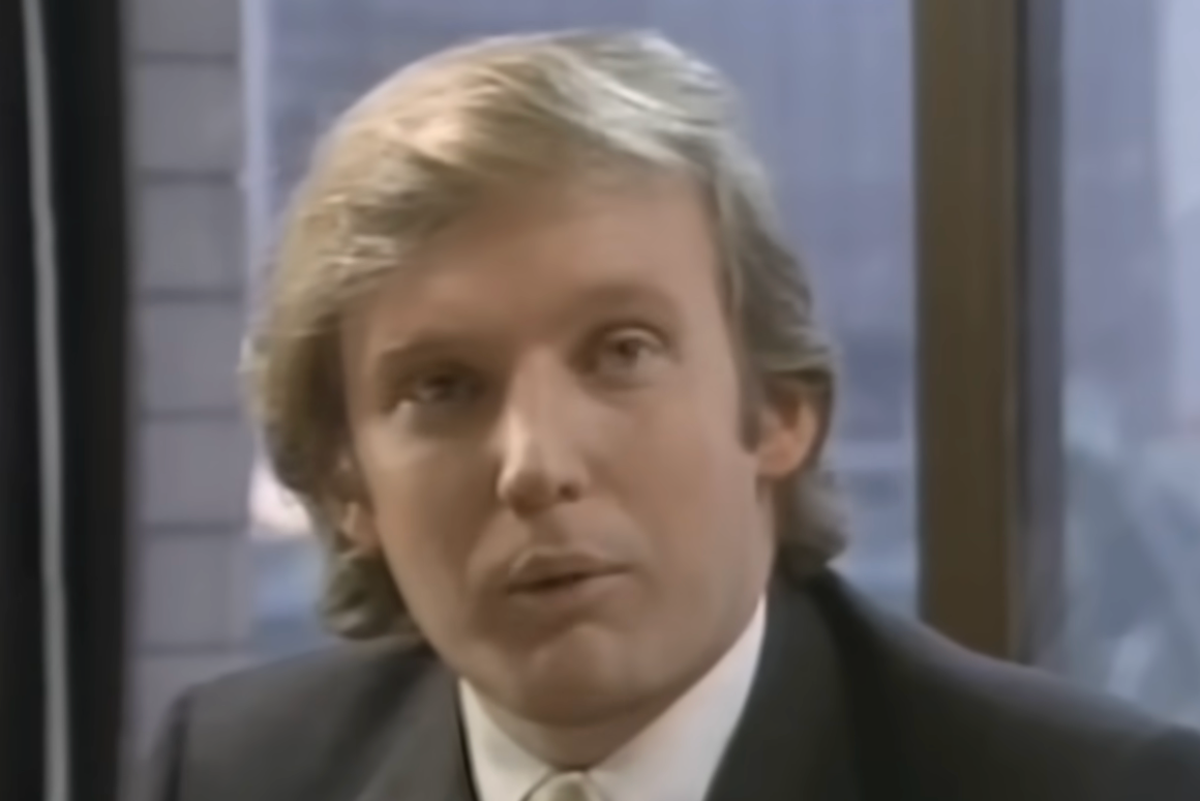
The second limitation is the Contrast Risk. By showing high-definition footage of a 34-year-old Trump alongside 2026 footage, the campaign inadvertently highlights the biological reality of aging. While the rhetoric is static, the vessel is not. This creates a friction point in the "Brand Durability" argument, as the visual evidence of time passing contradicts the message of timelessness.
Strategic Deployment of Compressed History
The use of video as a medium for this archive is intentional. Text requires analysis; video requires only perception. The rapid-fire editing style mimics the "Short-Form Dopamine Loop" prevalent in modern social media consumption.
The campaign is leveraging three specific psychological triggers:
- The Mere Exposure Effect: Repeated exposure to a stimulus (the Trump face/voice) increases preference for that stimulus, regardless of the quality of the stimulus.
- Survivorship Bias: By showing 45 years of clips, the video implies that because Trump "survived" the various scandals and economic shifts of the past, his survival in the current environment is an inevitability.
- Anchoring to Prosperity: By including 1980s footage, the campaign triggers a subconscious link to a period of perceived American economic dominance, attempting to "transfer" the vibes of the 80s bull market to the current 2026 political climate.
Operationalizing Nostalgia in High-Friction Markets
The "prices surge" context mentioned in the competitor's headline is the very thing the video seeks to neutralize. The campaign is not ignoring the price of eggs; it is attempting to devalue the importance of the current moment by placing it within a 45-year window.
This is a Macro-Frame Shift. If the voter looks at the last 12 months, they see inflation. If the video forces them to look at the last 45 years, they see a "Legend" who has outlasted multiple inflationary cycles. This shifts the voter's decision-making process from a Tactical Choice (Who lowers prices now?) to a Strategic Alignment (Who do I trust to represent my values over the long haul?).
The Pivot from Information to Iconography
The transition from a political figure to an icon occurs when the person no longer needs to present new information to remain relevant. This 1980–2026 video is the final stage of that transition. It contains zero new policy data. It contains zero new promises. It is a pure Signal of Existence.
In a saturated information environment, "Existence" becomes a competitive advantage. Competitors spend millions trying to define themselves to a skeptical public. Trump uses 45 years of existing footage to argue that he is already defined, and therefore, "un-buyable" and "un-changeable."
This creates a high barrier to entry for any challenger. A challenger must build a brand from scratch while Trump simply hits "replay." The efficiency of this marketing spend is unparalleled in modern politics. While other candidates are forced to buy "Discovery" ads, Trump is running "Remembrance" campaigns.
Definitive Forecast for Media Strategy
Expect the Trump campaign to further lean into AI-Enhanced Archival Content. As we move deeper into 2026, the use of generative tools to upscale 1980s footage into 4K or 8K resolution will be used to close the visual gap between the past and the present. The goal will be to make the 1980 version of the brand look as "current" as the 2026 version, further erasing the concept of time.
The strategic play for opposing entities is not to argue with the history, but to break the Continuity Loop. To defeat a brand built on stasis, the counter-message must emphasize Evolutionary Necessity. If the world of 2026 faces problems that did not exist in 1980 (e.g., specific AI threats, modern supply chain fragility), the "Consistency" of the Trump brand can be reframed as "Obsolescence."
The final move in this brand war will not be won on facts, but on whether the American public views a 45-year-old record as a "Proof of Reliability" or a "Certificate of Expiration." The campaign has bet the entire house on the former. Every video, every post, and every speech is now a component of this singular, monolithic archive. To engage with it is to enter a closed logic loop where the only answer is the one that has been provided since 1980.