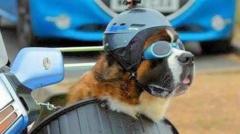
The phenomenon of a canine passenger in a motorcycle sidecar operates as a high-yield social catalyst, transforming a standard transit event into a multi-sensory public spectacle. While casual observers attribute the resulting communal uplift to simple "cuteness," a rigorous decomposition of the event reveals a complex interplay of mechanical engineering, interspecies trust dynamics, and the psychological impact of unexpected whimsicality in urban environments. This interaction creates a measurable shift in bystander affect, triggered by the juxtaposition of rugged machinery and domestic vulnerability.
The Tri-Factor Architecture of Canine Sidecar Utility
Success in this niche transit mode depends on three distinct structural pillars. If any single pillar is compromised, the operation shifts from a public benefit to a high-risk liability.
1. Mechanical Stability and Ballast Physics
A motorcycle with a sidecar is an asymmetrical vehicle. Unlike a standard bicycle or motorcycle, it does not lean into turns. The addition of a canine passenger introduces a live, shifting weight—a dynamic variable that alters the vehicle’s center of gravity. For a dog weighing between 20kg and 40kg, the centripetal force exerted during a left-hand turn (where the sidecar is on the left) can cause "flying the chair," where the sidecar wheel lifts off the pavement. The rider must account for:
- Static Ballast: Ensuring the sidecar floor is weighted sufficiently to counteract the dog’s movement.
- Suspension Tuning: Adjusting pre-load settings to manage the uneven load distribution between the bike’s frame and the sidecar’s single-arm suspension.
- Torque Management: Compensation for the lateral pull during acceleration and braking caused by the sidecar's drag.
2. The Canine Sensory Threshold
The environment of an open sidecar presents a high-velocity sensory load. At 60 km/h, the acoustic pressure from wind noise and engine exhaust can exceed 90 decibels, potentially damaging a dog's sensitive hearing. Furthermore, ocular safety is a critical failure point; windborne debris, insects, and UV exposure pose direct threats to corneal health. The integration of "Doggles" (specialized canine eyewear) and ear protection transforms the dog from a passive passenger into an equipped participant, signaling to the public a high standard of animal welfare.
3. Psychographic Impact on Urban Bystanders
The "smile effect" documented in competitor reports is actually a documented psychological response to the "Incongruity-Resolution Theory." Bystanders expect a motorcycle to be a solitary, utilitarian, or aggressive transport mode. The presence of a dog—specifically one wearing gear—creates a cognitive dissonance that resolves into humor or delight. This creates a temporary "micro-community" among strangers who share the visual experience, momentarily lowering the social friction inherent in dense city environments.
The Cognitive Load of the Operator
Operating a sidecar rig with a canine requires a significant increase in cognitive bandwidth compared to standard riding. The operator must manage the machine while simultaneously monitoring the emotional and physical state of the animal.
Risk Mitigation Framework
A disciplined approach to canine transit involves a hierarchy of safety protocols:
- Retention Systems: A short, center-mounted lead attached to a crash-tested harness. This prevents the dog from attempting to exit the vehicle while in motion or in the event of a sudden swerve, while ensuring the dog cannot be thrown clear during a collision.
- Thermal Regulation: Sidecars, often constructed of metal or fiberglass, act as heat sinks. In direct sunlight, surface temperatures can cause paw pad burns. High-quality rigs utilize ventilated floor mats and reflective coatings to maintain a habitable microclimate.
- Predictive Maneuvering: The rider must scan the road 15 seconds ahead to avoid sudden inputs. Abrupt braking or swerving can cause "canine vestibular disorientation," leading to anxiety or motion sickness in the animal.
Economic and Social Capital Attribution
While the primary driver is often personal enjoyment, the sidecar-riding dog generates significant social capital for the operator. In a marketing context, this is referred to as a "Magnet Asset."
Visibility Metrics
A dog in a sidecar achieves a 95% "head-turn rate" in urban settings, a metric far exceeding that of luxury supercars or custom motorcycles. This visibility can be leveraged for:
- Charitable Advocacy: Using the high-visibility platform to raise awareness for animal rescues or local causes.
- Local Commerce Integration: Establishments that welcome the duo often see increased foot traffic as the "spectacle" pauses at their location.
- Community Cohesion: The rig acts as a low-stakes conversation starter, breaking down the "urban anonymity" barrier that typically prevents interaction between disparate demographic groups.
Logistics of the K9-Sidecar Adaptation Phase
Training a dog for sidecar transit is an exercise in desensitization and positive reinforcement. The process follows a linear progression of increasing complexity.
Stationary Acclimatization
The dog is introduced to the sidecar while the engine is off. The goal is to establish the sidecar as a "high-value zone" through the use of treats and familiar bedding. This stage is complete only when the dog voluntarily enters the vehicle and remains calm for extended periods.
Harmonic Desensitization
The engine is started while the dog is near, but not in, the vehicle. The operator monitors for signs of "stress stacking"—a physiological buildup of cortisol. Once the dog ignores the acoustic output of the engine, the dog is placed in the sidecar with the engine idling.
Low-Velocity Calibration
Initial sorties should be limited to empty parking lots or quiet residential streets. The rider must practice "figure-eights" to acclimate the dog to the lateral G-forces unique to sidecar travel. Only after the dog demonstrates the ability to "lean" or brace against turns should high-speed or high-traffic environments be attempted.
The Limitation of Universal Appeal
Despite the high success rate of these interactions, the strategy has hard limits. Not all canine temperaments are suited for high-exposure transit. Dogs with high prey drives may attempt to leap at passing animals, while those with noise phobias will experience trauma rather than enjoyment. The operator must remain an objective analyst of their pet’s behavior, prioritizing animal welfare over public performance.
Furthermore, the legal landscape is fragmented. Various jurisdictions have differing views on "unsecured loads" and "distracted driving." In some regions, a dog in a sidecar is legally equivalent to cargo, while in others, specific pet-transport laws apply. Failure to research local statutes can result in significant fines or vehicle impoundment.
Strategic Implementation for Aspiring Practitioners
For those seeking to replicate this model, the objective is not simply to "ride with a dog" but to curate a safe, high-visibility mobile experience. This requires a commitment to high-end equipment—specifically a rig with a wide track and a braked sidecar wheel—and a meticulous training schedule.
The final strategic move for any operator is the transition from "spectacle" to "steward." By maintaining a pristine rig and demonstrating impeccable canine control, the rider ensures that the "smile effect" remains a sustainable social asset rather than a public nuisance. The focus must remain on the precision of the execution; a well-managed sidecar dog is a feat of training and engineering, whereas a poorly managed one is merely a hazard. Prioritize the acquisition of a heavy-duty harness and impact-rated goggles before the first public outing to solidify the operation’s legitimacy.