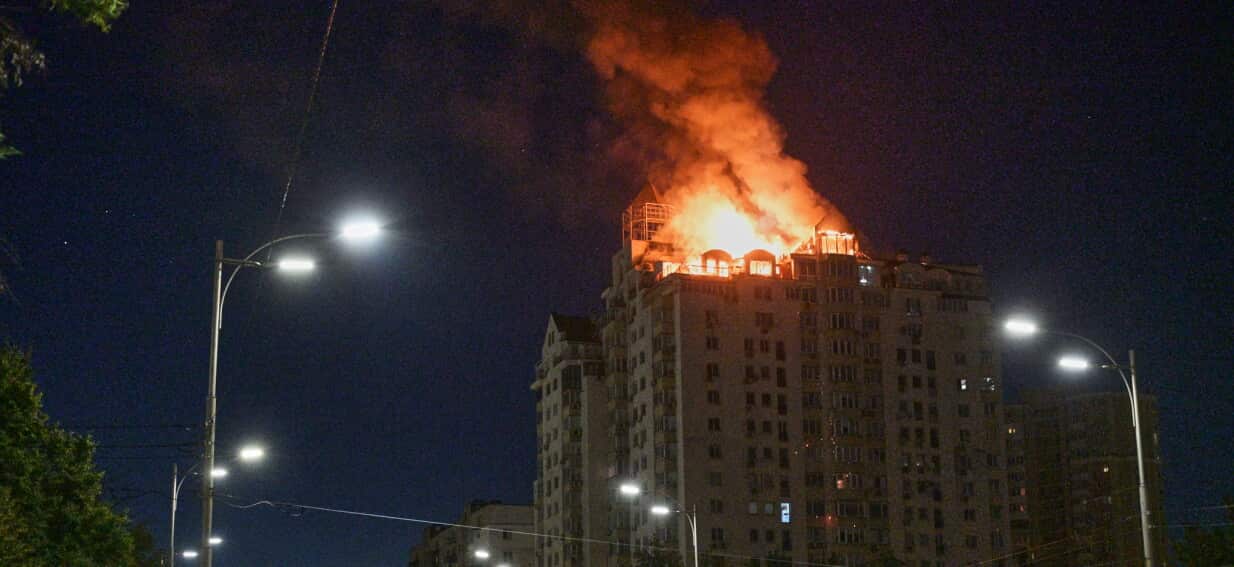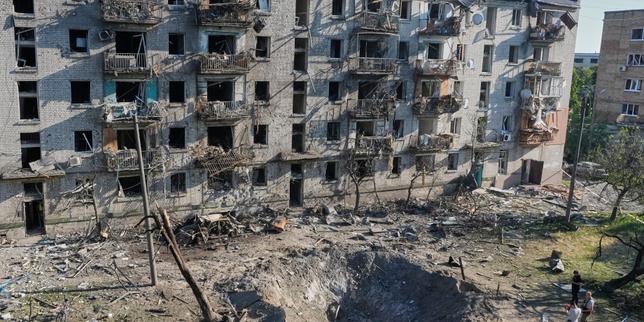
The scaling of aerial bombardment against concentrated urban targets follows a predictable path of resource depletion rather than pure territorial acquisition. When analyzing the most massive aerial assault on Kiev since the initiation of hostilities, standard journalistic accounts focus heavily on the visual debris and immediate civilian distress. A strategic assessment, however, requires evaluating this event through the lens of air defense saturation, critical infrastructure degradation, and the economic asymmetric ratios of modern kinetic warfare.
The primary objective of multi-vector aerial operations is not always the total destruction of localized targets, but rather the forcing of an unsustainable defensive expenditure. By deploying a heterogeneous mix of low-cost loitering munitions, cruise missiles, and ballistic vectors simultaneously, an attacker forces the defender into a critical decision-making bottleneck regarding engagement priorities and inventory management.
The Tri-Vector Saturation Model
To understand the structural impact of the strike, the offensive deployment must be categorized into three distinct functional layers, each designed to exploit specific vulnerabilities in an integrated air defense system (IADS).
1. The Attrition Vector (Loitering Munitions)
Low-velocity, radar-evading drone platforms serve as the vanguard of the assault. Their primary utility lies not in their destructive payload, but in their ability to map radar positions, trigger early-warning systems, and deplete the defender’s inventory of highly sophisticated surface-to-air missiles (SAMs). The cost asymmetry here is stark: utilizing a million-dollar interceptor to neutralize a $20,000 loitering munition represents an unsustainable economic burn rate for the defender.
2. The Penetration Vector (Cruise Missiles)
Operating at low altitudes and utilizing terrain-following radar, cruise missiles exploit the gaps opened by the initial wave of attrition drones. These assets target fixed logistical nodes and energy generation infrastructure. Their flight paths are rarely linear; they utilize pre-programmed waypoint alterations to bypass known air defense sectors, creating a prolonged state of high alert that induces operator fatigue and system overheating.
3. The Kinetic Climax (Ballistic and Hypersonic Vectors)
The final layer consists of high-velocity ballistic or pseudo-ballistic missiles. Launched when the defender’s tracking radars are saturated by the volume of incoming low-tier targets, these assets rely on sheer velocity and steep terminal angles to penetrate the inner tier of terminal defenses. Their targets are typically high-value command structures or heavily fortified infrastructure points.
Infrastructure Resilience and Cascading Failure Networks
The physical damage documented in urban centers like Kiev cannot be assessed purely by counting destroyed buildings. Urban infrastructure operates as a network of interconnected nodes; a strike on a single substational node can trigger a cascading failure across the entire system.
When a kinetic strike impacts an electrical substational node, the immediate loss of megawatt capacity is only the primary effect. The secondary effects ripple through the municipal ecosystem via distinct vectors:
- Hydraulic Pressure Collapse: Water distribution networks rely on electrically powered pumping stations. A prolonged power failure drops line pressure, which not only cuts off supply to civilian sectors but also renders localized firefighting efforts highly inefficient during concurrent kinetic impacts.
- Thermal Network Dissipation: In centralized urban heating systems, the cessation of circulation pumps during sub-zero temperatures introduces the risk of structural freezing within the pipe network. If the water inside the distribution lines freezes, the resulting volumetric expansion causes widespread ruptures, transforming a temporary power outage into a months-long metallurgical repair crisis.
- Logistical Asymmetry: The physical debris from structural collapses chokes internal urban supply lines. This delays the deployment of first responders and engineering crews, increasing the mean time to repair (MTTR) for nearby critical assets that may have suffered only minor, non-structural damage.
The Logistics of Air Defense Depletion
A rigorous analysis of mass aerial assaults reveals that the critical constraint for urban defense is rarely the availability of launcher platforms, but rather the reload logistics and interceptor production timelines.
Modern integrated air defense relies on a tiered architecture. Long-range systems protect wide areas, medium-range systems guard specific sectors, and short-range air defense (SHORAD) units handle point defense. A mass strike seeks to collapse this hierarchy by flooding all three tiers simultaneously.
Incoming Threat Volume > (Simultaneous Tracking Capacity + Terminal Interceptor Inventory)
When this threshold is crossed, defensive batteries face target prioritization dilemmas. If a battery engages every incoming target, it risks running completely out of interceptors before the high-velocity ballistic wave arrives. Conversely, if it holds fire to conserve ammunition, it allows low-tier munitions to impact their targets unimpeded.
This dynamic alters the strategic evaluation of success. An attack where 80% of incoming vectors are intercepted can still be classified as an operational success for the attacker if the remaining 20% destroy key industrial targets while forcing the expenditure of the defender's remaining high-tier interceptor stockpiles. The true metric of consequence is the replacement ratio: the speed at which Western industrial capacity can supply replacement missiles versus the speed at which the adversary can manufacture or procure low-cost kinetic vectors.
Structural Mitigation and Strategic Deflection Strategies
Faced with the reality of periodic mass kinetic saturation, urban defense strategies must shift from absolute interception toward resilient survivability and rapid restoration frameworks.
The first operational imperative is the physical decentralization of critical network nodes. Large, centralized thermal and electrical generation plants must be systematically supplemented or replaced by modular, containerized substations protected by concrete revetments and anti-drone netting. This limits the blast radius of successful kinetic impacts and ensures that the loss of a single asset does not compromise the entire municipal grid.
The second imperative involves the optimization of mobile air defense assets. Relying exclusively on fixed SAM sites creates predictable vectors for offensive planning. By increasing the density of highly mobile, radar-silent SHORAD teams equipped with visual and thermal tracking capabilities, a defender can neutralize a significant percentage of low-tier loitering munitions without revealing the positions or depleting the ammunition of their primary strategic air defense assets.
The final operational requirement is the pre-positioning of heavy engineering assets and standardized structural repair components. Reducing the mean time to repair requires a redundant supply chain of high-voltage transformers, water main segments, and structural steel stored in dispersed, hardened locations outside the urban perimeter, ready for immediate deployment the moment kinetic operations subside.